
Commentary
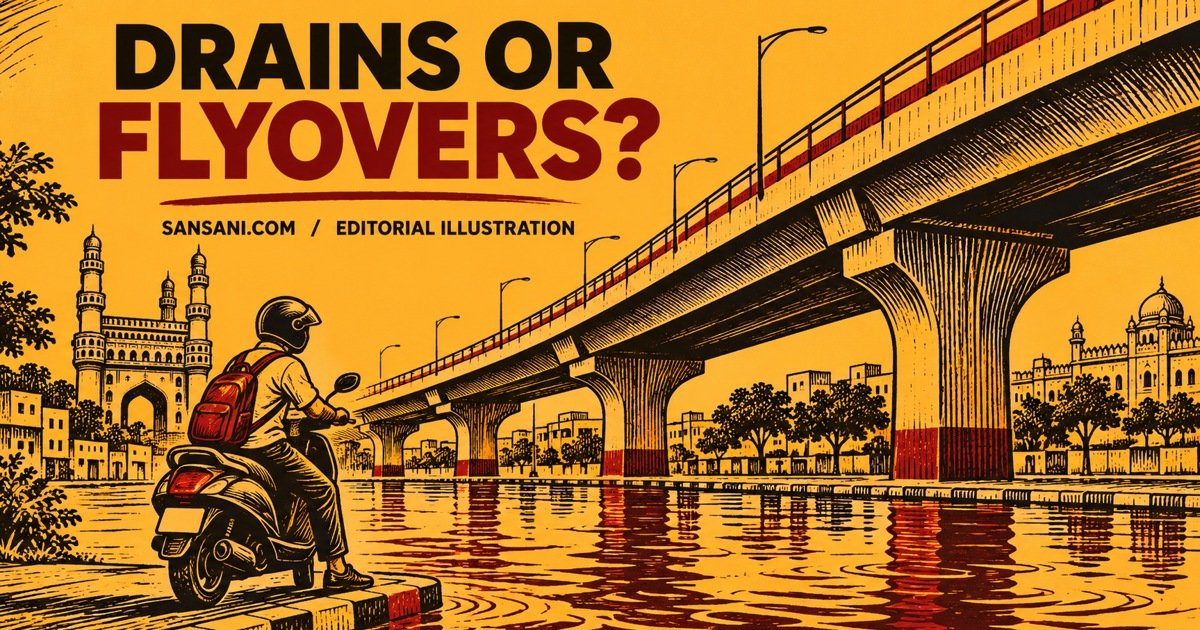
On 27 November, overnight rain left roads waterlogged in parts of Hyderabad, including Gachibowli, Tolichowki and Begumpet. A gauge in Vivekananda Nagar, Kukatpally, recorded 79.3 mm. A flyover can save commuters time every weekday. Fixing a road that repeatedly floods can keep an essential route open. When both projects compete for the same funds, which should come first?
Listen to The Bigger Question
English · 3:01
Read the transcript
On Friday morning, parts of Hyderabad faced a question more urgent than how long the commute would take. Was the usual road usable at all?
Overnight rain left roads waterlogged in Gachibowli, Tolichowki, Mehdipatnam and Begumpet. The Times of India reported that a rain gauge in Vivekananda Nagar, Kukatpally, recorded seventy-nine point three millimetres. That was one gauge, in one neighbourhood. It tells us how much rain fell there. It cannot tell us why another street went under.
Here is the bigger question. If Hyderabad has enough uncommitted money for only one of two projects, what should come first? A flyover that saves time on ordinary days? Or a drainage fix that keeps a road usable during heavy rain?
Imagine a colony with one practical exit. If a busy junction backs up, residents can still plan around the delay. If that exit repeatedly floods, the choice may be to wait or turn back. A bus route can be interrupted. A trip to a clinic or school can become much harder. The effect depends on what the road connects and how long people lose access.
There is a strong case for putting those routes first, but only once the city knows what is going wrong. One junction may need an inlet cleared. Another may need a larger channel downstream. If you fix the place where you see water without checking where that water goes, the next colony may inherit the same problem.
There is a credible case for building a flyover too. Imagine a bus packed with passengers losing time at the same signal every weekday. A well-designed project might save thousands of people time over a year. That benefit deserves to count. But the proposal needs to show where the queues go next and whether people at street level will still have a usable road when it rains.
The Greater Hyderabad Municipal Corporation’s budget for twenty twenty-four to twenty twenty-five describes a programme to plan and maintain the stormwater drainage network. Friday’s reporting tells us which places deserve another look. To decide where money should go next, we need to know what happened at those places more than once.
My take is this. Where both projects compete for the same money, a stretch that regularly loses essential access deserves first claim. Show us how often it floods. Show us how long it takes to reopen. Show us who depends on that road and how much the proposed repair would cost. Then ask the flyover proposal to show what it would save, for whom, and on how many days.
Friday’s downpour gives Hyderabad a reason to inspect the affected streets. It does not tell us to cancel a particular flyover or rebuild every drain. It tells us to measure what happens and to explain which problem the next rupee will actually solve.
So where would you put it? Into a road that needs to stay open when it rains, or a junction where people lose time every weekday? And what evidence would change your mind?
What should the city show us?
My take is that roads that repeatedly lose essential access deserve priority when the same money could fund either project. Hyderabad should show how often each stretch floods, how long it stays unusable and who depends on it. A flyover proposal should show who would save time and how much.
Your verdict: Which project would you fund first, and what evidence would change your mind?
Sources: Telangana Today’s account of the affected roads, The Times of India’s rainfall figures and the GHMC budget’s Strategic Nala Development Programme section.


