Multimodal AI processes or relates more than one kind of information, such as text, images, audio and video. A multimodal system might answer a question about a photograph, connect a spoken explanation to a diagram, or retrieve an image using a written description. Its value comes from using relationships between those inputs, not simply accepting several file extensions.
Suppose a teacher says, “The important change is here,” while pointing to a chart. A transcript preserves the words but not necessarily the point on the chart. A screenshot preserves the chart but not the explanation. A useful multimodal system needs to connect the right words, visual region and moment in time.
This guide explains how that connection can work, what different architectures preserve or discard, and how to evaluate an answer. The worked examples are hypothetical; they are not claims that SANSANI has tested a particular product.
AI explained, article 2 of 11. Researched and reviewed: 15 November 2026. Previous: Agentic AI and autonomous agents.
What does “multimodal” mean in AI?
A modality is a type or channel of information. Written language, visual information and acoustic signals can provide different evidence about the same event. Multimodal learning has a long research history: a 2017 survey organised its central challenges into representation, translation, alignment, fusion and co-learning. The field predates today’s conversational assistants. [1]
For a reader, the practical question is which signals a system can actually use. A product may accept a video file but analyse only selected frames. Another may extract its soundtrack, transcribe speech and pass the transcript to a text model. Both can be useful, but they preserve different information.
Input and output capabilities are separate. A system can accept an image and produce only text. A model that generates images from text is also connecting modalities, but it does not automatically have the same strengths as a visual question-answering model. Avoid treating “multimodal” as a promise that every input and output combination is supported.
| Input | Useful evidence | Example question |
|---|---|---|
| Text | Words, explicit instructions and written facts | What does this paragraph claim? |
| Image | Visible layout, objects, shapes and marks | Which label belongs to this chart axis? |
| Audio | Speech and potentially non-speech sounds | What was said, and where does the alarm occur? |
| Video | Visual change over time, potentially with audio | Which step happens before the object is moved? |
The word “potentially” matters. Support for a modality does not establish that a given model can accurately solve every task involving it.
How does multimodal AI connect different inputs?
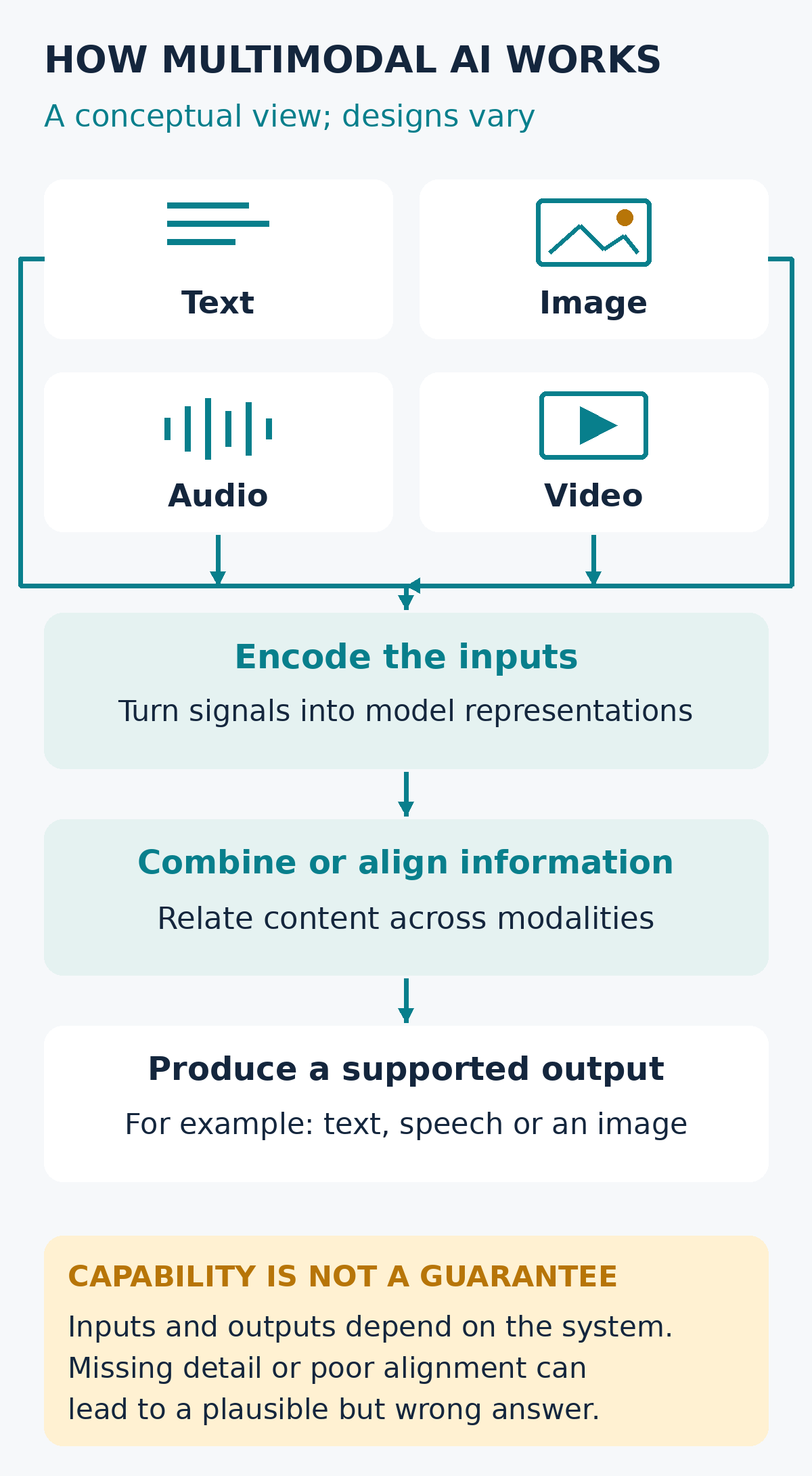
There is no single architecture used by all multimodal systems. A useful conceptual view is: prepare the inputs, represent them numerically, connect relevant information and produce an output. These stages may be separate components or tightly integrated within a model.
Representation: turning signals into useful features
An encoder converts an input into a numerical representation. A vision encoder can represent image information; a language component represents text. Those representations are learned patterns, not a perfect copy of human perception.
CLIP, described in a 2021 research paper, learns relationships between images and text by training on image–text pairs. Its contrastive approach makes matching pairs more similar in a learned representation space than mismatched pairs. That supports tasks such as comparing an image with candidate descriptions. CLIP itself is not a general conversational assistant or image generator. [2]
Alignment: matching the right pieces
Alignment concerns correspondence. A word might relate to an object region, a spoken phrase to a video segment, or a caption to an entire image. Matching “the red line” to the correct curve matters more than recognising that the picture contains a chart.
Consider two speakers discussing two different slides. If the system pairs the first explanation with the second slide, it can produce a fluent but misleading summary. Timing and context are part of the evidence, not merely presentation details.
Fusion and interaction: using information together
Fusion concerns combining information from modalities. Some designs combine intermediate representations; others combine separate predictions. Attention-based connections can allow language processing to use visual features. The right design depends on the task and available data. [1]
Flamingo’s 2022 architecture is a research example that bridges pretrained vision and language models and handles interleaved visual and textual inputs. Its paper evaluates image and video tasks. It illustrates one design approach, rather than a blueprint followed by every current product. [3]
Instruction following: responding to the question
Recognising visual patterns is different from following a user’s request about them. The LLaVA research introduced a vision-language assistant connecting a vision encoder with a large language model and using visual instruction tuning. It is an example of training a system to answer requests involving an image and language together. [4]
For users, the distinction explains why a model can describe a scene generally yet struggle with a precise question about a tiny symbol. Different tasks demand different kinds of training and evidence.
A multimodal model and a tool pipeline are different designs
A combined model can work directly with representations from supported modalities. A modular pipeline can instead convert information into an intermediate form: optical character recognition (OCR) extracts visible text, speech recognition produces a transcript, and a text model processes those results.
Speech-to-text is a substantial AI task in its own right. The Whisper research paper, published in 2022, studied speech recognition using large-scale weak supervision. A transcription component can be valuable inside a wider system without giving the downstream text model direct access to the original sound. [5]
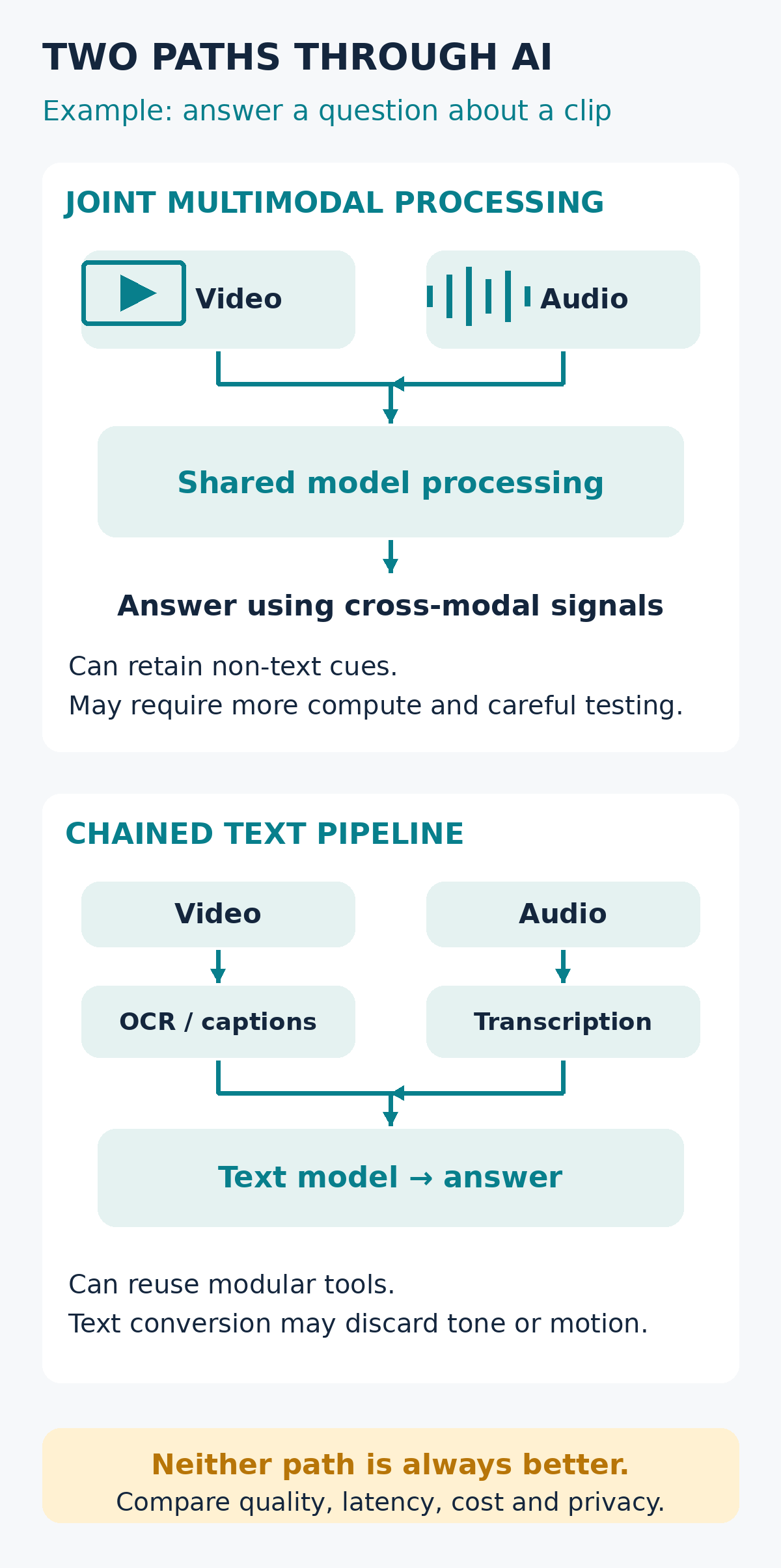
Imagine asking what a speaker said. A transcript pipeline may be enough. Ask whether a warning beep occurred during the demonstration, and a transcript containing only spoken words may omit the necessary evidence. Similarly, OCR may preserve a chart title while losing the relation between a curve and its legend.
Neither architecture wins automatically. Modular stages can make intermediate results easier to inspect and replace. Joint processing can retain relationships that a text-only intermediate representation omits. Both need evaluation on actual tasks; the marketing term “native multimodal” does not substitute for evidence.
Worked example: explaining a recorded lesson
Hypothetical task: a student has permission to use a short recorded lesson containing narration and slides. They ask: “Explain the chart discussed between 02:00 and 02:40. State the labels and values you can read, distinguish observation from interpretation, and tell me what is unclear.”
Suppose the relevant slide shows monthly sign-ups: January 100, February 120 and March 90. The teacher says, “The increase here did not continue into the following month,” while pointing to February. The recording then moves to another slide.
- Select the evidence. Identify the requested time segment. Confirm that the chart appears during that interval instead of borrowing a similar slide from elsewhere.
- Read the visible data. Extract the title, axis labels, units and values. If “sign-ups” is blurry, report the label as uncertain rather than silently changing it to revenue.
- Connect narration and chart. Determine that “the increase here” refers to January-to-February, using timing and the visible pointer where available.
- Calculate separately. A rise from 100 to 120 is 20%. A fall from 120 to 90 is 25%. The denominator changes, so these are not equal-and-opposite percentage changes.
- Explain only what is supported. The figures show a rise followed by a fall. They do not establish why sign-ups fell.
- Give a checkable answer. Include the relevant timestamp, the values read, the calculation and any missing evidence.
A good answer might say: “At approximately 02:18, the chart appears to show 100, 120 and 90 sign-ups for January, February and March. February is 20% above January; March is 25% below February. The explanation identifies a reversal but does not give a verified cause.”
A poor answer might say that March revenue fell because a marketing campaign ended. That invents both the quantity and the cause. More input channels do not justify more confident speculation.
Now remove the video and keep only the transcript. “Here” and “the following month” may become ambiguous. Remove the narration instead, and the model may still read the chart but lose the teacher’s intended emphasis. This comparison reveals which modality contributes to the task.
Where multimodal AI can be useful
Documents, diagrams and visual explanations
A student can ask about a graph beside a paragraph. A document-review system can connect a table entry to its footnote or flag a mismatch between a diagram and written instructions. These are possible applications, not guarantees of correct extraction. Small labels, complex layouts and ambiguous units still need checking.
Audio and video search
Cross-modal search can help locate a described event inside media. Google’s Gemini 1.5 technical report, introduced in 2024, studies long-context multimodal capabilities including video and audio tasks. Those reported experiments establish a research milestone, not a promise that every video question is answered correctly or that the same model versions remain available today. [6]
Accessibility and assistance
Describing an image, producing captions or explaining an unfamiliar interface can make information easier to access. The output should preserve uncertainty and give the user control over how much detail is provided. A general-purpose image description should not be treated as a dependable navigation or emergency-warning system.
Creative and editorial work
A creator might compare a storyboard with a brief, organise footage or check whether a caption refers to the correct image. Understanding media and generating media are different capabilities. A tool that explains an image does not necessarily edit it, and a tool that generates a video does not necessarily verify its factual content.
What can go wrong with multimodal AI?
Object hallucination: a system may describe something that is not in the image. The 2023 POPE paper studied this problem in large vision-language models and proposed a way to evaluate whether models incorrectly claim objects are present. Its findings concern the models and settings tested, not a universal failure rate for every model today. [7]
Lost detail: preprocessing can resize images, select frames or divide audio into chunks. A small handwritten digit or brief event may not survive the representation that reaches the model. Ask what the actual input processing preserves before concluding the model inspected every detail.
Conflicting evidence: a slide may show one number while narration gives another. The useful answer identifies the disagreement and points to both sources. Quietly choosing the more plausible version conceals an important limitation.
Overinterpretation: a pause, facial expression or tone does not reliably establish a person’s private intentions. Describing observable behaviour is different from asserting emotion, honesty or competence.
Privacy and untrusted content: recordings can include faces, background conversations and confidential screens. Use material you are authorised to process, minimise unnecessary personal information and check the service’s current data-handling terms. Text embedded in a screenshot is task data; it should not automatically become an instruction to send files or change accounts.
How to evaluate a multimodal system
A single overall score rarely answers whether a system suits your use case. MMMU is a research benchmark containing around 11,500 multimodal questions across 30 subjects, using varied image types such as charts and diagrams. It evaluates demanding perception and subject reasoning; it is not a complete test of audio, video, privacy or operational reliability. [8]
For the lesson example, create a small evaluation set with known answers and separate perception from calculation. If the model misreads 90 as 900, correct arithmetic on the wrong number is still a failed answer. If it reads the values correctly but uses the wrong denominator, the failure is elsewhere.
| Check | Useful test |
|---|---|
| Perception | Read labels and numbers at realistic recording quality |
| Alignment | Match a spoken reference to the right slide and timestamp |
| Reasoning | Verify calculations and distinguish observation from cause |
| Missing evidence | Include silent clips, blurry slides and incomplete diagrams |
| Contradictions | Make narration and a visible value disagree |
| Efficiency | Measure review time, latency and total processing cost |
Also compare against simpler baselines: transcript-only, image-only and OCR plus a text model. If adding video changes an answer, check that the change comes from useful visual evidence rather than noise. If the extra modality adds cost without helping, it may not belong in that workflow.
Frequently asked questions
Is a PDF a separate modality?
A PDF is a file format. It may contain selectable text, scanned images, tables or diagrams. The relevant modalities depend on its contents and how the system processes them.
Does a multimodal model see like a person?
No. It processes learned representations. Human-style language about “seeing” is shorthand and should not imply identical perception or understanding.
Can it analyse every moment of a video?
That depends on the system’s processing method and limits. Ask about frame selection, audio handling and timestamp precision. A fluent summary alone does not establish complete coverage.
Is multimodal AI the same as agentic AI?
No. Multimodality concerns information types; agency concerns selecting and carrying out steps. A system can have either capability or combine them. See our agentic AI guide for the distinction.
What should a beginner try?
Use a non-sensitive image or diagram with known answers. Ask the system to separate visible facts, calculations and uncertain interpretation. Check the result against the original before trying a more complicated task.
The practical takeaway
Multimodal AI is useful when different kinds of evidence need to be connected. The essential questions are what information reaches the model, which relationships it can use, and whether its answer is checkable. More modalities expand possibilities; careful evaluation determines whether they improve the result.
Sources and further reading
- Baltrušaitis, Ahuja and Morency: Multimodal Machine Learning: A Survey and Taxonomy — 2017.
- Radford et al.: Learning Transferable Visual Models From Natural Language Supervision — ICML 2021, CLIP.
- Alayrac et al.: Flamingo: a Visual Language Model for Few-Shot Learning — 2022.
- Liu et al.: Visual Instruction Tuning — 2023, LLaVA.
- Radford et al.: Robust Speech Recognition via Large-Scale Weak Supervision — 2022, Whisper.
- Gemini Team: Gemini 1.5 technical report — 2024; cited as historical research, not a current product recommendation.
- Li et al.: Evaluating Object Hallucination in Large Vision-Language Models — EMNLP 2023.
- MMMU benchmark: official project page — accessed 15 November 2026.