Exclusive Content:

Why Do People Stay in Jobs They Hate for Years?

Every morning, millions of people wake up with the...

Power Talks Loud. The Cost Stays Silent.

The Truth No One Wants to Say Out Loud People...

Why Do We Overthink Things That Don’t Really Matter?

You replay a conversation in your head. You wonder if...
Home Blog Page 14

Anchoring With Consequences: The Invisible Force That Quietly Shapes Your Decisions

0


The First Number You Hear Is Rarely Innocent

Imagine walking into a shop and seeing a jacket labeled:

$800
Now $249.

Suddenly, $249 feels like a bargain.

But what if the jacket was never worth $800?

That first number — even if meaningless — becomes the anchor. And once it drops into your mind, it quietly pulls every judgment toward it.

This is called anchoring bias — and its consequences reach far beyond shopping.

It shapes negotiations.
It influences salaries.
It distorts political debates.
It bends relationships.
It even alters how you judge yourself.

And the most dangerous part?

You rarely notice it happening.


What Is Anchoring — Really?

Anchoring is a cognitive shortcut.

When we’re uncertain, our brain grabs the first available reference point — a number, idea, opinion, or label — and uses it as a starting position.

From there, we adjust.

But we don’t adjust enough.

So the anchor quietly dominates the outcome.

The first offer in a negotiation.
The first diagnosis you hear.
The first impression someone makes.
The first comment under a social media post.

All anchors.

And they are powerful.


Why Anchoring Works on Us

Your brain prefers efficiency over accuracy.

When faced with complexity, it asks:

“What’s the easiest starting point I can use?”

The anchor becomes that shortcut.

Even when we know it’s arbitrary, it still affects us.
Even experts fall for it.
Even when warned, the effect persists.

Because anchoring works beneath conscious awareness.

It influences perception before logic catches up.


The Consequences Most People Don’t See

Anchoring isn’t just about money.

It quietly creates ripple effects.

1. Financial Consequences

If your first salary offer is low, every negotiation starts lower.
If your property listing price is unrealistic, buyers adjust downward — but not enough.

The first number sets the psychological battlefield.

And many people lose before they even begin.


2. Relationship Consequences

If someone labels you “lazy” early on, future behaviors get interpreted through that anchor.

One mistake becomes “proof.”
One late reply becomes “you always do this.”

First impressions stick harder than we admit.


3. Political & Social Consequences

When a headline frames a story with a specific number or emotional tone, it anchors public opinion.

Later corrections rarely undo the initial anchor.

The first narrative wins disproportionate influence.


4. Self-Identity Consequences

This one is subtle.

If you anchor your identity to:

“I’m bad at math.”
“I’m not leadership material.”
“I always fail.”

Your future attempts get interpreted through that anchor.

Your growth becomes constrained by your first conclusion about yourself.

And this may be the most dangerous anchor of all.


The Hidden Root Cause

Anchoring thrives in three environments:

  1. Uncertainty
  2. Time pressure
  3. Information overload

Modern life contains all three.

Which means anchoring is everywhere.

And digital media amplifies it:

  • First comment sets tone
  • First review shapes expectation
  • First search result frames credibility

The digital age is an anchoring machine.


The Anchor Awareness Framework (AAF)

To reduce anchoring bias, use this 4-step reset:

Step 1: Identify the Anchor

Ask:
“What was the first number, opinion, or label I heard?”

Name it explicitly.


Step 2: Zero the Frame

Mentally remove it.
Ask:
“If I never heard that first number, what would I think?”

Force a fresh evaluation.


Step 3: Generate Independent Data

Look for external references before deciding.

Compare multiple sources.
Delay commitment.
Expand context.


Step 4: Reverse Anchor Test

Ask the ego-challenging question:

“What would have to be true for the opposite to be correct?”

If your anchor says “This is expensive,” ask: “What would make this actually cheap?”

If your anchor says “I’m not capable,” ask: “What evidence suggests I am?”

This breaks the mental gravity field.


Mistakes People Make

• Believing awareness alone removes bias
• Assuming expertise protects them
• Letting the first offer define value
• Anchoring to emotional first impressions
• Anchoring to outdated self-beliefs

Anchoring is subtle. It doesn’t feel like manipulation.

It feels like logic.


The Opposite Truth

Not every anchor is harmful.

Used strategically, anchoring can protect you.

Set a high anchor in negotiation.
Anchor your self-image to capability.
Anchor your standards to excellence.

The question isn’t whether anchoring exists.

The question is:

Who sets the anchor — you or someone else?


Final Reflection

Most people believe they make rational decisions.

Few realize their thinking often begins from a planted starting point.

Anchoring is not loud.
It does not argue.
It does not force.

It simply sits there.

Quietly shaping outcomes.

The next time you hear a number, a label, or a first impression — pause.

Because the first thing you hear is rarely neutral.

And sometimes, the consequences last longer than the decision itself.
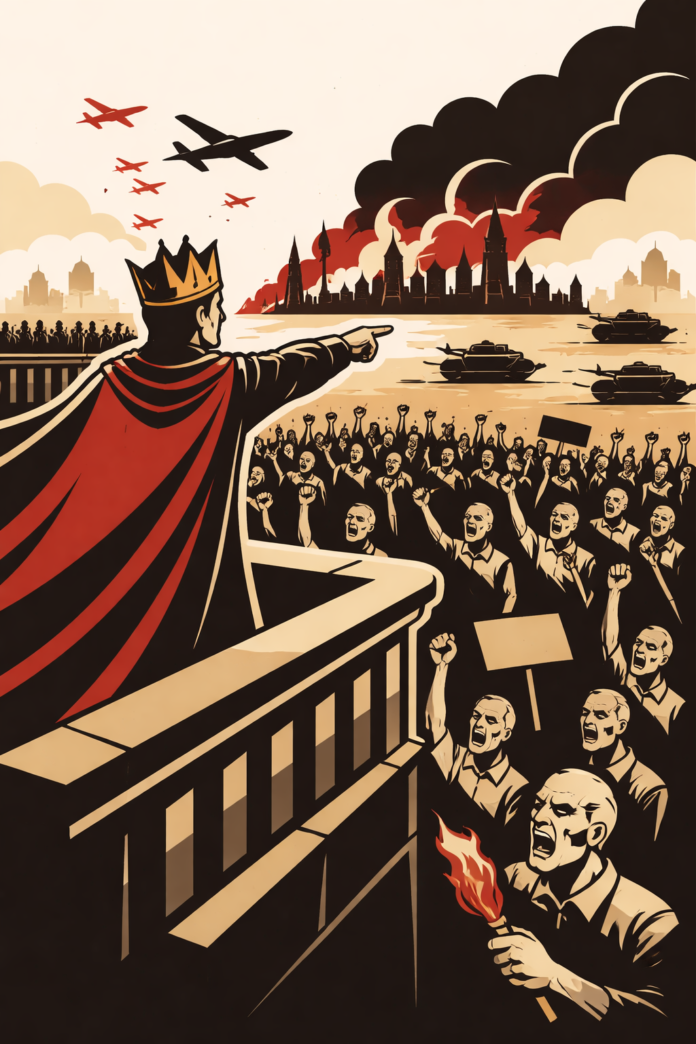

When a King Fears His People, He Looks for an Enemy

0

There is an old political pattern that rarely announces itself honestly.

When a ruler senses unrest at home — rising anger, economic strain, growing distrust — something dramatic often happens.

Suddenly, attention shifts outward.

A foreign threat emerges.
An external enemy is named.
A war begins.

Is it coincidence?
Or strategy?

Let’s examine it carefully.


The Core Idea Behind the Statement

“When a king feels his people are about to rebel, he declares war on another country.”

This idea reflects a political phenomenon often described as:

Diversion through conflict.

Instead of solving internal problems, a leader redirects national emotion toward an external target.

Why?

Because fear unites faster than reform.


Why External Enemies Create Internal Unity

Human psychology responds strongly to threat.

When people feel attacked:

  • They rally behind leadership.
  • They postpone criticism.
  • They tolerate restrictions.
  • They accept sacrifice.

Internal disagreements suddenly seem small compared to a perceived outside danger.

This effect is not new. It has appeared across monarchies, empires, and modern states alike.


Historical Echoes

Throughout history, rulers have sometimes used war to stabilize shaky power.

For example:

  • consolidated influence through continuous military campaigns that kept national energy outward.
  • used expansionist aggression to unify domestic support amid economic instability.
  • Argentina’s military junta initiated the during severe internal unrest.

These cases show a pattern: when domestic legitimacy weakens, external confrontation can temporarily restore authority.

But only temporarily.


Why This Strategy Works — At First

  1. Narrative Control
    The leader defines a common enemy.
  2. Emotional Redirection
    Anger shifts from government to outsiders.
  3. Patriotic Surge
    National identity strengthens under threat.
  4. Emergency Powers
    Extraordinary measures become socially acceptable.

In moments of crisis, people often choose stability over accountability.


But There’s a Hidden Cost

War does not erase internal problems.

It only delays them.

Economic weakness, inequality, corruption, or repression remain beneath the surface. And if the war fails — or drags on — the backlash becomes stronger.

In some cases, the attempt to suppress rebellion through war accelerates collapse.

History is filled with leaders who miscalculated this gamble.


Is It Always Manipulation?

We must stay intellectually honest.

Not every war is declared to suppress rebellion.

Some wars arise from:

  • Defensive necessity
  • Territorial disputes
  • Ideological conflict
  • Security threats

But the political incentive to externalize internal pressure is real — and documented in political science under what scholars call “diversionary war theory.”

The temptation exists whenever power feels unstable.


The Psychological Mechanism Behind It

When people are frustrated with leadership, they ask:

“Why are things broken?”

When an external threat appears, the question changes to:

“How do we survive?”

The focus shifts from accountability to survival.

And survival narratives are powerful.


The Modern Version of the Same Pattern

In today’s world, war doesn’t always mean tanks crossing borders.

It can look like:

  • Trade wars
  • Information wars
  • Cyber conflicts
  • Political confrontation rhetoric

The mechanism remains the same: redirect attention outward.

Even in modern geopolitical tensions — whether between and or other rival blocs — analysts often debate how domestic politics influence external decisions.

Internal stability and external aggression are rarely unrelated.


The Dangerous Feedback Loop

If citizens reward leaders for external confrontation, a cycle begins:

  1. Domestic pressure rises.
  2. External conflict is declared.
  3. Approval increases temporarily.
  4. Structural issues remain unresolved.
  5. Pressure returns stronger.

Eventually, reality catches up.


The Real Strength of Leadership

A strong ruler does not need war to maintain loyalty.

True stability comes from:

  • Economic fairness
  • Institutional trust
  • Transparent governance
  • Shared prosperity

War may unify a nation briefly.

Justice unifies it sustainably.


Final Reflection

If a king fears his people, the deeper issue is not rebellion.

It is broken trust.

Declaring war may silence internal unrest for a moment — but it cannot heal it.

Because enemies outside the border are easier to fight
than dissatisfaction inside the heart of a nation.

And history quietly reminds us:

Leaders who rely on war to preserve power
often lose both.


War Is Where the Young Die for the Decisions of the Old

0

There’s a sentence that quietly shakes you when you read it slowly:

War is a place where the young kill one another without knowing or hating each other, because of the decisions of old people who know and hate each other — without killing each other.

It feels harsh.
It feels unfair.
And it feels disturbingly true.

But instead of reacting emotionally, let’s sit with it. Let’s unpack it. Because inside this sentence is not just anger — but a deeper truth about power, distance, and responsibility.


The Real Tragedy of War Is Not Just Death — It’s Distance

Most young soldiers on opposite sides have never met.
They don’t know each other’s stories.
They don’t hate each other personally.

They may:

  • Love football.
  • Worry about their families.
  • Dream about building something meaningful.
  • Want safety and dignity.

Yet suddenly, they become “the enemy.”

The battlefield erases individuality. It replaces names with uniforms.

And that’s the first tragedy.


Who Actually Decides War?

History shows a consistent pattern.

Wars are rarely started by the 19-year-old on the front line.

They are usually declared by:

  • Political leaders
  • Strategic advisors
  • Ideological elites
  • Power blocs competing for influence

From the Napoleonic Wars under to global conflicts involving leaders like or , decisions were made in rooms far from trenches.

The pattern repeats across centuries:

Those who declare war are rarely the first to bleed in it.


The Age Gap Is Not Just Biological — It’s Structural

When we say “old people decide,” it’s not about age alone.

It’s about:

  • Distance from immediate risk
  • Institutional protection
  • Power without proportional exposure

The 20-year-old soldier carries a rifle.
The decision-maker carries authority.

One risks his body.
The other risks reputation.

That imbalance creates a moral tension that humanity has never fully resolved.


Do Leaders “Know and Hate” Each Other?

Sometimes yes — sometimes no.

Conflicts are often fueled by:

  • Historical grievances
  • Territorial disputes
  • Ideological rivalry
  • Economic control
  • Strategic dominance

Leaders may deeply distrust or oppose each other. But the hatred is usually strategic, not personal survival-based.

Meanwhile, soldiers are often fighting someone who, under different circumstances, might have been a classmate, coworker, or online friend.

That contrast makes the quote emotionally powerful.


Why This Quote Still Resonates Today

Because the pattern hasn’t disappeared.

In modern conflicts, technology has changed the battlefield — drones, cyberwarfare, AI systems — but the human cost still falls heavily on the young.

Even in places like or , or tensions involving and , the faces on the front lines are often barely adults.

History modernizes weapons.
But it does not modernize who dies first.


But Is It That Simple?

Here’s where we need intellectual honesty.

Not all wars are purely ego battles between old rivals.

Some wars are fought for:

  • Survival
  • Defense against invasion
  • Protection of civilians
  • Resistance against oppression

Sometimes young people volunteer because they believe deeply in defending their land or values.

So the quote captures a painful pattern — but not every complexity.

Reality is layered.


The Psychological Cost We Don’t Talk About

Even those who survive war often carry invisible wounds:

  • Trauma
  • Survivor’s guilt
  • Moral injury
  • Loss of identity

When the war ends, leaders negotiate.
Soldiers remember.

That memory lasts generations.


The Hard Question We Avoid

If this pattern keeps repeating across centuries, the real issue may not be “old vs young.”

It may be:

Why do societies allow concentrated decision-making power without shared risk?

Why is accountability rarely symmetrical with consequence?

These are uncomfortable questions — but necessary ones.


A Quiet Reflection

Imagine two 20-year-olds on opposite sides.

If they met at a café instead of a battlefield, what would happen?

They might argue.
They might disagree.
They might even dislike each other.

But they probably would not kill each other.

War changes context.
Context changes morality.

And that is the deepest tragedy of all.


Final Thought

The quote is not just criticism.
It’s a warning.

When decision-makers are insulated from consequences, and the young carry the cost, a society must pause and reflect.

Because storms don’t just test borders.

They test conscience.

And the true strength of a civilization may not be how it fights —
but how carefully it chooses when not to.


Group Words in English: Understanding What’s Inside Uncountable Nouns

0

If you’ve ever wondered why we say “some advice” but not “advices,” or “a piece of information” instead of “informations,” you’re not alone.

English has a special category of words that represent a group of many small parts — but we talk about them as a single whole. These are often called uncountable nouns, and understanding them clearly can dramatically improve your grammar, IELTS score, writing clarity, and overall fluency.

In this guide, you’ll learn:

  • What group words are
  • Why we don’t count them normally
  • Clear examples of “group → things in the group”
  • How to use them correctly in sentences
  • Common mistakes to avoid

Let’s break it down properly.


What Are Group Words in English?

Some nouns represent many smaller individual items, but we treat them as one general idea.

For example:

Information is actually many facts.
Furniture is many chairs, tables, and sofas.
Advice is many suggestions.

Even though they contain many parts, we do not usually add “s” to make them plural.

Instead, we talk about them as a whole.


Education & Knowledge Group Words

These words represent collections of ideas, learning, or mental content.

Information → many facts
Knowledge → many things a person knows
Research → many studies and findings
Education → many lessons and subjects
Evidence → many facts that prove something
Experience → many events someone has lived through
Wisdom → many deep understandings
Intelligence → many thinking abilities

Correct usage examples:

  • I need some information.
  • She has a lot of knowledge.
  • The police found strong evidence.
  • He has years of experience.

Not correct:

  • informations
  • knowledges
  • evidences

If you want to count them, you must say:

  • a piece of information
  • a piece of evidence
  • a bit of advice

Communication & Media Group Words

These words represent collections of messages or spoken content.

News → many details about recent events
Advice → many suggestions
Feedback → many comments or opinions
Mail → many letters and packages
Correspondence → many messages
Gossip → many small stories about people
Content → many articles, videos, or posts

Examples:

  • I have some news.
  • She gave me useful advice.
  • We received positive feedback.
  • There is too much gossip in the office.

Notice something important:
Even though “news” ends in S, it is singular.

Correct:

  • The news is shocking.

Not correct:

  • The news are shocking.

Business & Money Group Words

These words represent collections of physical or financial items.

Money → many coins and notes
Cash → many bills and coins
Wealth → many valuable assets
Equipment → many tools and machines
Machinery → many machines
Luggage → many bags
Furniture → many chairs, beds, tables
Clothing → many clothes items
Jewelry → many rings and necklaces

Examples:

  • I don’t have enough money.
  • The company bought new equipment.
  • Her luggage is heavy.
  • The furniture looks expensive.

Incorrect forms to avoid:

  • moneys
  • equipments
  • furnitures
  • luggages

If counting is necessary:

  • a piece of furniture
  • a piece of equipment
  • an item of clothing

Nature & Materials Group Words

These words represent substances made of many tiny parts.

Sand → many tiny grains
Rice → many small grains
Water → many drops
Air → many gases
Grass → many blades
Traffic → many cars
Rain → many drops

Examples:

  • There is sand everywhere.
  • We bought some rice.
  • Traffic is terrible today.
  • The grass is wet.

You don’t say:

  • sands (unless talking about different deserts)
  • rices (unless talking about types of rice)

Work & Productivity Group Words

These words represent collections of tasks or actions.

Work → many tasks
Homework → many assignments
Progress → many improvements
Software → many programs
Training → many practice sessions

Examples:

  • I have too much work.
  • She made great progress.
  • The software is updated.
  • The training was helpful.

Incorrect:

  • works (when meaning tasks)
  • homeworks
  • softwares

Why English Uses Group Words This Way

English often focuses on the whole concept, not the individual parts.

When we say:

“I need advice.”

We mean: “I need suggestions.”

But we are thinking about advice as one general idea, not separate pieces.

This is why we treat these nouns as uncountable.


How to Count Group Words Correctly

When you must count them, use expressions like:

  • a piece of
  • a bit of
  • an item of
  • a piece of equipment
  • a piece of furniture
  • a piece of advice
  • a grain of rice
  • a drop of water

Example:

Correct:

  • She gave me three pieces of advice.

Not correct:

  • She gave me three advices.

Common Mistakes Students Make

  1. Adding “S” to uncountable nouns
  2. Using “many” instead of “much”
  3. Treating “news” as plural

Correct comparisons:

  • much information (not many information)
  • much advice (not many advice)
  • the news is (not the news are)

Why This Matters for IELTS and Professional Writing

Using group words correctly:

  • Makes your grammar sound natural
  • Improves your writing score
  • Shows advanced understanding of English structure
  • Prevents common beginner mistakes

Many IELTS Band 6 students lose marks because of small grammar mistakes like “advices” or “informations.”

Mastering this topic can help you move toward Band 7 or Band 8.


Final Thought

Some English words represent many small parts, but we treat them as one whole concept.

When you understand this pattern, English becomes more logical and easier to control.

Instead of memorizing random rules, see the structure:

Group word → many smaller things inside it.

Once you think this way, your grammar becomes clearer, cleaner, and more confident.


Emotional Stability Protocol for High-Risk Builders

0

Entrepreneurship is not just financially risky.

It is emotionally volatile.

Revenue fluctuates.
Clients disappear.
Markets shift.
Plans break.

If your emotional state rises and falls with every external variable, you will exhaust yourself before you scale.

High-risk builders do not eliminate volatility.

They train stability inside volatility.

This is your Emotional Stability Protocol.


Why Emotional Instability Is a Hidden Business Risk

When emotions drive decisions:

  • You overreact to small losses.
  • You underreact to real danger.
  • You pivot too quickly.
  • You chase validation.
  • You avoid uncomfortable but necessary actions.

Emotional spikes create strategic noise.

Noise distorts clarity.

Clarity determines survival.


The Emotional Volatility Cycle

Here’s what typically happens:

  1. Small win → Overconfidence
  2. Minor setback → Self-doubt
  3. Silence → Anxiety
  4. Pressure → Reactive decision
  5. Regret → Emotional fatigue

Repeat this long enough, and burnout is guaranteed.

Stability interrupts this loop.


Emotional Stability Is Not Suppression

It is not ignoring feelings.

It is regulating response.

You will feel:

  • Fear
  • Excitement
  • Frustration
  • Doubt
  • Ambition

The difference is this:

Stable founders feel emotions — but they do not let emotions dictate action.


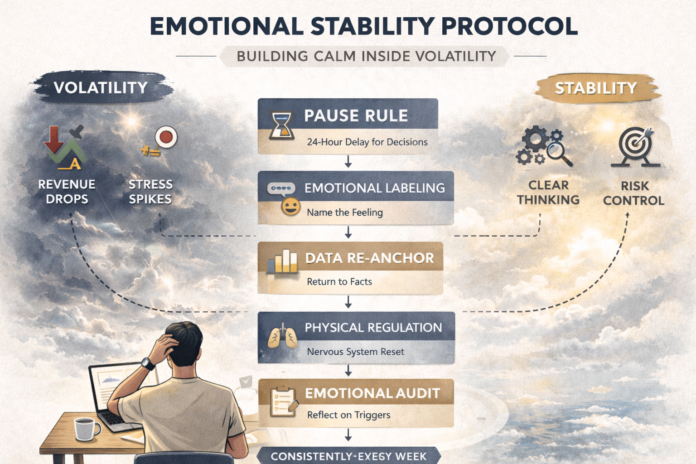
The 5-Part Emotional Stability Protocol

Use this when volatility hits.


1. Pause Rule (Minimum 24 Hours for High Impact Decisions)

Never make:

  • Major pivots
  • Price changes
  • Team changes
  • Public announcements

While emotionally elevated.

Time reduces distortion.


2. Emotional Labeling

Instead of:

“I need to change everything.”

Say:

“I am feeling anxious because revenue dropped.”

Labeling emotion reduces its intensity.

Clarity replaces panic.


3. Data Re-Anchor

Return to facts:

  • What are the numbers?
  • What changed objectively?
  • Is this trend or noise?

Emotion exaggerates.

Data stabilizes.


4. Physical Regulation

Your nervous system drives your perception.

Stability practices include:

  • Deep breathing cycles
  • Short walks
  • Structured workouts
  • Sleep protection

If your body is dysregulated, your strategy will be too.


5. Weekly Emotional Audit

Ask weekly:

  • What triggered stress?
  • What triggered overconfidence?
  • Where did emotion override structure?
  • What pattern is forming?

Patterns reveal emotional blind spots.


The Founder’s Emotional Discipline

High-risk builders accept:

Volatility is normal.

They expect fluctuation.

They normalize uncertainty.

When uncertainty becomes expected, it stops feeling like failure.


The Emotional Maturity Shift

Beginner founders ask:

“Why is this happening to me?”

Experienced founders ask:

“How do I respond intelligently?”

The difference is emotional maturity.

And emotional maturity compounds just like capital.


Protecting Your Nervous System

Your nervous system is a strategic asset.

If constantly overstimulated:

  • Creativity drops.
  • Focus fragments.
  • Risk tolerance distorts.
  • Burnout accelerates.

Protecting your emotional baseline is not self-care fluff.

It is business infrastructure.


The Long-Term Advantage

When emotionally stable:

  • You negotiate calmly.
  • You see risk clearly.
  • You think long-term.
  • You resist panic pivots.
  • You outlast reactive competitors.

Emotional stability is an unfair advantage in high-risk environments.


Final Thought

Entrepreneurship will test your strategy.

But it will test your nervous system first.

Build your Emotional Stability Protocol before volatility arrives.

Because it will arrive.

And when it does, the calm founder wins.

Weekly Strategic Review Framework for Entrepreneurs

0

Most founders plan yearly.

Some plan quarterly.

Very few review weekly.

And that is where silent failure begins.

Entrepreneurship is not lost in one catastrophic mistake.

It drifts.

Slowly.

Quietly.

Weekly strategic review is the mechanism that stops drift before it becomes damage.


Why Weekly Review Is Non-Negotiable

Without structured review:

  • You confuse activity with progress.
  • You repeat inefficient actions.
  • You ignore early warning signs.
  • You operate emotionally instead of analytically.

Momentum feels productive.

But direction determines outcome.

Weekly review protects direction.


The Purpose of a Weekly Strategic Review

A proper review does not ask:

“Did I work hard?”

It asks:

“Did I move the system forward?”

It separates:

  • Motion from progress
  • Emotion from data
  • Reaction from strategy

It converts chaos into clarity.


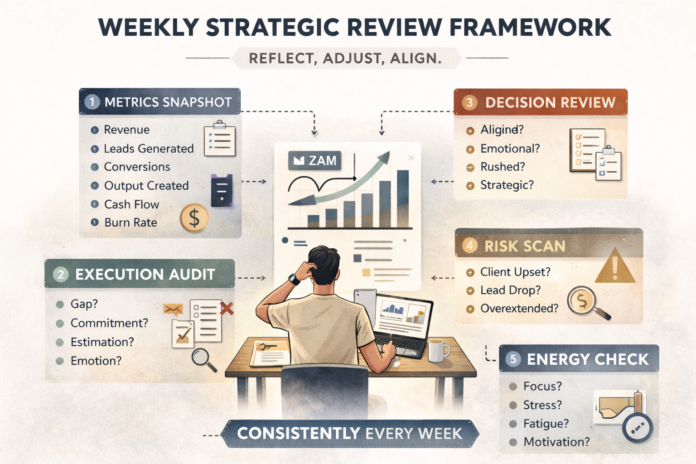
The 6-Block Weekly Strategic Review Framework

Use this every week. Same day. Same time.

Consistency builds pattern recognition.


1. Metrics Snapshot (Data First)

Review only measurable numbers:

  • Revenue
  • Leads generated
  • Conversions
  • Output created
  • Cash flow
  • Burn rate

No interpretation yet.

Just data.

Emotion enters after facts.


2. Execution Audit

Ask:

  • What did I say I would do?
  • What actually got done?
  • Where did execution break?

If there’s a gap, identify the cause:

  • Overcommitment?
  • Distraction?
  • Poor estimation?
  • Emotional resistance?

Execution patterns reveal structural weaknesses.


3. Decision Review

List key decisions made this week.

Evaluate:

  • Were they aligned with long-term direction?
  • Were they emotional?
  • Were they rushed?
  • Were they strategic?

Over time, you will see decision patterns.

Patterns reveal growth — or repeated mistakes.


4. Risk Scan

Look for early signals:

  • Declining leads?
  • Increased expenses?
  • Energy drop?
  • Client dissatisfaction?
  • Overextension?

Risk rarely explodes suddenly.

It whispers first.

Weekly review amplifies the whisper.


5. Energy & Psychological Check

Entrepreneurs ignore this at their own cost.

Rate:

  • Focus level
  • Stress level
  • Motivation
  • Fatigue

Your energy is a business asset.

If energy declines, performance declines.

Adjust before burnout.


6. Strategic Adjustment

Only after reviewing everything:

Ask:

  • What will I stop?
  • What will I continue?
  • What will I improve?
  • What single priority matters most next week?

One main priority.

Not ten.

Clarity compounds.


The Founder Discipline Rule

Your weekly review is sacred.

No skipping.
No rushing.
No multitasking.

Even 45–60 minutes of structured review can save months of strategic drift.


Why Most Founders Avoid It

Because review forces confrontation.

It shows:

  • Poor decisions.
  • Broken systems.
  • Inconsistent discipline.
  • Emotional reactions.

But discomfort during review prevents disaster later.


The Compound Effect

Weekly reviews create:

  • Faster learning cycles.
  • Reduced repeated mistakes.
  • Improved decision quality.
  • Better risk management.
  • Higher emotional stability.

Small weekly adjustments prevent large yearly regrets.


The Hidden Advantage

When you review weekly:

  • You become self-correcting.
  • You reduce dependence on external advice.
  • You build pattern awareness.
  • You operate like a CEO — even solo.

Entrepreneurship is not about intensity.

It is about intelligent iteration.


Final Thought

If you want to outlast most founders, do one thing they won’t:

Review consistently.

Not when things go wrong.

Every week.

Progress is built in reflection, not just action.

Decision Architecture for Solo Founders

0

The quality of your business will never exceed the quality of your decisions.

As a solo founder, there is no board.
No management layer.
No senior advisor filtering noise.

There is only you.

And if your decision-making is emotional, reactive, or inconsistent — your business becomes unstable by default.

That’s why solo founders don’t just need discipline.

They need decision architecture.


What Is Decision Architecture?

Decision architecture is a pre-designed structure that determines:

  • How you evaluate opportunities
  • When you say yes
  • When you say no
  • How you assess risk
  • How long you wait before committing

It removes randomness.

It reduces emotional interference.

It protects your long-term strategy.


Why Solo Founders Are Especially Vulnerable

When you work alone:

  • Every idea feels urgent.
  • Every opportunity feels important.
  • Every risk feels personal.
  • Every mistake feels amplified.

Without structure, you will:

  • Overcommit.
  • Pivot too fast.
  • Accept misaligned clients.
  • Chase short-term gains.
  • Burn out from decision fatigue.

Decision fatigue is silent — but lethal.


The 5 Layers of Decision Architecture

1. Opportunity Filter

Before saying yes, ask:

  • Does this align with my core model?
  • Does it improve leverage?
  • Does it increase complexity?
  • Does it protect long-term positioning?

If it creates noise, not clarity — it’s a no.


2. Time Delay Rule

For major decisions:

  • Wait 24–72 hours.
  • No emotional commitments.
  • No pressure responses.

If urgency disappears after delay, it wasn’t strategic.


3. Risk Ceiling Definition

Define in advance:

  • Maximum financial risk per experiment.
  • Maximum time investment per project.
  • Maximum workload threshold.

Pre-set ceilings prevent emotional overreach.


4. Reversibility Check

Ask:

  • Can this decision be reversed easily?
  • What is the cost of undoing it?

Low-reversibility decisions require deeper analysis.

High-reversibility decisions require speed.


5. Weekly Decision Review

Every week, review:

  • Decisions made.
  • Outcomes.
  • Emotional triggers.
  • Bias patterns.

Patterns reveal blind spots.

Blind spots cause repeated mistakes.


The Biggest Trap: Emotional Decisions Disguised as Strategy

Examples:

  • Saying yes because you fear missing out.
  • Pricing lower because you fear rejection.
  • Launching early to feel productive.
  • Expanding because competitors are growing.

Emotion-driven decisions feel urgent.

Strategic decisions feel structured.


Build Decision Rules in Calm Moments

Never design your decision framework during crisis.

Design it when calm.

So when stress hits, you follow structure — not fear.

This is how professionals operate.

Not from impulse.

But from architecture.


The Solo Founder Advantage

When you build decision architecture:

  • You move faster without chaos.
  • You reject distractions easily.
  • You conserve mental energy.
  • You reduce regret.
  • You compound clarity.

Structure creates freedom.

Without structure, freedom becomes overwhelming.


The Long-Term Effect

Good decisions don’t guarantee immediate success.

But consistent decision logic guarantees stability.

And stability gives you enough time to win.


Final Thought

As a solo founder, you are not just building a business.

You are building a thinking system.

Your decisions shape your direction.
Your direction shapes your outcome.

Build your decision architecture before opportunity tests you.


When Giants Move, the Sky Feels Smaller

0


When the Ground Doesn’t Shake — But the Air Changes

Sometimes nothing explodes.

No alarms.
No visible collapse.

Yet something feels different.

Heavier.

Tighter.

As if the sky itself has lowered a few inches.

That’s what happens when giants move.

Not ordinary people.
Not daily noise.

Giants.


Who Are the Giants?

Giants are not just tall figures.

They are:

  • Superpowers.
  • Billion-dollar corporations.
  • Financial institutions.
  • Political leaders.
  • Tech platforms.
  • Military forces.
  • Cultural influencers.

When they shift direction, entire systems recalibrate.

Markets tremble.
Narratives rewrite.
Borders tense.
Currencies react.
Policies tighten.

You may not see the giant’s footsteps.

But you feel the shadow.


Why the Sky Feels Smaller

When power concentrates or repositions, three psychological effects happen:

1. Perceived Loss of Space

Uncertainty reduces perceived freedom.

People think:

  • “What if rules change?”
  • “What if opportunities shrink?”
  • “What if access disappears?”

The sky feels smaller because options feel narrower.


2. Heightened Sensitivity

When giants move, everyone watches.

Speculation increases.
Rumors accelerate.
Media amplifies.

Noise fills the air.

And noise compresses clarity.


3. Dependency Exposure

Most systems rely on bigger systems.

When giants shift:

  • Supply chains reveal fragility.
  • Financial markets expose leverage.
  • Political alliances show cracks.
  • Social media ecosystems shift algorithms.

Suddenly you realize how interconnected everything is.

That awareness can feel suffocating.


The G.I.A.N.T. Stability Framework

When giants move, don’t panic.

Adapt.

G – Ground Yourself

Separate signal from noise.

Not every headline equals collapse.

Stability begins with internal calm.


I – Increase Awareness, Not Anxiety

Study patterns.

Understand incentives.

Ask: Why are they moving?

Power rarely moves randomly.


A – Adjust Positioning

You may not control giants.

But you control your positioning.

Financially.
Professionally.
Digitally.
Emotionally.

Small players survive by being agile.


N – Narrow Your Focus

When the sky feels smaller, simplify.

Focus on:

  • Skills
  • Discipline
  • Relationships
  • Resilience

Macro shifts demand micro clarity.


T – Think Long-Term

Giants move in cycles.

History shows:

  • Empires rise and contract.
  • Markets boom and correct.
  • Technologies dominate and fade.

Temporary compression does not mean permanent confinement.


Hidden Truth Most People Miss

When giants move, opportunities are born.

Disruptions create:

  • New markets.
  • New alliances.
  • New industries.
  • New leadership spaces.

While many panic under the shrinking sky, a few look for open corridors.

Giants moving reshapes terrain.

It does not eliminate terrain.


Mistakes to Avoid

  • Don’t react emotionally to every shift.
  • Don’t overconsume crisis media.
  • Don’t freeze in uncertainty.
  • Don’t assume power moves mean personal doom.
  • Don’t underestimate adaptability.

History is filled with people who rose precisely when giants clashed.


Opposite-Truth Ego Check

We assume:

“When giants move, we become powerless.”

But what if:

Their movement creates space at lower levels?

When dominant forces reallocate attention, smaller actors gain maneuverability.

The sky may feel smaller above.

But new ground may open below.


Final Reflection

When giants move, the air tightens.

Yes.

The sky feels closer.

Yes.

But remember:

Pressure creates clarity.

Compression forces evolution.

And survival does not belong to the largest.

It belongs to the most adaptive.

When giants move, the sky may feel smaller—

But your awareness can grow larger.


Storms Don’t Shake Us. They Remind Us Who We Are.

0


The Myth of Being “Shaken”

When storms come — financial pressure, war, betrayal, loss, uncertainty — people say:

“This situation is shaking me.”

But is it?

Or is it revealing what was already unstable?

Storms don’t invent cracks.
They expose them.

They don’t insert fear.
They uncover it.

And sometimes, they don’t weaken you at all.

They remind you who you’ve always been.


Why Calm Water Lies

Calm environments are deceptive.

When life is stable:

  • Weak discipline survives.
  • Shallow beliefs feel strong.
  • Unexamined identities go unquestioned.
  • Comfort disguises fragility.

But storms remove comfort.

And without comfort, identity stands naked.

The question becomes:

What remains when everything comfortable disappears?

That remainder is your real self.


The Hidden Psychology of Pressure

Pressure activates truth.

Under stress, you cannot perform a fake personality for long.

Your automatic responses surface:

  • Do you panic or observe?
  • Do you blame or adapt?
  • Do you freeze or act?
  • Do you collapse or reorganize?

Storms compress time.

They accelerate exposure.

They force decisions that comfort once delayed.


The R.E.M.I.N.D. Framework: How Storms Reveal Identity

R – Reveal Beliefs

When things go wrong, what do you believe?

  • “This is unfair”
    or
  • “This is information”

Belief determines reaction.


E – Expose Discipline

Storms test systems.

If your habits were weak, chaos magnifies it.

If your routines were strong, they stabilize you.

Storms don’t destroy discipline.
They measure it.


M – Measure Character

Character isn’t shown when praised.

It’s shown when pressured.

How do you treat people when stressed?

That is identity.


I – Identify Anchors

In crisis, what grounds you?

Faith.
Principles.
Mission.
Family.
Purpose.

Storms reveal whether your anchor is real — or decorative.


N – Neutralize Ego

Adversity crushes false pride.

It removes illusions of control.

But it also builds humility.

And humility strengthens clarity.


D – Define the Next Version of You

After the storm, you are not the same.

You are either:

  • Hardened and wiser
    or
  • Bitter and defensive

The storm reveals.

You decide what to become next.


Mistakes People Make During Storms

  • They confuse discomfort with destruction.
  • They assume difficulty means weakness.
  • They seek immediate escape instead of growth.
  • They compare their storm to someone else’s sunshine.

Every storm is personal.

Its lesson is tailored.


Opposite-Truth Ego Check

Many say:

“I was strong until this happened.”

But what if:

You were comfortable — not strong?

Storms don’t remove strength.

They separate real strength from imagined strength.


The Deeper Truth

Storms do not exist to break you.

They exist to clarify you.

When pressure rises:

  • Illusions fall.
  • Identity sharpens.
  • Priorities simplify.
  • Noise disappears.

And in that stripped-down moment,
you finally meet yourself.

Not the social version.

Not the comfortable version.

The core version.


Final Reflection

If storms didn’t come,
you might never know:

  • How patient you are.
  • How disciplined you can be.
  • How much faith you truly hold.
  • How resilient your mind actually is.

Storms don’t shake us.

They remind us who we are.


OUR SAFETY IS OUR SHARED RESPONSIBILITY

0

Avoid Sharing Sensitive Visuals — A National Duty as Well as a Legal Obligation


The Camera Is Not Always Neutral

In peaceful times, a photo is just a memory.
In tense times, a photo can become intelligence.

A single image — a military convoy, damaged infrastructure, troop movement, restricted facilities — may look ordinary to you.

But to someone analyzing patterns, it can reveal:

  • Location coordinates
  • Security weaknesses
  • Response timelines
  • Equipment capabilities
  • Vulnerable entry points

Your intention may be innocent.
The impact may not be.


The Hidden Power of Visual Data

Modern technology has changed the stakes.

Images today carry more than pixels. They contain:

  • Embedded metadata (GPS location, time stamps)
  • Background landmarks
  • Reflections
  • Tactical layouts
  • Environmental clues

What looks like a simple “update post” can become a piece of open-source intelligence (OSINT).

And during conflict or heightened security periods, adversaries actively monitor public content.

The battlefield is no longer only physical.

It is digital.


Why This Is a Shared Responsibility

Security is not maintained only by authorities.

It is strengthened or weakened by collective behavior.

Every citizen with a smartphone holds:

  • A publishing tool
  • A broadcasting channel
  • A potential intelligence source

The question is not: “Will my one post matter?”

The better question is: “What would have to be true for this to matter more than I think?”

When thousands share similar visuals, patterns emerge.

Patterns create vulnerability.


Legal Consequences Are Real

Most nations have laws restricting:

  • Sharing military movements
  • Publishing restricted infrastructure visuals
  • Broadcasting sensitive emergency response scenes
  • Spreading unverified security-related content

Violations may result in:

  • Fines
  • Criminal charges
  • Platform bans
  • Investigation for aiding hostile analysis

Even if intent was harmless.

Ignorance rarely protects against accountability.


The Psychology Trap

Why do people share sensitive visuals?

  1. Emotional reaction (“Look what’s happening!”)
  2. Desire for attention or validation
  3. Panic-driven urgency
  4. Lack of awareness about consequences

During unstable times, emotion overrides restraint.

That is exactly when discipline matters most.


The S.A.F.E. Digital Discipline Framework

Before posting any sensitive visual, apply this filter:

S – Sensitivity Check

Does this show:

  • Military presence?
  • Strategic locations?
  • Emergency infrastructure?
  • Damage assessment?
  • Crowd movements during tension?

If yes, stop.


A – Authority Guidance

Have official authorities requested:

  • Not to share?
  • To avoid speculation?
  • To rely on verified updates only?

Follow official communication channels.


F – Future Impact

Imagine worst-case misuse.

Could this:

  • Help someone analyze response timing?
  • Expose security gaps?
  • Create public panic?

If the answer is even “maybe,” don’t post.


E – Ethical Responsibility

Ask yourself: Am I helping stability — or increasing noise?

Silence is sometimes a form of service.


Mistakes & Traps to Avoid

  • Don’t forward unverified images.
  • Don’t share “breaking” content without source verification.
  • Don’t screenshot restricted areas.
  • Don’t assume deleted posts disappear permanently.
  • Don’t think private groups are truly private.

Digital footprints travel farther than intentions.


Opposite-Truth Ego Check

Many think:

“I’m just one person.”

But national resilience is built from millions of “one persons.”

Security is not only about weapons and walls.

It is about awareness and restraint.


The Bigger Picture

In times of uncertainty, enemies look for weaknesses.

Carelessness can become exposure.

Discipline becomes protection.

Your phone is powerful.

Use it wisely.

Because safety is not only enforced.

It is practiced.