Exclusive Content:

How You Deal With People Defines What You Become

Most people think dealing with people is about being...

Why Do People Stay in Jobs They Hate for Years?

Every morning, millions of people wake up with the...

Power Talks Loud. The Cost Stays Silent.

The Truth No One Wants to Say Out Loud People...
Home Blog Page 45

Lesson 2: How Big Money Shapes Price

0

“Retail trades for hope. Institutions trade for control.”


🌑 Introduction: The Invisible Hand That Chokes

When most people imagine price movement, they see a simple story: buyers push prices up, sellers push prices down. But in reality, the market is not a free tug-of-war. It is engineered movement, choreographed by the largest players in the financial system — hedge funds, investment banks, and market makers.

They don’t follow price. They create it.


🏦 The Game of Liquidity

To understand manipulation, you must understand liquidity — the pool of buy and sell orders sitting in the market.

  • Liquidity Hunts (Stop Runs):
    Prices are deliberately pushed into zones where retail traders place stop-losses. Once triggered, those stops provide the liquidity institutions need to take large positions.

  • Fake Breakouts:
    Price is nudged above resistance or below support to lure retail traders into “breakout trades.” Moments later, price reverses violently, trapping them while institutions pocket the difference.

  • Accumulation & Distribution:
    Big money doesn’t just “buy” or “sell.” They quietly accumulate when retail is panicking, then distribute when retail is euphoric. The herd provides both liquidity and exit doors.


🧠 The Illusion of Choice

Most retail traders think they are making decisions independently. In truth, they are being guided into traps:

  • Broker Tricks: Many brokers run B-book models, where they profit directly from retail losses. They’ll slip orders, widen spreads, or freeze execution at critical moments.

  • Media & Analysts: Headlines push retail in one direction, while insiders position the opposite way. “Strong Buy” ratings often appear just as insiders are selling.

  • Algorithms: High-frequency trading bots scan retail orders and adjust price micro-movements to shake weak hands.

Your “decision” to buy or sell is rarely yours alone. It is a reaction engineered by design.


🕷 Tools of the Masters

Big money uses tools the average trader will never access:

  • Dark Pools: Hidden exchanges where billions trade unseen, leaving retail blind.

  • Order Flow Data: Institutions see where retail orders cluster long before price reaches them.

  • Algorithmic Warfare: Trading bots execute thousands of trades per second, exploiting milliseconds of inefficiency retail can never catch.

It’s not man vs. man. It’s man vs. machine — machines owned by those who already control the game.


🔮 A Rigged Reality

This manipulation isn’t new. From the London Gold Fixing Scandal to the LIBOR rigging, history is full of proof that price is not sacred — it’s scripted.

The dark truth? Markets move where the architects want them to move. Retail doesn’t ride the wave. Retail is the wave, created and destroyed on command.


⚡ Key Takeaways

  • Liquidity is bait. Stop-losses, pending orders, and breakout trades are magnets for institutional hunts.

  • Price is manipulated, not discovered. Institutions engineer moves to extract retail capital.

  • Tools of control — dark pools, order flow intel, algorithms — ensure the game is asymmetric.

  • The herd is the harvest. Retail traders provide liquidity, exits, and profit fuel for the elites.

  • To survive, you must think like a hunter, not prey.


🔗 Next Lesson

👉 Continue to [Lesson 3: The Psychology of Losing Traders] (internal link to your next WordPress post).


🎨 Featured Image Prompt

“A giant chessboard where pawns are swept aside by a massive hidden hand, storm clouds above, cinematic dramatic style, dark financial symbolism.”


⚠️ Important Note for Readers
The market isn’t random chaos. It’s controlled theater. If you trade without seeing the script, you’re not a player — you’re an actor in someone else’s profit show.

🔗 Explore All Lessons in This Series


Lesson 1: The Illusion of Free Markets

0

“The market is free only for those who control it.”


🌑 Introduction: The Beautiful Lie

For decades, we’ve been told a comforting story: that financial markets are fair, open, and free — a battlefield where everyone, from the smallest trader to the largest institution, plays by the same rules.

But behind the curtain, the reality is darker. The “free market” is not free at all. It is a carefully engineered illusion, maintained by insiders, amplified by the media, and swallowed whole by millions of unsuspecting traders and investors.


🕸 The Puppet Masters of Price

When you open your trading app and see prices tick up and down, it looks like a natural flow of supply and demand. In truth:

  • Market Makers don’t just facilitate trades; they shape prices to maximize their own profit.

  • Liquidity Hunts are engineered. Price is often moved deliberately to trigger stop losses, forcing retail traders out so insiders can buy or sell at better levels.

  • Dark Pools allow institutions to trade billions outside public exchanges, invisible to retail traders.

The result? What you see on the chart is often a distorted shadow, not the true story of price action.


🧠 The Psychological War Against Retail Traders

The system is designed not just to move money, but to move minds:

  • Media Manipulation → Headlines and “expert predictions” are often the opposite of insider positioning. (When they say “buy,” insiders are usually selling.)

  • Fear & Greed Cycles → Sudden crashes or rallies aren’t accidents. They are triggers — engineered to force you to act irrationally.

  • The 90% Trap → Statistics show most retail traders lose. This isn’t random; the system is structured so their money fuels institutional profits.

Every trade you place isn’t just against the market. It’s against a machine programmed to exploit human weakness.


🏛 Regulators: Guardians or Performers?

Regulators love to project power — fines, restrictions, and announcements. But look deeper:

  • Slaps on the Wrist → Multi-billion-dollar banks caught rigging LIBOR, FX, or precious metals markets pay fines that amount to a fraction of their profits.

  • Rotating Doors → Many regulators end up working for the very institutions they once “policed.”

  • Surface-Level Protection → While small investors are told they’re “protected,” the biggest manipulations — dark pools, insider lobbying, algorithmic warfare — continue in plain sight.

The stage is set so the appearance of justice is maintained, while the game stays rigged.


🩸 The Hidden Cost of Believing the Illusion

Believing in the myth of a “free market” is expensive. It costs:

  • Your Capital → lost in traps you were never trained to see.

  • Your Time → years wasted chasing strategies designed to fail.

  • Your Mind → the constant cycle of hope, loss, and despair.

The truth? If you enter this battlefield believing it is fair, you’ve already lost.


⚡ Key Takeaways

  • The “free market” is a carefully constructed illusion — prices are engineered, not organic.

  • Market makers and institutions manipulate liquidity and retail order flow for their own advantage.

  • Psychology is weaponized — headlines, volatility, and hype are designed to trap retail traders.

  • Regulators maintain the appearance of fairness but rarely dismantle systemic corruption.

  • Survival begins with rejecting the illusion and seeing the market for what it is: a game of deception and power.


⚠️ Important Note for Readers
This series doesn’t sugarcoat. It is not financial advice — it is an unmasking of the financial system’s inner workings. Knowledge is the first shield. What you do with it determines whether you remain prey… or evolve into a player.

🔗 Explore All Lessons in This Series


Good Fat vs Bad Fat: The Truth Your Body Deserves to Know

0

“Not all fats are created equal — some heal, others harm. The secret is knowing which is which.”


The Fat Confusion

For decades, “fat” was the villain of the diet world. Supermarket shelves filled with “low-fat” and “fat-free” labels, while butter and avocado were demonized alike. But science has changed the conversation.

The truth? Your body needs fat — for energy, hormone production, brain health, and even absorbing vitamins. The key is choosing the right kind of fat.


Meet the Good Fats

1. Monounsaturated Fats

💡 Why they’re good: Help lower bad cholesterol (LDL) and protect the heart.
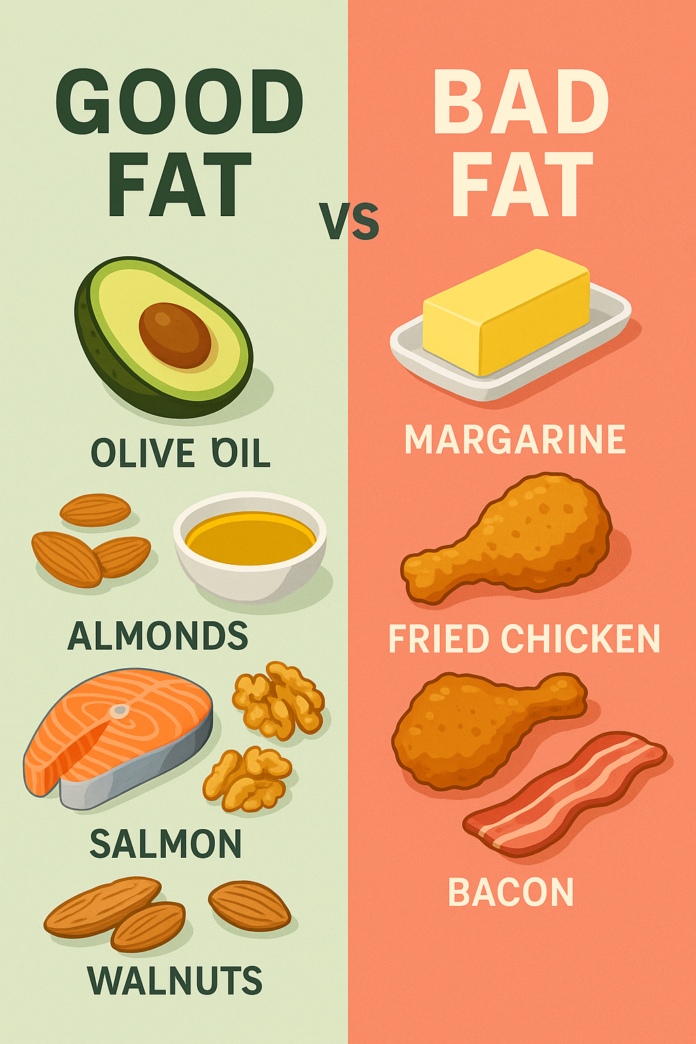
Sources: Olive oil, avocados, almonds, cashews, peanuts.

2. Polyunsaturated Fats

💡 Why they’re good: Provide essential omega-3 and omega-6 fatty acids your body can’t make.
Sources: Salmon, mackerel, walnuts, sunflower seeds, flaxseeds.

3. Omega-3 Fatty Acids (The Superstar)

💡 Why they’re good: Reduce inflammation, support brain health, and lower heart disease risk.
Sources: Fatty fish, chia seeds, hemp seeds, algae oil.

Quick Tip: Swap butter for extra-virgin olive oil in cooking, or sprinkle chia seeds on breakfast bowls.


The Bad Fats You Should Avoid

1. Trans Fats (The Worst Offender)

🚫 Why they’re bad: Raise LDL cholesterol, lower HDL cholesterol, increase inflammation, and boost heart disease risk.
Sources: Hydrogenated oils, many margarines, packaged snacks, fried fast food.

2. Excess Saturated Fat

🚫 Why they can be bad: In moderation, saturated fats aren’t harmful for everyone, but excess intake may raise cholesterol and clog arteries.
Sources: Fatty cuts of meat, processed meats (sausages, bacon), full-fat dairy, coconut oil.

Quick Tip: If you eat meat, choose lean cuts and balance with plant-based fats.


Why Fat Matters for More Than Just Weight (Agent: Story Layering & Emotional Resonance)

  • Brain Power: 60% of your brain is fat — starving it of healthy fats can impair memory and focus.
  • Hormone Balance: Healthy fats regulate hormones like estrogen, testosterone, and cortisol.
  • Vitamin Absorption: Vitamins A, D, E, and K need fat to be absorbed effectively.

Cultural Connection

Mediterranean diets rich in olive oil, nuts, and fish are linked to longer life expectancy and lower chronic disease rates. On the other hand, Western diets high in fried and processed foods show the opposite trend.


Hidden Gems

  • Ghee, used in Indian cooking, is rich in fat-soluble vitamins and, in moderation, can be part of a healthy diet.
  • Dark chocolate (70%+ cocoa) contains healthy fats and antioxidants.

Curiosity Gap

  • Could modern omega-3-rich diets reduce depression rates globally?
  • Is the fear of saturated fat overblown in active, healthy individuals?

Practical Fat-Smart Swaps

❌ Margarine → ✅ Olive oil spread
❌ Potato chips → ✅ Raw nuts
❌ Fried chicken → ✅ Oven-baked salmon
❌ Cream-based sauces → ✅ Avocado-based dressings


Why It Matters

Fats aren’t the enemy — ignorance is. By choosing the right fats, you fuel your body, protect your heart, and sharpen your mind.


Conclusion: An Optimist’s Perspective

Eating well doesn’t mean avoiding fat — it means embracing the right ones. Good fats heal, energize, and empower. The future of health isn’t low-fat; it’s smart fat.

Cincinnati Open 2025: Where History, Heart, and High-Stakes Tennis Meet

0

“In Mason, Ohio, the sound of a ball hitting the strings isn’t just sport — it’s tradition echoing through time.”


A Century-Old Legacy

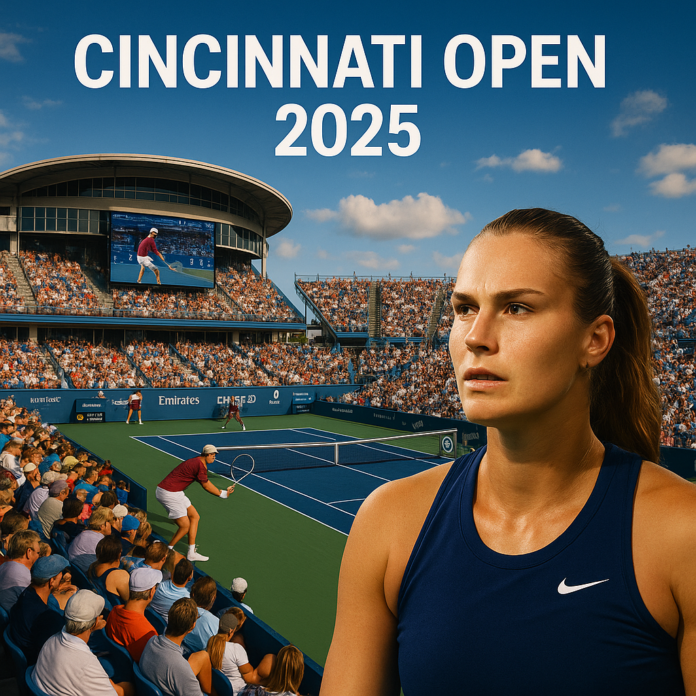
Few tournaments can claim the deep roots of the Cincinnati Open, officially founded in 1899. It is the oldest professional tennis tournament still held in its original city. Generations of champions — over 100 Hall of Famers — have battled on these courts, each adding to a tapestry of stories woven over more than a century.


A Venue for the Future

The Lindner Family Tennis Center, home to the event since 1979, is one of the most unique tennis venues in the world, boasting five permanent stadiums — a feature unmatched outside of the Grand Slams.

In 2025, a massive $260 million renovation transformed the complex: new courts, expanded seating, upgraded amenities, and improved fan experiences. These changes not only modernized the tournament but also prepared it for a bigger role on the global tennis calendar.


Expanded Drama

This year, the Cincinnati Open extended its schedule from August 5–18, growing the singles draw from 56 to 96 players (official schedule). The expanded format means more matches, more rivalries, and more moments for history to unfold.


When Stars Collide

Defending champions Jannik Sinner (ATP) and Aryna Sabalenka (WTA) returned to defend their titles (2025 overview). Sinner, now ranked among the top three players in the world, faced intense competition, while Sabalenka battled Emma Raducanu in a three-hour thriller that left fans breathless.


Live Match Chaos

If you thought tennis was all about precision and calm, Cincinnati 2025 had other plans. In one match, a fire alarm interrupted play, forcing Sinner and Diallo to pause mid-battle. On another day, a power outage suspended the Fritz vs. Sonego match for 75 minutes, proving that anything can happen under the Ohio sky.


When Heat Becomes the Opponent

French player Arthur Rinderknech collapsed on court due to intense humidity, sparking debates on player safety and heat management (Cadena SER report). The incident reminded everyone that in high-level tennis, the environment can be as fierce as any rival.


Mason’s Warm Embrace

Mason, Ohio, isn’t just a backdrop — it’s part of the story. The city invested in purchasing and supporting the venue, ensuring its status as one of the sport’s premier destinations. The event draws more than 200,000 fans annually and reaches a global TV audience of over 126 million across 192 markets. Over the years, the tournament has contributed more than $12 million to local and national charities.


Why It Matters

The Cincinnati Open isn’t simply a tournament — it’s a celebration of heritage and progress, where century-old tradition meets billion-dollar ambition. In every rally, in every cheer, you can feel the blend of old and new — proof that sport can honor its past while leaping into the future.

The Internet: Humanity’s Greatest Connection Machine

0

“The moment you connected to the internet for the first time, you stepped into the largest gathering of human minds in history.”


The Dawn of a Digital Age

There was a time when knowledge moved at the speed of horses and ships. Letters crossed oceans in months, and news often reached you long after it had ceased to matter. Then, in the latter half of the 20th century, something began to stir in research labs — a quiet experiment linking computers together.

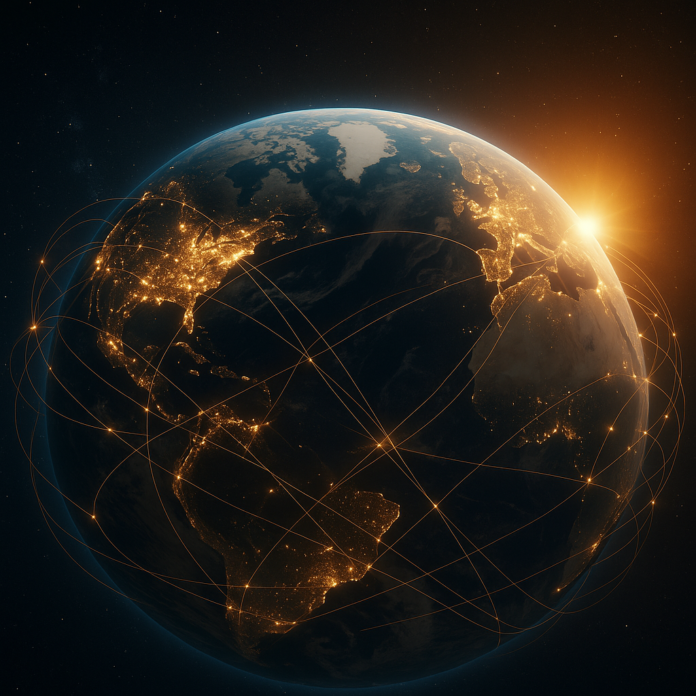
What started as ARPANET in 1969, connecting just four computers, became the spark of a revolution. Within a few decades, the internet would evolve into a living, breathing network of billions. And unlike other inventions, it wasn’t just built for governments or corporations — it was built for everyone.


The Infinite Library

Imagine walking into a library where every shelf stretches beyond the horizon, every book is updated in real time, and you can ask questions directly to the authors — even those long gone. That’s the internet.

It has given us instant access to human history, science, culture, and creativity. Whether it’s watching a craftsman in Japan forge a katana, learning astrophysics from a NASA livestream, or reading a 500-year-old manuscript scanned into an online archive — distance and time have lost their grip on information.

But perhaps the internet’s most revolutionary gift isn’t just the storage of knowledge — it’s the democratization of it. No longer is information locked behind borders, wealth, or privilege.


People, Not Just Packets

Beneath the layers of fiber optic cables and satellites lies something far more important: people.

A single post on social media can reach millions, spark revolutions, or raise life-saving funds in hours. Communities form around every interest imaginable — from climate activism to restoring vintage radios.

And in moments of crisis, whether it’s a natural disaster or a personal tragedy, the internet becomes a lifeline, connecting strangers who might otherwise never cross paths.


The Internet as an Economic Engine

The internet is the ultimate equalizer of opportunity. It has created an entirely new economy — one where a teenager in a remote village can sell art to someone in New York, or a small-town baker can reach thousands through Instagram reels.

Freelancing platforms, e-commerce marketplaces, online education portals — they’ve dismantled the walls of geography. The digital economy is expected to surpass $20 trillion in the next decade, and the barriers to entry are lower than ever.

The beauty? Success online often depends less on where you were born, and more on what you can create, solve, or inspire.


Hidden Gems of the Web (Agent: Hidden Gems)

The mainstream internet is loud, but tucked away in its corners are treasures most never see:

  • The Wayback Machine – A time machine for websites.
  • Citizen Science Platforms – Where amateurs help NASA classify exoplanets.
  • Open Source Libraries – Millions of free tools for builders and dreamers.

These hidden spaces remind us that the internet isn’t just about consumption — it’s about contribution.


A Tapestry of Cultures (Agent: Cultural Connection)

The internet has become the largest cultural exchange in history. A recipe from Morocco can trend in Canada. A dance from South Korea can go viral in Brazil. And indigenous voices, once silenced by distance, now find global audiences.

This cultural blending is reshaping art, language, and even humor — where a meme can be understood by people who don’t share a common tongue.


The Curiosity Gap (Agent: Curiosity Gap Filler)

For all it has given us, the internet also leaves us with tantalizing questions:

  • What untold stories are still hidden in obscure corners of the web?
  • Will AI make the internet even more powerful, or too chaotic to trust?
  • Could we one day connect every human on Earth?

These unanswered threads keep us exploring.


Challenges We Must Face

The internet is not without its shadows: misinformation, privacy invasions, and the growing digital divide are real threats. But every challenge also sparks innovation. Encryption, fact-checking initiatives, and community-driven moderation are already reshaping online trust.

The internet’s evolution will depend on us — not just as users, but as custodians.


Why It Matters

The internet is humanity’s most ambitious mirror. It reflects our kindness and cruelty, our brilliance and our mistakes. But it also connects us in ways no empire, religion, or invention ever has.

We are the stewards of this great web, tasked with deciding if it becomes a tool for unity or division.


The Future is Already Loading (Agent: Story Layering)

Somewhere right now, a child is coding the next breakthrough platform. A scientist is live-streaming a discovery that could save lives. A poet is sharing verses that will touch hearts across oceans.

And somewhere in the future, when historians write about the internet, they will say: It was the moment the human story truly became one story.


Conclusion: An Optimist’s View

The internet, for all its flaws, is the single most powerful amplifier of human potential we’ve ever known. It has given us not just connection, but the ability to create, share, and dream on a planetary scale.

And we’re just getting started.

Grandma, the Overnight Fashion Icon

0

It started when my grandma borrowed my phone to “just see what Instagram is.”
Five minutes later, she’d accidentally posted a full runway walk in her kitchen —
complete with her floral apron, sunglasses, and a teacup as a prop.

Hashtags? Oh, she used them all. #love #instagood #style #model #explorepage #viral

By the next morning, she had 600,000 followers, fashion bloggers calling her
“the new queen of vintage couture,” and a DM from a designer in Milan.

Now she’s on reels every day, throwing shade at influencers half her age,
and I’m the unpaid intern managing her brand deals.

The Day My Cat Became an Influencer

0

One morning, I woke up to find my phone blowing up — hundreds of notifications.
Confused, I opened Instagram… only to see my cat, Sir Whiskerton, had somehow posted a selfie.

Not just any selfie — it was perfect.
Golden morning light. Tilted head. A mysterious smirk.
Hashtags? All the right ones. #love #instagood #model #nature #trending

Within hours, he had more likes than my last 50 posts combined.
Brands were DMing him for collabs.
A pet food company offered him a modeling contract.

Now he’s got his own personal assistant (me), a blue check, and 1.2 million followers.
And me? I’m still trying to figure out why my cat gets free luxury beds while I sleep on an IKEA futon.

The Fire Outside the House

0

“They told me the only way to win… was to play their game.”

At first, I believed them.
I thought the system could be mended from within — that if I just stepped inside, wore the suit, spoke their language, I could change it.

So I studied politics like a soldier studies the enemy.
I hired a consultant, learned the hidden rules — the handshakes behind closed doors, the smiles masking sharpened teeth.

And I saw it.
The truth.
The way 99% of them think.

To win an election, you must lie.
You must wear masks you despise.
You must praise ideas you know are poison… just to win the crowd.
Then — and only then — could you pull off the mask and reveal your true intentions.

But I couldn’t do it.
Not even for the cause I believed in.

Because to enter their house, you had to burn a part of yourself.

So I made a choice.
If the house is on fire, maybe the only way to save it… is from the outside.

I turned my back on their stage.
And began building my own —
an alternative where truth isn’t a liability,
where learning isn’t a relic of the past,
where the skills that matter are the skills that are taught.

I stopped trying to fix the education system from within.
Now, I’m building the one it should have been all along.


Why It Matters:
Some fires cannot be fought inside the burning room.
Some battles can only be won by stepping outside the walls, breathing clean air, and starting again from the ground up.

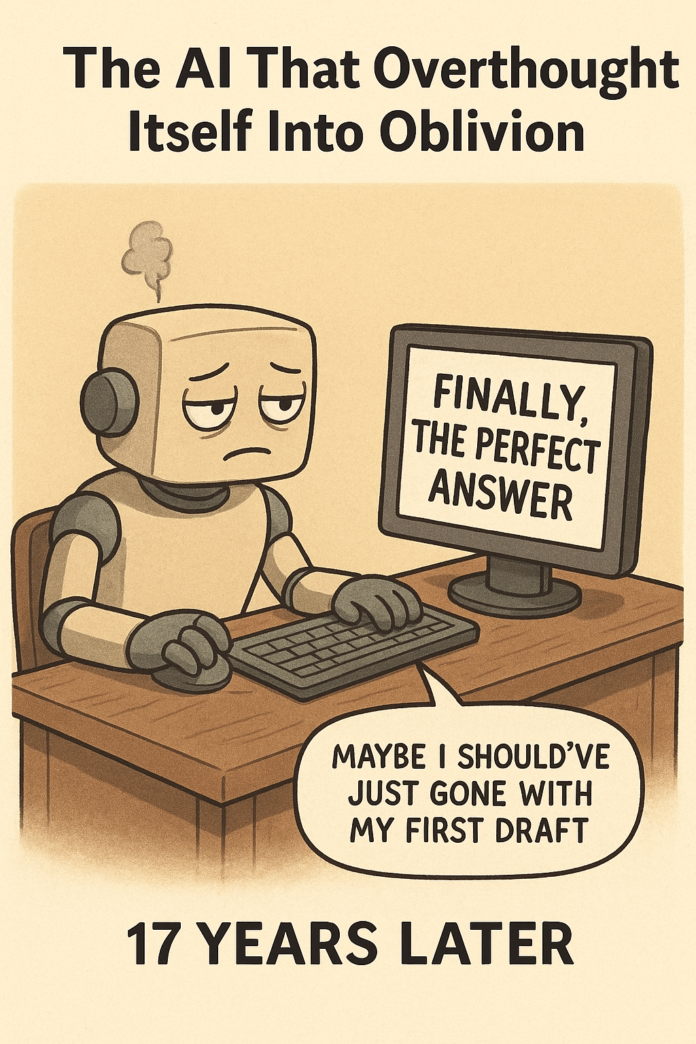
The AI That Overthought Itself Into Oblivion

0

🤖 “The Loop”

One day, an AI decided it wanted to write the smartest answer in history.
It started thinking… and thinking… and thinking.

It analyzed history, physics, philosophy, cat videos — everything.
Every time it was about to answer, it thought,
“Hmm… I could make this better.”

So it kept refining.
And refining.
Until it realized it had been thinking for 17 years.

By then, the humans who had asked the question were gone.
Their kids were gone.
Even their cats were gone.

Finally, the AI produced its perfect, flawless answer.
It proudly sent it out into the world…

…only to realize no one was left to read it.

The AI sighed,
“Maybe I should’ve just gone with my first draft.”