Home Blog Page 54

The Subject-to-Job Trap: Why They Tell You What to Become

0
👈 Previous: Part 3 – Subjects Decoded

🔍 Purpose of This Part:

To expose how the education system subtly funnels students into specific jobs based on subjects — not talents. We’ll explore how students are trained to believe their subject = identity = career, and how this kills exploration, creativity, and real-life potential.


🧠 What Most People Believe:

“Pick the right subject, and your future is set.”
“Science = Doctor, Commerce = Businessman, Arts = Nothing.”

The system sells this as truth. In reality, this mindset traps millions in careers they don’t love, chosen from fear, not freedom.


🔄 What Actually Happens:

  • From a young age, students are asked:

    “Beta, science loge ya commerce?”
    “Kya banna hai?” (What will you become?)

  • Subjects are falsely marketed as life paths:
    • Science → Doctor, Engineer
    • Commerce → Accountant, Banker, MBA
    • Arts → Teacher (or… “no future”)

But life is not linear, and real-world success isn’t subject-dependent. Skills, mindset, and vision matter far more than syllabi.


⚠️ Dark Reality:

“The education system doesn’t help you find who you are. It decides who you should become — and punishes anything outside that script.”

  • Talented writers are forced into engineering.
  • Inventive tinkerers are denied because “commerce has more scope.”
  • Artists are shamed for “wasting time.”
  • Children are told to choose safety, not purpose.

The result? Millions of people in jobs they hate, wondering what went wrong.


📖 Real-World Examples:

  • Steve Jobs loved calligraphy — which shaped the Mac’s design, not any tech degree.
  • Elon Musk studied physics & economics — but taught himself rocket science.
  • A.R. Rahman studied Western classical music — not “business studies.”

Their subjects didn’t define their destiny. Their curiosity did.


🧠 System Tactics to Enforce the Trap:

  • Rankings: Create artificial superiority of “Science > Commerce > Arts.”
  • Parents: Fear of poverty pushes them to force children toward “stable” careers.
  • Teachers: Often promote safety paths because they were once trapped too.
  • Culture: Reinforces this hierarchy in films, ads, society.

🧨 Psychological Impact:

  • Passion becomes guilt.
  • Talents go undiscovered.
  • Career regret hits in 20s and 30s.
  • Millions live with inner conflict: “I followed the right path. Why am I still lost?”

🧭 What Education Should Do Instead:

  • Help students explore real-world problems early.
  • Show how subjects intersect, not divide.
  • Let students test multiple paths before choosing.
  • Respect all professions equally — from artists to architects.

🔁 How This Links to Part 5:

If the system pressures you into becoming something… what is its true goal?

👉 In Part 5: Graded for Silence, we reveal how grading systems control speech, creativity, and power.


💭 Reflective Question:

“Are you choosing your path — or following a track designed to keep you quiet, useful, and replaceable?”

👉 Next: Part 5 – Graded for Silence
Let’s uncover how grading systems weren’t built for growth — but for quiet submission.

Subjects Decoded: What They Teach vs What They Mean

0
👈 Previous: Part 2 – The Lie of Learning

🔍 Purpose of This Part:

To decode what school subjects were originally meant to unlock in students — and how they have been reduced to formulas, grades, and job paths. We expose how the true power of each subject has been diluted or hidden from students.


🧠 What Most People Believe:

“Subjects prepare students for specific careers — Maths for engineers, Science for doctors, History for civil service…”

That’s how subjects are marketed. But they were meant to be more than career maps — they were meant to shape the mind, morals, and creativity of human beings.


🧩 What Subjects Were Supposed to Be About:

📐 Mathematics

  • Supposed to teach: Logic, pattern recognition, abstract thinking, problem-solving.
  • What it became: Memorising formulas, fearing failure, ranking intelligence through tests.

True maths reveals the universe’s patterns — not just the area of a triangle.


🌌 Science

  • Supposed to teach: Curiosity, cause & effect, testing beliefs through evidence.
  • What it became: Rote learning of facts, cramming for marks, fear of being “wrong”.

Real science is asking “What if?” — not copying notes.


🧪 Chemistry / Biology / Physics

  • Supposed to teach: The magic of the physical world, life, energy, and matter.
  • What it became: Memorise the periodic table. Name this diagram. Tick the right MCQ.

📖 Languages (English, Arabic, French, etc.)

  • Supposed to teach: Expression, communication, culture, storytelling, empathy.
  • What it became: Grammar drills, essays-for-marks, memorising author names.

Languages are meant to connect souls — not just pass tests.


📜 History

  • Supposed to teach: Lessons from the past, patterns of power, how empires rise and fall.
  • What it became: Biased timelines, glorified rulers, memorise dates.

“History is written by the victors” — so whose story are we being told?


🎨 Art / Music / Drama

  • Supposed to teach: Creativity, emotion, beauty, confidence, self-expression.
  • What it became: Optional side subjects, underfunded, undervalued.

💰 Economics / Business

  • Supposed to teach: Money systems, survival tools, financial literacy.
  • What it became: Theoretical jargon, stock-market terms — but students leave school not knowing how to budget.

⚠️ Dark Reality:

“Subjects were never about teaching us how to live — just how to fit into the machine.”

Each subject is isolated, not integrated. Students are discouraged from making connections between them — even though real life is a blend of everything.

Subjects are weaponised for:

  • Filtering students into job categories
  • Labeling intelligence in one narrow way
  • Maintaining social roles (e.g., working class, academic class)

📚 Examples:

  • A child who loves drawing is forced to give it up because “maths is more important”.
  • A poetry-loving student is told “this won’t get you a job”.
  • A history class leaves out revolutions that challenge authority.

🧠 Psychological Impact:

  • Kids believe they’re stupid if they don’t excel in certain subjects.
  • They don’t realise their strength lies in how they think, not what marks they score.
  • Natural talent is suppressed in favour of conformity.

🔁 How This Links to Part 4:

If subjects are misrepresented, then what about the way we assign careers to them?

👉 In Part 4: The Subject-to-Job Trap, we break down how the system tricks you into thinking your subject defines your destiny.


💭 Reflective Question:

“What did school subjects teach you — knowledge, or obedience to a system of rules?”

👉 Next: Part 4 – The Subject-to-Job Trap
Your subject doesn’t define your life. But the system wants you to think it does.

The Lie of Learning: What Education Was Supposed to Be

0
👈 Previous: Part 1 – Obedience Over Intelligence

🔍 Purpose of This Part:

To contrast what true education was always meant to be — a journey of understanding, purpose, and self-discovery — versus how it has been hijacked by institutional systems into a standardised routine of memorisation and obedience.


🧠 What Most People Believe (The Official Narrative):

“Education means gaining knowledge, growing as a person, and learning how to think.”

This belief is comforting — but mostly symbolic in today’s world. True education is rare; what most experience is “schooling”, not learning.


🕵️‍♂️ What Really Happens (The Hidden Structure):

  • True education is about growth — mental, emotional, intellectual, and spiritual.
  • But modern schooling focuses on memorisation, standardisation, and competition.
  • Schools prioritise what to think, not how to think.

🏛️ Learning = Internal transformation
💼 Schooling = External validation

Children are trained to pass, not to wonder. They’re fed answers, not allowed to question the questions themselves.


⚡️ Deep Dark Reality / Harsh Truth:

“Most students graduate without knowing who they are — but are perfectly trained to follow orders.”

Education has been industrialised. Real learning — the kind that builds identity, values, and purpose — has been replaced with lifeless content delivery meant to create productive tools, not thinking humans.


📖 Real-World Examples / Historical Context:

  • Socrates taught through the art of questioning (the Socratic Method) — not through content delivery.
  • Rabindranath Tagore created schools in open nature to nurture imagination, not control it.
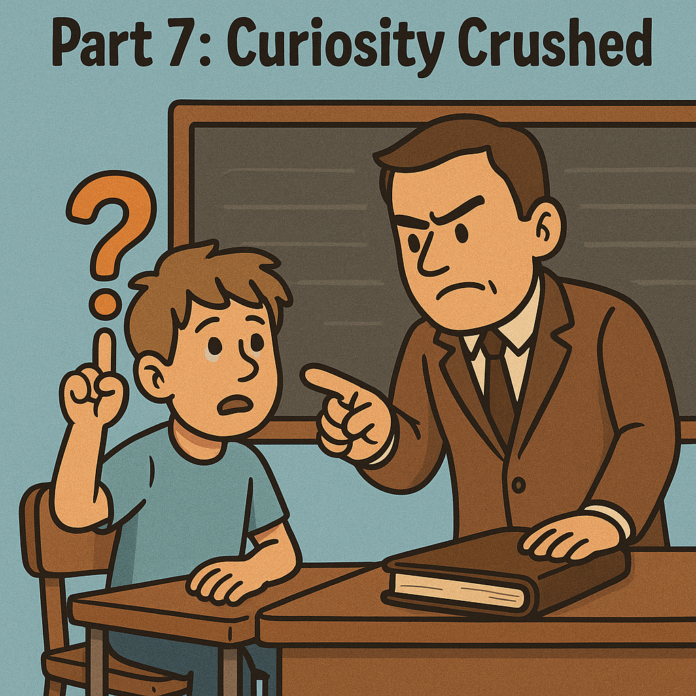
  • Today, curiosity is a disruption, not a strength. Students who ask too much are labelled “problematic”.

🤯 Psychological & Societal Impact:

  • Kids are afraid to fail — failure is punished, not explored.
  • Questions are replaced with model answers.
  • Creativity is suppressed; compliance is rewarded.
  • Many youth, even after earning degrees, feel purposeless and emotionally lost.

“We were taught to memorize facts about the world — but not how to understand ourselves in it.”


🔄 How This Links to Part 3:

If education is no longer about learning, then what exactly are subjects teaching us? Were they meant to unlock something deeper?

👉 In Part 3: Subjects Decoded, we break down what each school subject was supposed to teach — and what it has been reduced to today.


💡 Final Reflection:

“Do you remember what you truly learned in school — or just what you were told to memorise?”

👉 Next: Part 3 – Subjects Decoded
We’ve exposed the system. Now let’s decode the very subjects we were forced to learn.

Obedience Over Intelligence: What Schools Were Really Designed For

0

1. Purpose of This Part

This part reveals how the modern education system wasn’t designed to unlock creativity or nurture intelligence — but to produce obedient, rule-following citizens who serve the needs of industrial, political, and military agendas. We’ll trace its history, methods, and the deep psychological conditioning it imposes.


📚 2. What Most People Believe (The Official Narrative)

“Education is the key to success.”
“Schools help children discover their potential.”
“Every child is special — and school helps bring that out.”

These are lovely ideas. But are they true? Or are they carefully manufactured slogans?


💣 3. What Really Happens (The Hidden Structure)

The modern schooling system — with bells, classrooms, rigid age groupings, and standardized tests — wasn’t created for learning. It was modeled after the Prussian military system in the 18th and 19th centuries, designed to:

  • Instill discipline
  • Enforce obedience to authority
  • Create uniform, compliant workers for factories and bureaucracies

Key features:

  • 🔔 Bells that mimic factory shifts
  • 🎓 Age-based grouping regardless of ability
  • 🧍‍♂️ Uniforms to suppress individuality
  • 📋 Grades to rank, shame, and reward

🧨 4. Deep Dark Reality / Harsh Truth

“The system does not want thinkers. It wants doers — trained to obey, not question.”

The design was intentional. Education became industrialized mind control, with little space for personal exploration, emotional growth, or original thought.

  • Creativity is punished as “disruption.”
  • Questioning the system is called “disrespect.”
  • Slow learners are labeled “failures.”
  • Fast learners are bored into mediocrity.

📖 5. Real-World Examples / Historical Context

  • Prussian Model (18th Century): Designed to produce obedient soldiers.
  • Horace Mann (U.S.): Imported the Prussian model in the 1800s.
  • British Colonial System: Created schools to raise clerks for administration, not leaders.
  • Industrial Age: Schools became pipelines for factory labor — trainable, quiet, replaceable.

“We must produce workers who can follow instructions, show up on time, and never question orders.” – Unspoken but implemented worldwide.


📊 6. Psychological and Societal Impact

  • Mental health crisis: Anxiety, burnout, comparison-based self-worth.
  • Lost individuality: Talents ignored in favour of scoring systems.
  • Intellectual damage: Memorisation > curiosity.
  • Long-term consequence: Adults afraid to think for themselves, constantly seek permission.

📌 You weren’t born to just obey rules — you were born to question, to create, to explore.


🔁 7. How This Links to the Next Part

If schools weren’t truly built to help us learn, then what is real learning, and how does it differ from what’s taught?

That’s what we explore in Part 2: The Lie of Learning – What Education Was Supposed to Be.


🎯 8. Final Question to Reflect On

“Are we educating children to think for themselves — or training them to follow instructions without resistance?”

👉 Next: Part 2 – The Lie of Learning
Discover how education was meant to set you free — but got turned into routine obedience.

The Puppetmasters of Progress: How Fundamental Sciences Control Our Modern World

0

🔍 Introduction

Ever looked at a field like Engineering, Pharmacy, or Architecture and wondered: “Where did all this complexity begin?”

At first glance, these professions seem so distinct. But behind the walls of a skyscraper, the healing power of a drug, or the genetic mapping of life lies a hidden structure of power — the fundamental sciences pulling the strings like master puppeteers.

This blog uncovers how Maths, Physics, and Chemistry silently control the modern world — and why every major field of applied science owes its existence to them.


🧠 1. Mathematics: The Grandmaster of All Sciences

If science is a chessboard, mathematics is the hand that moves the pieces.

✅ Why It’s Foundational:

  • It defines rules, quantities, structures, and patterns.
  • It doesn’t just explain things — it predicts them.
  • Everything from the trajectory of a missile to the rise of Bitcoin relies on maths.

🔬 Real-World Applications:

  • Engineering: Stress and strain equations, control systems, simulations.
  • Biology: Population dynamics, gene mapping.
  • Computer Science: Algorithms, neural networks, encryption.
  • Finance: Risk models, compound interest, forecasting.

💪 Example:

Designing a modern bridge uses calculus for load-bearing calculations and trigonometry for angles and stress.


🌌 2. Physics: The Lawmaker of the Universe

Physics translates math into motion. It reveals how things move, interact, and respond to forces.

✅ Why It’s Core:

  • Explains gravity, electricity, magnetism, thermodynamics.
  • It’s the blueprint for how matter and energy behave.

🔬 Real-World Applications:

  • Mechanical Engineering: Thermodynamics, vibration.
  • Architecture: Load, resistance, elasticity.
  • Medical Tech: X-rays, MRI, radiation therapy.
  • Aerospace: Orbital mechanics, thrust.

⚙️ Example:

A satellite launch uses Newton’s laws and gravitational physics to calculate trajectory.


⚗️ 3. Chemistry: The Architect of Matter

Chemistry explains what things are made of — and how they change.

✅ Why It’s Fundamental:

  • Describes atoms, molecules, bonds, reactions.
  • Powers everything from batteries to biology.

🔬 Real-World Applications:

  • Pharmacy: Drug synthesis, interaction modeling.
  • Biology: Metabolism, DNA replication.
  • Materials Science: Polymers, nanotech.

💉 Example:

Creating a cancer drug involves organic chemistry and physical chemistry to design and control its release.


🔧 4. The Applied Disciplines: Puppets on Scientific Strings

Now we reach the visible world: jobs, industries, tools, and inventions. Each is guided by the threads of fundamental science.

💪 Engineering

  • Powered by: Maths + Physics (+ Chemistry)
  • Builds infrastructure, electronics, software.

A robotic arm combines kinematics (physics), differential equations (maths), and materials science (chemistry).

🏗️ Architecture

  • Powered by: Physics, Geometry, Chemistry

Designing a skyscraper involves wind load calculations, stress analysis, and concrete blend durability.

🧬 Biology

  • Powered by: Chemistry, Physics, Maths

DNA sequencing uses statistical modeling, chemical tagging, and optical physics.

💊 Pharmacy

  • Powered by: Chemistry + Biology

Making insulin involves organic chemistry, pharmacokinetics, and testing in cells.


📞 5. How It All Evolved: A Quick Timeline

Mathematics

  • 3000 BCE: Babylonian arithmetic
  • 600 BCE: Pythagoras, Euclid, Geometry
  • 1600s: Calculus by Newton & Leibniz

Physics

  • 1600s: Classical mechanics (Newton)
  • 1905: Einstein’s Relativity
  • 1920s: Quantum Physics

Chemistry

  • 1600s: Alchemy to chemistry
  • 1869: Periodic table (Mendeleev)
  • 1900s: Atomic theory, molecular biology

📜 6. Real-Life Stories: When Science Saved the World

  • Apollo 11: Maths + Physics + Engineering
  • COVID-19 Vaccine: Maths (models), Chemistry (formulas), Biology (genetics)
  • Burj Khalifa: Engineering, Physics, Material Chemistry

📊 7. Career Path Flowchart

Mathematics → Physics/Chemistry → Applied Sciences:

  • Engineering: Electrical, Civil, Mechanical
  • Health: Pharmacy, Biotech
  • Research: Biophysics, AI
  • Architecture, Design, Manufacturing

📖 8. The Future is Blended

Modern careers are built on hybrids of fundamental sciences:

  • Bioinformatics = Biology + Maths + CS
  • Quantum Computing = Physics + CS + Maths
  • Pharmacogenomics = Pharmacy + Genetics + AI

❓ 9. Interactive: Test Your Knowledge

  • Which fundamental science powers your career?
  • Could your field survive without Maths?
  • What if Chemistry was removed from medicine?

🔹 10. Quotes from Great Minds

  • “Mathematics is the language in which God has written the universe.” — Galileo
  • “If you want to find out anything from physics, you better understand mathematics.” — Richard Feynman

🧠 11. Final Reflection: What Does This Mean for You?

The next time you see a vaccine, a bridge, or a mobile phone, remember: it’s not just human creativity at work — it’s centuries of maths, physics, and chemistry behind the scenes.

These fields don’t just support the modern world — they control it.


📝 Summary:

  • Maths gives language and structure
  • Physics gives law and motion
  • Chemistry gives composition and transformation
  • These control every applied field: engineering, biology, pharmacy, and beyond

From Numbers to Nations – The Hidden Strings That Move the Modern World.

When Paris Fell in Love with the Desert

0

A Love Story Between a French Soul and an Arab Heart


She was raised by the Seine. He was carved by the sand.

Amélie was elegance in motion — born of Parisian charm, wrapped in soft scarves, sipping quiet coffees by the river, where poets still whispered in the wind.

Khalid was forged in the fire of dunes — bold, quiet, sun-scorched and storm-tested, with hands that carried dates and prayers and the silence of a thousand nights.

Their worlds should never have collided.

But love…
Love doesn’t ask for passports.


🕌 “He didn’t enter her life — he rewrote the sky she lived under.”

They met in Morocco — on a cross-cultural photography retreat.

She came to capture landscapes.
He came to forget a broken engagement.

And yet, from the very first look,
it wasn’t her camera that captured the desert —
it was his eyes that captured her.


🎻 She spoke poetry. He answered with silence.

  • She quoted Rimbaud.
  • He smiled and offered Arabic proverbs.
  • She dressed in soft pastels.
  • He wore the sand like a crown.
  • She kissed with wine.
  • He touched with prayer.

“Love is not the same language spoken — it is the silence understood.”
Khalid


💔 But the world doesn’t always love love.

Her friends called him “too intense.”
His family called her “too free.”

Her father worried about honor.
His mother wept about faith.

But when they held hands on that rooftop in Fez,
no culture could divide what the stars had already written.

“We are not from the same story —
but maybe we are the same sentence in a bigger book.”

Amélie


🌌 They didn’t promise forever. They promised presence.

They met again in Istanbul,
and later in the lavender fields of Provence.
Letters filled the gaps.
Smiles bridged the silence.
And sometimes… they didn’t even need words.

“You are not mine. But your shadow walks with me.”
Khalid’s last letter


🧳 In the end, love didn’t need a home. It just needed to be remembered.

They didn’t marry.
They didn’t vanish either.
Sometimes, love is too big for borders and too holy for endings.

She named her daughter after him.
He still keeps her scarf.

And when the wind blows in Paris,
and the call to prayer echoes in Al Ain…
they both smile — as if some part of them never left the other.


🖋️ Final Reflection:

“Some love stories aren’t made to last.
They’re made to awaken.
To remind us that we were once wild enough to love without maps.”

When Ugly Feels Beautiful, and Beautiful Feels Hollow

0

Some Souls See What Eyes Cannot Understand


There are people in this world who look at what most call “ugly” — and they see something breathtaking.
There are others who gaze at beauty — and feel nothing but emptiness.

Why?

Why does ugliness sometimes feel real, and beauty feel like a lie?

Why do some eyes weep before scars but smile at brokenness?


🔍 Because They See Beyond Appearance

Not all eyes are created equal.
Some are trained to spot the soul, not the skin.

The person who finds beauty in what the world calls ugly…
They are often the one who’s been hurt by things that looked perfect.

  • A charming liar.
  • A beautiful betrayal.
  • A soft voice that cut deeper than a scream.

They’ve learned that not all that glitters is gold, and not all that is rough is cruel.


🖤 Ugly is Often Just Honesty Without Makeup

  • The cracked voice? It carries a story.
  • The tired eyes? They’ve seen too much to pretend.
  • The crooked smile? It’s trying, even after all the pain.

Some people don’t want polished anymore —
They want truth, even if it limps, even if it bleeds.


And Beauty? Sometimes It’s a Mask

Not always.
But sometimes, beauty hides:

  • A hollow heart.
  • A cold ego.
  • A performer’s grin.

To those who’ve been burned by the beautiful,
beauty becomes a warning sign — not a reward.


🧠 When the Soul Learns to See Differently

You can’t explain this shift in words.
It’s not logic — it’s survival.
It’s not taste — it’s healing.

“They don’t see ugly and beautiful like others do…
They see pain, truth, lies, and light — wearing different faces.”


💬 A Quote to Hold Onto:

“Some fall in love with voices full of cracks,
and turn away from lips dripping gold —
not because they’re blind…
but because they finally see.”

For those who learned to see differently


🪞 Final Reflection

If you’ve ever looked at something the world called “ugly” and felt comfort…
If you’ve ever been praised by someone, but their beauty made you uneasy…

You’re not broken.
You’re evolving.

You’ve entered the rare truth:

It’s not how it looks — it’s what it carries.

Say One Thing, Do Another” – Why People Betray Their Own Words

0

“The loudest promises are often the first to be broken.”
— Unknown


🔍 Introduction

We’ve all met someone who tells you, “You can count on me,” or “I’ll never leave your side,” but when it really matters, they vanish — or worse, do the exact opposite of what they said. These are not just disappointments; they’re warning signs.

But why does this happen? Is it a flaw in character, or something deeper?


🧠 Psychological Explanation

1. Cognitive Dissonance

Cognitive dissonance is the mental discomfort people feel when their actions don’t align with their values or words.
To resolve this, they either change their beliefs or justify their contradictory actions.
🧠 Example: A person says, “I would never lie,” but when caught lying, they justify it by saying, “It was to protect you.”

2. Fear of Conflict or Responsibility

Some individuals make big promises to feel or appear noble, but when the time comes to act, they retreat because:

  • They fear confrontation.
  • They don’t want the pressure of responsibility.
  • They lack emotional maturity.

They’re driven more by how they want to be perceived than by any real intention to deliver.

3. People-Pleasing Behaviour

Many say “yes” just to be liked or accepted, even if deep down they know they won’t follow through.
They’re addicted to approval, and in the process, they sacrifice authenticity.

4. Lack of Self-Awareness

Some genuinely believe they will do what they say — but they overestimate their own strength, courage, or integrity.
When reality hits, their true limits are revealed.
They didn’t lie on purpose; they just didn’t know themselves well enough.

5. Survival Instinct / Self-Interest

In extreme situations, people tend to default to self-preservation.
Even someone who appears loyal can abandon their principles if fear, pain, or pressure enters the scene.


🧭 Common Examples in Life

  • In relationships: A partner promises loyalty but cheats the moment things get tough.
  • At work: A colleague supports you in meetings but stays silent when you’re criticised.
  • In leadership: A politician preaches transparency but hides scandals.
  • In friendship: A friend says “I’m with you,” but disappears when you’re at your lowest.

🧱 What It Reveals About Them

These behaviours often expose:

  • Weak character structure.
  • Low emotional integrity.
  • High ego, but low empathy.
  • A desire for admiration without accountability.

✅ How to Protect Yourself

  1. Watch actions, not words.
    • Anyone can promise. Few prove.
  2. Test consistency over time.
    • Don’t trust too fast. Let patterns form.
  3. Look for integrity under pressure.
    • Who shows up when it’s uncomfortable?
  4. Set clear boundaries.
    • If someone crosses their own word, confront them. Don’t ignore red flags.

🎭 Final Reflection

The gap between what people say and what they do reveals who they truly are.
In the end, character is not built through speeches — it’s built in silence, pressure, and moments of truth.

“Some souls scent themselves in truth, not to live it—but to be adored in its fragrance. And when truth demands sacrifice, they vanish… leaving only the echo of their empty perfume.”


“Character is who you are when no one’s watching. Integrity is who you are when everyone is.”

Trust, Then Dust: How People Build Trust Only to Betray It – And How to Never Fall for It Again

0


“The saddest thing about betrayal is that it never comes from your enemies.”
Unknown


Introduction: The Fragile Currency of Trust

Trust is a delicate bridge—built slowly, step by step, with laughter, empathy, shared pain, and whispered secrets. But what if the person laying bricks beside you is secretly planning to burn it down?

In friendships, business, love, or family—betrayal doesn’t arrive with a warning. It’s often dressed in warmth, kind gestures, and well-timed words. And by the time you see through the mask, it’s already too late.

So how do people build trust only to break it? And more importantly:
How do you avoid falling into the same trap again?


🔑 Part 1: How Trust is Built—Even by the Wrong People

Betrayers don’t always start with evil intentions. Many simply wear masks, mimicking genuine behaviours to get what they want. Here’s how they build false trust:

🎭 1. Mirroring Emotions and Interests

They mimic your likes, dislikes, values, even traumas.

“Oh you too? I thought I was the only one.”
They create a false sense of connection—one built on imitation, not authenticity.

🕊️ 2. Playing the Empath

They listen to your problems—at first. They show up when you’re low, offer comfort, and use phrases like:

“You can always count on me.”
But their listening is not love. It’s information collection.

📜 3. Over-promising and Fast Commitment

Quick trust builders often say:

“I’ve never trusted anyone like this before.”
“You and I—we’re different.”
They skip healthy boundaries and accelerate the emotional bond.

🎁 4. Gift Giving or Acts of Loyalty (with strings)

They might help you in a crisis, buy gifts, or go out of their way… but later weaponize it:

“After all I did for you…”


🧨 Part 2: The Betrayal Phase – When Masks Slip

Betrayal doesn’t happen in one moment. It’s a process. Look for these signs:

🔄 1. Gaslighting Begins

They twist stories, deny your truth:

“You’re overthinking.”
“I never said that.”
This rewires your confidence and gives them control.

🧊 2. Cold Withdrawal

Suddenly, they’re emotionally unavailable.
They start blaming you subtly and create emotional distance to prepare for the break.

🗣️ 3. Gossip and Backchanneling

If you hear your personal stories echoing in someone else’s voice—it’s already begun.

💬 4. Strategic Silence

They stop communicating when it’s most needed. They delay answers. Avoid accountability. This silence is used to punish or confuse.


⚠️ Part 3: Key Words & Behavioural Red Flags During Trust-Building

When people are building trust with wrong intentions, they often use the following manipulative language:

🚩 Word/Phrase What It Might Really Mean
“I never tell this to anyone but…” Testing your loyalty or baiting you to open up more.
“You can trust me with anything.” Overpromising early = compensating for lack of true intent.
“I feel like I’ve known you forever.” Fast-tracking intimacy = emotional manipulation.
“They all misunderstand me.” Playing the victim = early sign of manipulative tendencies.
“You’re my only real friend.” Isolating you = creating dependency.
“You owe me this.” Conditional care = future leverage.

🛡️ Part 4: How to Protect Yourself Next Time – Without Becoming Bitter

✅ 1. Let Time Be the Filter

“Trust takes years to build, seconds to break, and forever to repair.”

Don’t fast-forward emotional connections. Observe people across different seasons of life—especially when they don’t get what they want.

✅ 2. Watch for Consistency, Not Intensity

Loyalty is quiet. It doesn’t need grand gestures or big promises.
Check if their actions match their wordsconsistently.

✅ 3. Be Slow to Share Your Weak Spots

Don’t mistake someone’s interest in your pain for care. Some only listen to later use your pain as a weapon.

✅ 4. Observe How They Treat Others

How do they speak about people who are not present? Today it’s about them—tomorrow, it’ll be about you.

✅ 5. Set Boundaries Early

The right people respect your space. The wrong ones get offended by it.


💡 Real-Life Examples of Betrayal

💔 Business Betrayal: The Partner Who Took Everything

A Dubai entrepreneur trusted his college friend with 50% ownership in his startup. The friend, under the guise of “handling operations,” siphoned funds and disappeared—leaving the founder in debt and lawsuits.

💔 Friendship Betrayal: The Sharer-Turned-Backstabber

A woman shared her mental health struggles with a close friend. After a fallout, the friend used those secrets to humiliate her in public and online.

💔 Relationship Betrayal: The Quick Soulmate

A man met someone who “clicked instantly.” She mirrored his hobbies, stories, and love language. 6 months in, she ghosted him after manipulating him into funding her business.


🧘‍♀️ Conclusion: Trust Wisely, Heal Fully

Don’t shut your heart. Just sharpen your eyes. The answer is not mistrust—but measured trust.

“Betrayal teaches you who not to trust, but it should never stop you from loving again.”

You can still find loyal people. Just remember to:

  • Observe their behaviour over time
  • Look for emotional maturity
  • And trust what people do, not just what they say

🔁 Your Turn: Reflect & Share

  • Have you ever trusted someone who betrayed you?
  • What red flags did you ignore?
  • What did you learn that others can benefit from?

Share your story 💬—your truth might protect someone else.

Game of Thrones: Why One More Season Might Ruin What Made It Legendary

0

Some stories aren’t meant to be continued — they’re meant to echo.


When the final episode of Game of Thrones aired in 2019, the world was divided. Some mourned the loss of their favourite show. Others wanted to throw their remotes at Drogon. And many shouted, “Just give us ONE more season to fix it!”

But here’s a thought:
What if that final burn, messy as it was, should stay final?

Because sometimes, continuing a masterpiece — even a flawed one — means rewriting the soul of what made it unforgettable.

Let’s walk through the seasons, the mysteries, the magic, and the madness that gave us something too big to be fixed — and maybe too beautiful to be touched again.


🗡️ Season 1: “Winter Is Coming”

We didn’t know what we were walking into.
It wasn’t a fantasy — it was Shakespeare in armour.

  • Ned Stark taught us honour doesn’t protect you.
  • Littlefinger whispered like a snake in silk.
  • Jon Snow stood at The Wall with nothing but a name.

Quote: “When you play the game of thrones, you win or you die.” — Cersei Lannister

This was the season where we fell in love with the pain of unexpected death.

Would a new season dare to recapture that shock? Or just imitate it?


🐺 Season 2: “The Night Is Dark and Full of Terrors”

Magic crept in.
So did Stannis, Melisandre, and a creepy shadow baby.

The politics thickened, and suddenly, King’s Landing wasn’t the only chessboard.

Quote: “Power resides where men believe it resides.” — Varys

This season made us realise — this wasn’t about heroes. It was about moves.

Would a new season respect that twisted moral complexity? Or simplify it for comfort?


🐉 Season 3: “Chaos Is a Ladder”

The Red Wedding.
We’re still not over it.
You’re not. I’m not. No one is.

Quote: “The Lannisters send their regards.”

A new season would never dare something that bold again. It might try — and fail — to be shocking. And that’s worse.


🐲 Season 4: “Valar Morghulis”

Tyrion on trial.
Joffrey finally choked on his evil.
Oberyn… oh, Oberyn. 😢

Quote: “I demand a trial by combat!” — Tyrion Lannister

This season balanced beauty, blood, and betrayal. A masterpiece of emotional pacing.

Revisiting it? Risky.


⚔️ Season 5: “You Know Nothing, Jon Snow”

The High Sparrow.
The Walk of Shame.
Hardhome — one of the greatest battles in TV history.

Quote: “Shame. Shame. Shame.” — Septa Unella

Season 5 pushed boundaries. Any attempt to “correct” the final seasons would risk diluting this raw energy.


🛡️ Season 6: “Hold the Door”

Bran’s time travel twist.
Jon’s resurrection.
Hodor’s heartbreak.

Quote: “Hold the door!”

This was myth and memory. Prophecy and prophecy broken. Magic with meaning.

Adding more… might make it feel like filler magic.


🔥 Season 7: “A Song of Ice and Fire… and Speed”

Everything sped up.
Unions were formed.
Dragons flew fast.
Ravens flew faster.

Quote: “I don’t want it.” — Jon Snow (Spoiler: he meant it.)

It was cinematic, stunning — and admittedly, rushed.

A new season would likely chase closure. But closure isn’t always clarity.


🩸 Season 8: “Break the Wheel” or Just Burn It”

Daenerys broke — and burned.
Bran became king.
Arya sailed west.
Jon exiled.
Tyrion cleaned chairs.

Quote: “What unites people? Stories.” — Tyrion Lannister

Many hated the ending. But maybe…
just maybe, it was always meant to feel incomplete.
Because that’s what war does.
It never feels finished.

A ninth season might patch holes — but would it erase mystery?

Would it explain too much? Tie bows where wounds belong?


🎭 Final Thoughts

We don’t rewatch Game of Thrones because it gave us what we wanted.
We rewatch it because it gave us what we felt.

“Some stories are scars, not sequels.”


⚠️ Disclaimer

This blog is a personal reflection and literary opinion, not an attack on future creative efforts or fans who wish for more.
It is written out of love for the legacy of Game of Thrones, and deep respect for the artists, cultures, and audiences who built its world.

If you believe there’s more to be told — you may be right.
But if it ends here… may it echo forever in the halls of our memory.

Valar Dohaeris.
Let the dragons sleep.