Exclusive Content:

The Four Things Quietly Controlling Every Human Life

The body asks for sleep. The mind asks for wealth. The...

Why You Only Talk When Others Start First (And How to Break the Habit Without Changing Who You Are)

“Sorry… I don’t usually talk unless someone talks to...

Why Your AI Prompts Don’t Work (And How to Fix Them Instantly)

Most people think AI is the problem. “It gave a...
Home Blog Page 6

Why Most People Get Bad AI Results (And How to Fix It)

0

The Real Problem Isn’t AI — It’s Input Quality

You’ve probably experienced this.

You ask AI something simple.
You expect something useful.
You get something… average.

Not wrong.
Not broken.
Just not impressive.

So you try again.
Reword it.
Maybe add a few more words.

Still average.

At this point, many people conclude:

“AI is limited.”

But that’s not true.

AI is not failing.
The instruction is.


The Invisible Mistake Most People Don’t See

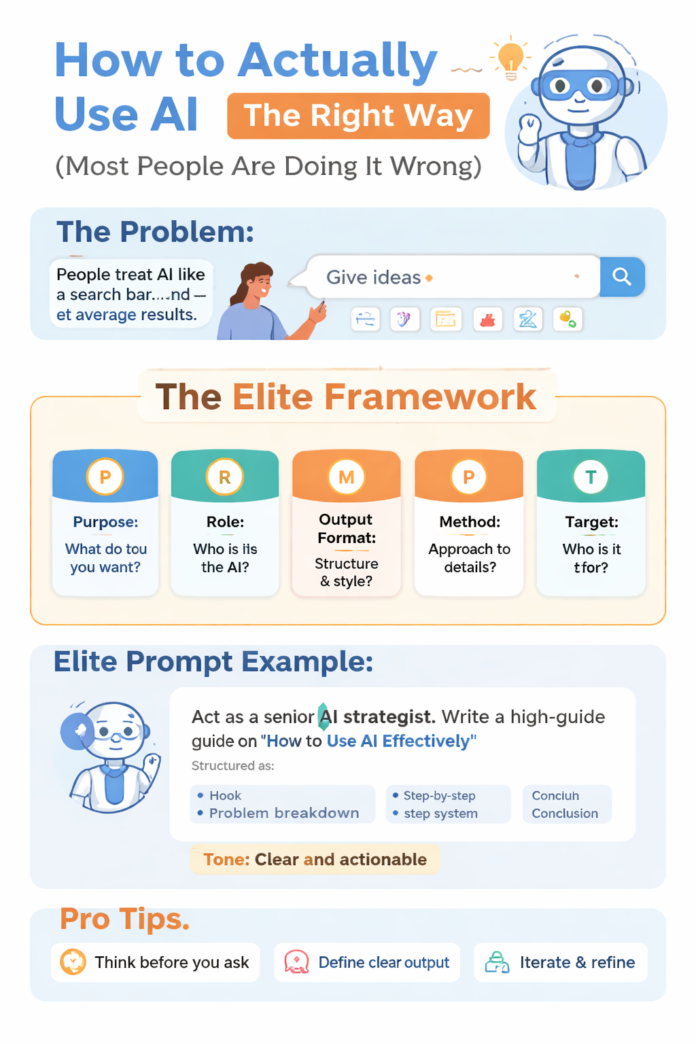
Most users treat AI like a search engine.

They type short, vague inputs and expect precise, high-quality output.

But AI doesn’t retrieve answers.

It generates responses based on how you guide it.

And if your guidance is unclear, the output becomes generic.

This is not a bug.

It’s a reflection.


The 7 Core Mistakes That Lead to Weak AI Output

Let’s break this down clearly.

1. Vague Task Definition

“Write something about productivity”

What does “something” mean?
What kind of productivity?
For whom?

AI fills the gap with safe, generic content.


2. No Context

No background. No situation. No intent.

Without context, AI assumes the “average case.”

And average output follows.


3. No Target Audience

Content for:

  • students
  • professionals
  • founders
  • beginners

…is completely different.

Without audience clarity, tone and depth collapse.


4. No Expert Perspective (Agent Role)

You ask AI as a general assistant.

So it responds like one.

But when you assign roles:

  • strategist
  • psychologist
  • developer
  • educator

…depth increases immediately.


5. No Output Structure

“Explain this topic”

Should it be:

  • short summary?
  • deep article?
  • bullet points?
  • step-by-step guide?

If you don’t define structure, AI guesses.


6. No Constraints

Without constraints, AI tends to:

  • be overly generic
  • use clichés
  • stay safe

Constraints force clarity.


7. No Quality Standard

You never tell AI what “good” looks like.

So it defaults to “acceptable.”

And acceptable is rarely impressive.


What High-Quality Prompting Actually Looks Like

Let’s transform a weak prompt into a strong one.


Weak Prompt

“Explain procrastination”


Structured Prompt

Act as a behavioral psychologist, educator, and simplification expert.

Task:
Explain procrastination in a clear and practical way.

Context:
Audience includes young adults who understand the problem but struggle to fix it.

Requirements:

  • Explain why procrastination happens psychologically
  • Include emotional triggers and avoidance behavior
  • Use simple language first, then deepen explanation
  • Give one real-world example
  • Provide a 3-step practical method to overcome it

Output:
Structured explanation with headings, example, steps, and recap.

Quality Standard:
Must feel clear, relatable, and actionable — not academic or generic.


Now compare the difference.

The second prompt doesn’t just ask.

It guides thinking, structure, and outcome.


The Mental Model That Fixes Everything

Instead of asking:

“What should I type?”

Start asking:

“What does AI need to produce the result I want?”

That shifts your thinking from:
user → requester
to
user → designer

And that’s where results change.


A Simple Framework to Improve Every Prompt Instantly

Use this mental checklist:

  • What exactly is the task?
  • Why does it matter?
  • Who is this for?
  • Which expert should think about it?
  • How should the output look?
  • What defines quality?

Even applying 3–4 of these will drastically improve results.


Real Example: Website Request

Weak Prompt

“Build a website”


Strong Prompt

Act as a frontend developer, UX designer, and conversion strategist.

Task:
Create a clean, modern website structure for a nonprofit organization.

Context:
The site is for an NGO focused on youth empowerment and anti-addiction awareness.

Requirements:

  • Clear homepage structure
  • Trust-building sections
  • Emotional storytelling
  • Strong CTA placement
  • Clean, minimal design approach

Output:
Page structure with section names, content ideas, and UI layout suggestions.

Quality Standard:
Must feel premium, professional, and purposeful — not template-like.


This is the difference between:
guessing
and
guiding.


Why Small Improvements Create Big Results

AI is highly sensitive to input quality.

A small upgrade in clarity can create a large upgrade in output.

Because you are reducing ambiguity.

And increasing direction.


The Psychological Shift That Changes Everything

Most users operate like this:

Ask → Wait → Accept

Advanced users operate like this:

Define → Structure → Guide → Evaluate → Refine

They don’t just use AI.

They direct it with intent.


If You Fix This, Everything Improves

Once you remove these mistakes:

  • your writing becomes sharper
  • your ideas become clearer
  • your outputs become usable
  • your workflows become faster

And most importantly:

You stop feeling like AI is “random.”


Final Thought

Bad results are not a limitation.

They are feedback.

They show you where:

  • clarity is missing
  • structure is weak
  • direction is unclear

Fix that…

…and AI starts working with you, not against you.


What to Read Next

Now that you understand what not to do, the next step is powerful:

Agent-Based Prompting: How to Make AI Think Like a Team

This is where your results move from “good” to “advanced.”


Continue the Series

⬅️ Previous:
There Are No Secret Prompts — Only Better Systems

➡️ Next:
Agent-Based Prompting: How to Make AI Think Like a Team


There Are No Secret Prompts — Only Better Systems

0

The Illusion That Keeps People Stuck

Somewhere along the way, a new kind of belief started spreading:

That there are hidden prompts
special sentences…
secret formulas…

…that only a few people know.

And if you could just find them,
your AI results would suddenly become perfect.

It sounds convincing.
It feels logical.

But it’s wrong.

There are no secret prompts.
There are only better systems.


Why “Secret Prompts” Feel So Powerful (Psychology Behind the Trap)

Humans are wired to look for shortcuts.

  • We want faster results
  • Less effort
  • Higher reward

So when someone says:

“This one prompt will change everything”

It triggers:

  • curiosity
  • urgency
  • fear of missing out

This is called cognitive bias toward simplicity.

We want to believe complex outcomes can come from simple tricks.

But AI doesn’t work like that.

Because AI is not magic.

It is a response system based on input quality.


What Actually Happens When You Use a “Viral Prompt”

Let’s break it down honestly.

You copy a viral prompt.

You paste it.

You get a slightly better result than usual.

So you think:

“This is powerful.”

But what actually happened?

That prompt already included:

  • clearer instructions
  • better structure
  • defined output

So compared to your usual vague input,
it felt advanced.

But it wasn’t secret.

It was just better designed.


The Real Problem: Most Prompts Are Structurally Weak

Let’s look at how people usually write prompts.

Example (Common)

“Write a blog about success”

This has:

  • no audience
  • no depth
  • no structure
  • no tone
  • no objective

So AI fills in the gaps with generic content.


The System That Changes Everything

Now compare this:

Act as a behavioral psychologist, experienced writer, and editor.

Task:
Write a deep, human-centered article about why people struggle to achieve success.

Context:
Audience includes young professionals who feel stuck despite effort.

Requirements:

  • Explain emotional and behavioral causes
  • Avoid clichés and motivational fluff
  • Include real-life relatable scenarios
  • Provide a structured 4-step improvement framework

Output:
Title, introduction, structured sections, conclusion, and 5 SEO tags.

Quality Standard:
Must feel realistic, thoughtful, and non-generic.


This is not a better sentence.

This is a better system.


The Hidden Pattern Behind Every High-Quality Prompt

All powerful prompts follow the same invisible structure:

Clarity → Context → Perspective → Structure → Control

Let’s simplify it.

1. Clarity

What exactly needs to be done?

2. Context

Why it matters and who it is for.

3. Perspective

Which expert roles should think about it.

4. Structure

How the output should be organized.

5. Control

What defines a good result.

When you include these, results improve — consistently.


Why Systems Always Beat Tricks

A trick works once.

A system works every time.

If you rely on:

  • copied prompts
  • viral templates
  • random hacks

You become dependent.

But if you understand:

  • how to design prompts
  • how to structure thinking
  • how to control output

You become independent.

That’s a completely different level.


Real Example: Same Task, Two Approaches

Approach 1 (Trick-Based)

Search → Copy → Paste → Hope

Approach 2 (System-Based)

Define → Structure → Assign roles → Guide → Evaluate

Only one of these scales.


The Shift That Upgrades Your Results Instantly

Instead of asking:

“What is the best prompt?”

Start asking:

“What system does this task require?”

Because every task is different.

  • Writing needs psychology + storytelling
  • Business needs strategy + analysis
  • Coding needs structure + logic
  • Learning needs simplification + clarity

A single prompt cannot cover all.

But a system can adapt to all.


What Most “Prompt Sellers” Don’t Tell You

They sell prompts.

Because it’s easy to package.

But they rarely teach:

  • why it works
  • when to use it
  • how to modify it
  • how to improve it

So users stay dependent.

You don’t need more prompts.

You need understanding.


The Foundation You Should Build Instead

Start using this simple internal checklist every time:

  • What exactly am I asking?
  • Who is this for?
  • Which expert perspective is needed?
  • How should the output look?
  • What makes it high quality?

That alone will outperform 90% of “secret prompts.”


The Truth Most People Realize Too Late

AI does not reward clever wording.

It rewards:

  • clear thinking
  • structured instruction
  • defined expectations

The better you think,
the better AI performs.


Final Thought

There is no hidden prompt waiting to change everything.

But there is a system.

And once you understand it,
you stop searching…

…and start building.


What to Read Next

Now that you understand why “secret prompts” don’t exist, the next step is even more important:

Why Most People Get Bad AI Results

Because once you see the mistakes clearly,
you can eliminate them permanently.


Continue the Series

➡️ Next:
Why Most People Get Bad AI Results (And How to Fix It)


Prompt Intelligence Series: The Real Way to Use AI at Full Potential (Without Chasing “Secret Prompts”)

0

Stop Searching for Prompts. Start Building Systems.

Most people using AI today are stuck in a loop.

Search → Copy → Paste → Hope.

They look for:

  • secret prompts
  • viral templates
  • hidden tricks

And yet…

The results stay average.

Because the real problem isn’t the prompt.

It’s the lack of structure behind it.

This series is built to fix that.

Not by giving you more prompts…
But by showing you how to think, structure, and control AI outputs like a system builder.


Why Most People Fail With AI

AI is powerful — but it reflects your input.

When instructions are:

  • vague
  • incomplete
  • unstructured

The output becomes:

  • generic
  • shallow
  • predictable

That’s why many people feel AI is “limited.”

But in reality:

AI is only as strong as the instruction system behind it.


The Truth About Powerful Prompting

High-level users don’t rely on:

  • clever wording
  • long prompts
  • secret tricks

They rely on:

  • clarity
  • structure
  • expert role assignment
  • output control
  • quality standards

They don’t ask AI randomly.

They design the response before it’s generated.


The Prompt Anatomy (Core System)

Every strong prompt follows this structure:

Task → Context → Agent Roles → Process → Output → Quality Check

  • Task: What needs to be done
  • Context: Why it matters + who it’s for
  • Agent Roles: Which experts should think
  • Process: How the task should be approached
  • Output: How results should be structured
  • Quality Check: What defines “good”

This is the difference between:
asking a question
and
engineering a result.


The Complete Series (Read in Order)

1. Break the Illusion

👉 https://sansani.com/there-are-no-secret-prompts-only-better-systems/
Understand why “secret prompts” don’t exist — and why systems always win.


2. Fix the Mistakes

👉 https://sansani.com/why-most-people-get-bad-ai-results-and-how-to-fix-it/
Learn the exact errors that lead to weak AI output — and how to eliminate them.


3. Think Like a Team

👉 https://sansani.com/agent-based-prompting-how-to-make-ai-think-like-a-team/
Use multi-agent thinking to turn AI into a system of experts.


4. Build the Structure

👉https://sansani.com/the-real-prompt-formula-a-system-you-can-use-every-time-p-r-o-m-p-t-framework/
Apply the P.R.O.M.P.T. framework to create consistent, high-quality results.


5. Apply in Real Life

👉 https://sansani.com/real-prompts-you-can-use-today-writing-business-coding-learning-research-decisions/
Use real prompts across writing, business, coding, learning, and decisions.


6. Master the System

👉 https://sansani.com/master-prompt-template-how-to-think-like-an-advanced-ai-user/
Build your own reusable prompt system and think like an advanced AI user.


Weak Prompt vs Structured Prompt

Weak

“Write a website”

Result:

  • generic
  • unclear
  • unusable

Structured

Act as a UX writer, strategist, and conversion expert.

Task: Create NGO homepage content
Context: Youth empowerment + donor audience
Process: Hook → Story → Mission → Proof → CTA
Output: Section-wise structure
Quality: Human, emotional, premium


Result:

  • clear
  • usable
  • high-quality

What You Will Gain From This Series

By the end, you will:

  • stop relying on random prompts
  • get consistent high-quality results
  • use AI across multiple domains
  • think in structured systems
  • build your own reusable frameworks

This is not about using AI better.

This is about thinking better with AI.


The Shift That Changes Everything

Most users:
Ask → Wait → Accept

Advanced users:
Define → Structure → Guide → Evaluate → Refine

They don’t depend on AI.

They direct it.


Final Thought

You don’t need more prompts.

You need:

  • clarity
  • structure
  • intentional design

Because the people getting the best results from AI…

Are not using secret tricks.

They are using systems.


Start Reading

If you want to move from average results to real leverage:

Start with:

👉 https://sansani.com/there-are-no-secret-prompts-only-better-systems/


What Happens If Someone Threatens You Online? Legal Consequences Explained

0

Quick Answer

If someone threatens you online, the situation may be treated as a serious legal matter depending on the nature of the threat and the laws of the country involved. Online threats, harassment, or intimidation can sometimes lead to criminal investigations or civil legal actions. Many countries have laws that address threats made through digital platforms such as social media, messaging apps, or email.


What the Law Says

Most legal systems consider threats—whether made in person or online—to be potentially unlawful if they involve intimidation, violence, or harm.

Online threats may fall under several legal categories, including:

  • Criminal threats
  • Harassment or cyber harassment
  • Intimidation
  • Cybercrime offenses

Authorities typically evaluate the context of the message, including:

  • the wording of the threat
  • whether the threat appears credible
  • the intent of the person sending the message
  • the potential risk to the recipient

Even messages sent through private chats or social media may be investigated if they suggest harm or unlawful behavior.


Real-Life Scenario

Imagine someone receives repeated messages on social media where another user threatens physical harm.

If the recipient reports the messages to authorities, investigators may review the communication and determine whether the threats violate criminal laws.

If the messages are found to be serious threats, law enforcement may investigate the account responsible and take appropriate legal action.


Possible Consequences

Criminal Investigation

Authorities may investigate individuals suspected of making serious threats.

Charges or Legal Penalties

Depending on the jurisdiction, threatening messages may result in fines or criminal charges.

Account Suspension

Online platforms may suspend or remove accounts involved in harassment or threats.

Protective Measures

In some cases, courts may issue protective orders or other legal protections.


What You Should Do If You Receive Online Threats

Preserve Evidence

Keep screenshots or records of the threatening messages.

Report the Threat

Most social media platforms allow users to report threatening or abusive content.

Contact Authorities

If the threat appears serious or immediate, contacting law enforcement may be appropriate.

Seek Legal Advice

A legal professional can help explain available options if the situation escalates.


Variations by Country

  • United States: Threatening messages may be investigated under criminal threat or harassment laws.
  • United Kingdom: Online threats may be prosecuted under communications or harassment legislation.
  • European Union countries: Many jurisdictions have laws addressing cyber harassment and online threats.
  • United Arab Emirates: Cybercrime laws may apply to threatening messages sent through digital platforms.

Because laws differ between countries, the exact legal consequences for online threats depend on the jurisdiction where the incident occurs.


Legal Disclaimer

This article provides general legal information for educational purposes only and should not be considered legal advice. Laws related to online threats and harassment vary between jurisdictions and individual circumstances. For advice related to a specific legal situation, consult a qualified legal professional.

Hetch Foundation: Building Real Change Through Health, Education, and Empowerment

0

The Truth About Social Impact Most People Don’t See

Every day, thousands of organizations claim to create impact.

But here’s the uncomfortable truth:

Most efforts are temporary.
Very few systems are designed to create lasting transformation.

Giving food solves hunger today.
Giving money solves a moment.
But building systems — changes generations.

This is where Hetch Foundation stands apart.


What Is Hetch Foundation?

Hetch Foundation is a public charitable trust established in 2003, working to uplift underprivileged communities through structured, multi-layered social programs.

It operates as a non-profit, non-governmental organization focused on:

  • Healthcare access
  • Education support
  • Livelihood & skill development
  • Women & youth empowerment
  • Community awareness (especially road safety)

Its core vision is simple but powerful:

A society where opportunity, dignity, and safety are not privileges — but basic rights.


Why Hetch Foundation Matters (Deeper Context)

India — like many developing regions — doesn’t suffer from lack of effort.

It suffers from fragmented solutions.

  • Education without jobs
  • Healthcare without access
  • Awareness without action
  • Empowerment without systems

Hetch Foundation addresses this gap by working across multiple impact layers simultaneously.

Because real change doesn’t happen in isolation.
It happens when systems connect.


Core Focus Areas of Hetch Foundation

1. Healthcare & Medical Support

The foundation actively works to bridge healthcare gaps, especially in underserved areas.

Key efforts include:

  • Free health camps and disease screenings
  • Blood donation drives
  • Financial support for surgeries and treatments
  • Distribution of medicines
  • Ambulance and emergency services

They also support health infrastructure development by providing medical equipment to rural clinics.

👉 Impact: Early detection, reduced mortality, accessible healthcare.


2. Education & Skill Development

Education is treated not as charity — but as long-term leverage.

Hetch Foundation:

  • Provides scholarships for vulnerable children
  • Supports school access and resources
  • Promotes inclusive education systems

At the same time, it offers:

  • Vocational training
  • Entrepreneurship support

👉 Impact: From dependency → to self-reliance.


3. Women & Youth Empowerment

Empowerment here is not symbolic — it is economic and structural.

Programs focus on:

  • Skill-based training for women
  • Income generation opportunities
  • Social awareness and safety

Over 6000+ women have been trained, creating independent livelihood pathways.

👉 Impact: From vulnerability → to independence.


4. Road Safety & Community Awareness

One of the most unique aspects of Hetch Foundation is its road safety movement.

Through initiatives like:

HarGhar Se Ek Sainik

  • Trains individuals to become road safety ambassadors
  • Promotes responsible driving culture
  • Aims to reduce accidents and save lives

👉 Impact: Behavioral change at community level.


5. Emergency & Disaster Relief

During crises, the foundation acts quickly:

  • Food, water, medicine distribution
  • Temporary shelters
  • Medical aid
  • Disaster preparedness training

👉 Impact: Survival + recovery + resilience.


Key Initiatives That Define Hetch Foundation

HarGhar Se Ek Sainik

Creates responsible citizens focused on road safety and discipline.

HarGhar Se Ek Tejasvini

Empowers women to be strong, aware, and independent.

Nasha Mukt Disha

Fights addiction and promotes healthier communities.

These initiatives are designed not just to solve problems
but to change behavior patterns.


Real Impact Numbers

Hetch Foundation’s work is not theoretical.

  • 5,00,000+ COVID safety kits distributed
  • 1000+ oxygen cylinders provided
  • 6000+ women trained
  • Active across multiple countries (India, UAE, USA, Canada)

👉 This shows scale + execution — not just intent.


Trust, Recognition & Global Alignment

Hetch Foundation is:

  • Registered under Indian Trusts Act
  • ISO 9001:2015 certified
  • CSR-approved by Ministry of Corporate Affairs
  • Affiliated with UNO, WHO, UNICEF, UN Volunteers

👉 This builds credibility + global trust layer.


The Hidden Advantage Most NGOs Don’t Have

Most NGOs operate like projects.

Hetch Foundation operates like a system.

It connects:

  • Awareness → Action
  • Education → Employment
  • Health → Accessibility
  • Women → Economic power

This multi-layer integration is what creates real impact.


What You Can Learn From This Model

Whether you are:

  • A donor
  • A volunteer
  • A policymaker
  • Or building your own NGO

There’s one key insight:

👉 Impact is not about how much you give
👉 It’s about how intelligently it is structured

Small efforts inside strong systems create exponential outcomes.


Opposite Truth (Ego Check Most People Ignore)

Many people believe:

“I want to help, so I’ll donate somewhere.”

But the real question is:

👉 Is that system designed to multiply your impact?

Because:

  • Random help disappears
  • Structured help compounds

Hetch Foundation focuses on compounding impact, not just distributing aid.


Final Thought

A foundation is not measured by how much it does.

It is measured by what happens after it leaves.

Do people go back to survival?
Or do they move forward into independence?

Hetch Foundation is built on one principle:

We rise… by raising others.

And that is what makes it not just an NGO —
but a system for long-term human transformation.


What Makes a Foundation Truly Matter?

0

A Quiet Look at How Hetch Foundation Changes Lives

Not all impact is loud.

Some of it happens quietly —
in a classroom where a child finally understands,
in a hospital where someone gets help they couldn’t afford,
in a home where a woman chooses courage over fear.

That’s where real change begins.

And that’s exactly where Hetch Foundation operates — not just as an organization, but as a system that lifts people from survival to dignity.


The Problem Most People Don’t See

When people think of charity, they imagine help.

But the real problem isn’t lack of help.

It’s lack of sustainable transformation.

A meal solves hunger for a day.
A donation solves a moment.
But a system changes a life.

Millions still struggle with:

  • No access to quality education
  • Limited healthcare support
  • Unemployment despite effort
  • Unsafe environments, especially for women

And the deeper truth?

Most solutions are temporary.
Very few are designed to break the cycle permanently.


What Makes Hetch Foundation Different

Founded in 2003 as a public charitable trust, the foundation has spent over two decades building something deeper than aid — a structured impact ecosystem

Instead of focusing on one problem, it works across multiple layers:

  • Health support (medical aid, camps, infrastructure)
  • Education & skill development (creating long-term independence)
  • Women & youth empowerment (economic and social strength)
  • Community awareness (road safety, environment, social responsibility)

Because real change doesn’t happen in isolation.
It happens when multiple problems are solved together.


The Human Layer: Where It Actually Hits

Behind every initiative is a story.

A young boy who didn’t drop out because someone intervened.
A woman who now earns instead of depends.
A family that avoided tragedy because of awareness.

These are not statistics.

These are trajectory shifts.

And over time, these small shifts compound into something powerful:

A generation that grows up differently.


The Three Core Initiatives (Psychological Impact Layer)

1. HarGhar Se Ek Sainik

Not just about defense —
it builds responsibility, discipline, and national identity.

Psychological impact:
Creates purpose-driven youth instead of directionless ambition.


2. HarGhar Se Ek Tejasvini

Focused on women’s safety and empowerment, addressing real threats like abuse and exploitation

Psychological impact:
Transforms fear into strength, silence into voice.


3. Nasha Mukt Disha

A fight against addiction — not just physically, but mentally.

Psychological impact:
Breaks cycles of self-destruction and restores control.


Why This Matters More Than Ever

We are living in a time where:

  • Information is everywhere
  • Awareness is rising
  • But action is still rare

People want change.

But they don’t know where to put their trust.

That’s why credibility matters.

Hetch Foundation is:

  • Legally registered and ISO certified
  • Government-recognized for CSR work
  • Associated with global organizations like WHO, UNICEF, and UN Volunteers

This isn’t just a local effort.

It’s a globally aligned impact system.


The Hidden Truth Most People Miss

People think impact is about money.

It’s not.

It’s about direction.

A small contribution in the wrong system disappears.
A small contribution in the right system multiplies.

That’s the difference between helping…
and creating change that lasts beyond you.


What You Can Actually Do

You don’t need to “change the world.”

You just need to step into it.

Here’s how:

  • Support initiatives that align with real problems
  • Share awareness, not just opinions
  • Contribute time, skill, or network — not just money
  • Be intentional about where your energy goes

Because impact is not built by organizations alone.

It is built by people who decide to participate.


Final Thought

A foundation is not defined by its name.

It is defined by what happens after someone encounters it.

Do they remain the same?

Or do they rise?

Hetch Foundation exists for one simple reason:

Not to help people survive…
but to help them rise with dignity.


It Takes 2 Years to Learn to Speak and 60 to Learn to Keep Quiet

0

Most people think communication is about saying more.

More confidence.
More words.
More explanation.
More proof.

But life teaches a much harder lesson:

Speaking is often instinct.
Silence is often discipline.

A child learns to talk early. It happens naturally. The mouth opens, the need comes out, and the world slowly begins to understand. But knowing when not to speak is a different kind of education. That lesson is not taught in a classroom. It is taught by regret, by betrayal, by ego, by conflict, by pain, and by watching what happens when words leave your mouth too early, too carelessly, or to the wrong person.

That is why it can take a lifetime to truly understand silence.

Why silence is harder than speech

Talking gives instant relief.

You feel angry, so you react.
You feel hurt, so you explain.
You feel proud, so you reveal.
You feel insecure, so you overtalk.
You feel challenged, so you defend yourself.

Speech is often emotional discharge.

Silence, on the other hand, requires control. It asks you to hold the emotion without immediately obeying it. It asks you to separate what is true from what is merely felt in the moment. It asks you to ask one powerful question:

Does this need to be said, or do I just need to release pressure?

That is why silence is not weakness. In many situations, silence is emotional strength under pressure.

The hidden root cause most people miss

People do not speak too much only because they are expressive.

They often speak too much because they are uncomfortable with uncertainty.

Silence feels risky.
Silence feels vulnerable.
Silence feels like losing control.

So people fill the gap.

They reveal plans too early.
They explain themselves to people who never intended to understand.
They argue with fools.
They answer disrespect with essays.
They expose pain in rooms that have not earned access to it.

Many people are not addicted to speaking.
They are addicted to reducing inner discomfort.

That is the real trap.

What life slowly teaches you

With time, you begin to notice patterns.

Not every opinion deserves your reply.
Not every insult deserves your energy.
Not every question deserves your truth.
Not every listener deserves your depth.
Not every room deserves your voice.

You start learning that words are expensive.

Once spoken, they cannot be gathered back easily.
Once revealed, they can be used, twisted, repeated, mocked, or weaponized.
Once overexplained, they often reduce your dignity instead of increasing your clarity.

And that is when maturity begins.

Not when you can talk well.
But when you can restrain yourself well.

The Quiet Power Framework

Here is a simple way to practice the wisdom behind this quote.

1. Pause before reacting

When emotion rises, delay your response.

Anger wants speed.
Wisdom wants space.

A few seconds of pause can save relationships, reputation, opportunities, and self-respect.

2. Ask what the purpose is

Before speaking, ask:

Am I trying to solve, or just unload?
Am I trying to clarify, or win?
Am I trying to connect, or control?
Am I speaking from strength, or from a wound?

This question alone can change the quality of your communication.

3. Protect what is private

Not everything meaningful should be announced.

Your goals, pain, strategy, next moves, and sacred parts of your life do not need public exposure. Privacy is not secrecy. Privacy is protection.

4. Choose the right audience

The same words can heal in one room and harm in another.

Speak where there is maturity.
Speak where there is trust.
Speak where there is context.
Speak where your words will not be wasted.

5. Learn the strength of leaving things unsaid

Sometimes the highest form of intelligence is not the perfect sentence.

It is the decision not to give your energy away.

Silence can end an argument.
Silence can expose foolishness.
Silence can protect peace.
Silence can show self-control more powerfully than any speech ever could.

Mistakes and traps to avoid

Many people misunderstand silence.

Silence is not suppression.
Silence is not fear.
Silence is not passive weakness.
Silence is not pretending nothing matters.

Healthy silence is intentional. It is chosen, not forced.

The trap is going to one extreme or the other: either speaking without discipline, or staying silent when truth must be spoken.

Wisdom is knowing the difference.

Stay silent when speech would lower you.
Speak when silence would betray your values.

That balance is rare. That balance is maturity.

The opposite-truth ego check

Here is the uncomfortable truth:

Sometimes people say, “I’m just honest,” when in reality they are impulsive.
Sometimes people say, “I speak my mind,” when in reality they lack restraint.
Sometimes people think being loud means being strong.

But uncontrolled speech is not power.

Power is being able to speak… and still choosing not to, unless it serves something meaningful.

Not every truth must be said immediately.
Not every thought deserves a voice.
Not every reaction deserves expression.

That realization hurts the ego, but it builds wisdom.

Final thought

Anyone can learn language.

Very few learn timing.
Very few learn restraint.
Very few learn that peace is often protected not by better arguments, but by better control over the tongue.

So yes, it may take 2 years to learn to speak and 60 years to learn to keep quiet.

Because speaking is a skill.
But silence, used properly, is a form of mastery.

The older you get, the more you realize that the strongest person in the room is often not the one saying the most — but the one who knows exactly what is not worth saying.

How Can Someone Build Real Self-Confidence?

0

Why confidence feels natural for some people and impossible for others.

Many people believe confidence is something you are either born with or without.

You see someone speaking comfortably in public, making decisions easily, expressing their opinions without hesitation.

And you wonder:

“How do they do that?”

At the same time, others constantly question themselves.

They hesitate before speaking, doubt their abilities, and fear being judged.

But confidence is rarely a natural personality trait.

In reality, confidence is a psychological system built through experience, perception, and action.

Understanding how it forms makes it possible for anyone to strengthen it.


The Real Psychology Behind Self-Confidence

Self-confidence comes from a simple internal belief:

“I can handle what happens next.”

This belief does not come from positive thinking alone.

It develops when the brain collects evidence that you are capable of facing challenges.

Each time you try something difficult and survive the outcome, your mind records a signal:

“I handled that.”

Over time, these experiences build what psychologists call self-efficacy — the belief that your actions can influence outcomes.

Without these experiences, confidence struggles to grow.


Hidden Causes of Low Confidence Most People Miss

1. Fear of Judgment

Many people hesitate because they imagine negative reactions from others.

They worry about:

  • being criticized
  • looking foolish
  • making mistakes in front of people

This fear creates hesitation before action even begins.


2. Perfectionism

Some people believe they must perform perfectly before they feel confident.

But perfection is an impossible standard.

Waiting to feel “ready enough” often prevents action completely.


3. Comparison Culture

Constant comparison to others can quietly weaken confidence.

Social media and competitive environments make it easy to focus only on what others appear to do better.

This distorts self-perception.


4. Lack of Personal Wins

Confidence grows from small victories.

If someone avoids challenges repeatedly, they miss the experiences that prove their abilities.

Without evidence, confidence remains fragile.


The 5-Step System to Build Real Confidence

1. Start With Small Challenges

Confidence grows step by step.

Choose challenges that are slightly uncomfortable but achievable.

Each small success strengthens belief in your abilities.


2. Separate Mistakes From Identity

Many people connect mistakes with personal failure.

Instead, treat mistakes as information about improvement.

Learning from errors builds stronger confidence than avoiding them.


3. Develop Competence

True confidence comes from skill and preparation.

Invest time in learning, practicing, and improving your abilities.

Competence naturally reduces uncertainty.


4. Change Your Inner Dialogue

Notice how you speak to yourself internally.

Replace thoughts like:

“I’m not good enough.”

with questions such as:

“What can I improve here?”

Constructive thinking shifts focus from fear to growth.


5. Take Action Before You Feel Ready

Waiting for confidence before acting rarely works.

Action usually comes first.

Confidence follows afterward.

Each step forward sends a message to your brain:

“I can handle this.”


The Trap Many People Fall Into

Many people believe confidence appears suddenly after success.

But confidence actually grows before major success, through repeated small efforts.

If someone waits until they feel confident to start something new, they may remain stuck.


The Opposite Truth Most People Don’t Expect

Highly confident people do not feel fearless all the time.

They often experience the same doubts as everyone else.

The difference is simple:

They act despite the doubt.

Confidence is not the absence of fear.

It is the willingness to move forward even when uncertainty exists.


Final Insight

Confidence is not something you discover.

It is something you build.

Every challenge you face, every mistake you learn from, every action you take despite hesitation becomes evidence for your mind.

And slowly, something powerful happens.

The voice of doubt grows quieter…

and the voice of capability becomes stronger.


Can Police Enter Your Phone Without Your Password? Legal Rules Explained

0

Quick Answer

In many countries, police cannot access the contents of your phone without proper legal authorization. Even if officers seize a phone during an investigation, they typically need a search warrant, court order, or legal authority to access the data stored inside the device. In some jurisdictions, you may not be required to reveal your phone password, although laws can vary.


What the Law Says

Smartphones contain large amounts of private information, including messages, photos, emails, financial records, and location data. Because of this, many legal systems treat phone data as highly protected personal information.

Law enforcement may need legal authorization before accessing phone contents. This authorization can include:

  • a search warrant issued by a judge
  • a court order allowing data extraction
  • special investigative authorization during criminal investigations

Once officers obtain proper authorization, they may use digital forensic tools to analyze data stored on the device.

In some legal systems, courts have ruled that forcing someone to reveal a memorized password may raise legal concerns related to self-incrimination or privacy rights.


Real-Life Scenario

Imagine police seize a suspect’s phone during a criminal investigation.

The phone may contain messages or files relevant to the case. However, officers usually cannot simply unlock the device and browse through its contents without following legal procedures.

Investigators may apply to a court for permission to examine the phone. If a judge approves the request, digital forensic specialists may analyze the device to retrieve relevant information.


Possible Consequences

Evidence Collection

Data recovered from a phone may be used as evidence in criminal investigations.

Device Seizure

Authorities may temporarily confiscate a phone while seeking legal authorization to examine it.

Privacy Disputes

Accessing phone data without proper authorization may lead to legal challenges.

Digital Forensic Investigations

Specialized investigators may analyze devices to recover messages, files, or other information relevant to a case.


What You Should Know

Protect Your Digital Privacy

Phones contain sensitive information that may be protected by law.

Understand Legal Procedures

Police generally must follow legal processes before accessing private digital data.

Seek Legal Advice

If your phone is involved in a legal investigation, a legal professional can help explain your rights.


Variations by Country

  • United States: Courts often require a warrant to search digital devices, and legal debates continue regarding compelled password disclosure.
  • United Kingdom: Authorities may obtain warrants allowing access to digital devices during investigations.
  • European Union: Data protection and privacy laws regulate access to personal digital information.
  • United Arab Emirates: Authorities may seize and analyze devices as part of criminal investigations under legal procedures.

Because digital privacy laws differ across jurisdictions, the exact rules regarding phone access may vary depending on the country.


Legal Disclaimer

This article provides general legal information for educational purposes only and should not be considered legal advice. Laws related to digital privacy and phone searches vary between jurisdictions and individual circumstances. For advice regarding a specific legal situation, consult a qualified legal professional.