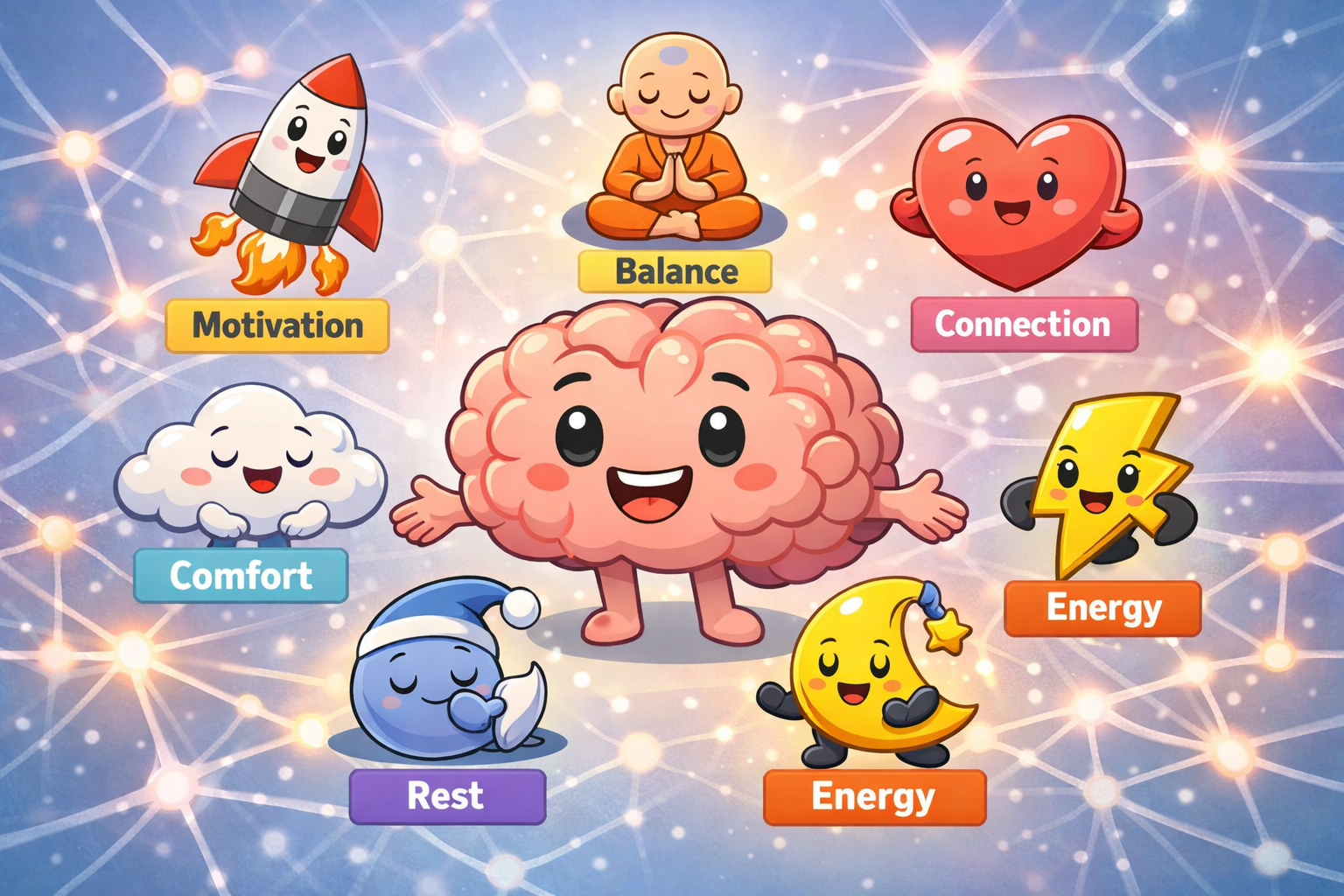
Understanding the Brain’s Natural Chemical System That Shapes Human Behavior, Emotions, and Mental Performance
Introduction: The Invisible System Running Your Life
Every emotion you feel, every moment of motivation, every wave of calm, every surge of energy — is controlled by chemical signals inside your body. These signals are not random. They are part of a biological intelligence system made of hormones and neurotransmitters that regulate:
- Emotional balance
- Motivation
- Mental focus
- Stress response
- Relaxation
- Energy levels
- Mood stability
- Psychological well-being
This internal chemical network silently controls how you think, feel, act, rest, and recover.
Dopamine: The Motivation & Drive Chemical
Primary Functions:
- Motivation
- Goal pursuit
- Focus
- Curiosity
- Learning
- Reward signaling
Scientific Role:
Dopamine activates the brain’s reward and motivation circuits. It doesn’t create pleasure — it creates desire and pursuit.
Effects on the Body & Mind:
- Increased focus
- Higher motivation
- Mental sharpness
- Drive for achievement
- Curiosity and ambition
- Psychological confidence
SEO Insight:
Dopamine is the core neurotransmitter behind productivity, discipline, and ambition.
Endorphins: The Body’s Natural Painkillers
Primary Functions:
- Pain relief
- Stress reduction
- Emotional comfort
- Relaxation
- Euphoria
Scientific Role:
Endorphins act like natural opioids, produced by the brain to regulate stress and discomfort.
Effects:
- Reduced anxiety
- Emotional calm
- Physical relaxation
- Stress buffering
- Mental peace
SEO Insight:
Endorphins are essential for emotional resilience and stress management.
Oxytocin: The Emotional Stability Hormone
Primary Functions:
- Emotional bonding
- Trust
- Calmness
- Safety perception
- Nervous system regulation
Scientific Role:
Oxytocin reduces fear response and activates parasympathetic nervous system balance.
Effects:
- Emotional safety
- Inner calm
- Reduced stress
- Nervous system relaxation
- Psychological security
SEO Insight:
Oxytocin is crucial for emotional health and social bonding.
Prolactin: The Satisfaction & Recovery Hormone
Primary Functions:
- Fulfillment
- Contentment
- Relaxation
- Sleep regulation
- Nervous system slowdown
Scientific Role:
Prolactin signals completion and recovery mode to the brain.
Effects:
- Sleepiness
- Calmness
- Deep relaxation
- Emotional satisfaction
- Nervous system recovery
SEO Insight:
Prolactin supports rest, recovery, and mental reset cycles.
Serotonin: The Emotional Balance Chemical
Primary Functions:
- Mood stability
- Emotional regulation
- Impulse control
- Mental clarity
- Psychological balance
Effects:
- Emotional control
- Calm thinking
- Reduced anxiety
- Stable mood
- Inner peace
SEO Insight:
Serotonin is directly linked to mental health and emotional stability.
Norepinephrine: The Energy & Alertness Neurochemical
Primary Functions:
- Focus
- Alertness
- Awareness
- Energy
- Cognitive speed
Effects:
- Mental sharpness
- Sensory awareness
- Faster reactions
- Increased attention
- Cognitive clarity
SEO Insight:
Norepinephrine drives focus, alertness, and performance states.
The Human Neurochemical Cycle
Activation Phase
Chemicals: Dopamine, Norepinephrine
State: Motivation, focus, energy, drive
Peak Phase
Chemicals: Dopamine, Endorphins, Oxytocin
State: Pleasure, emotional warmth, calm
Relaxation Phase
Chemicals: Endorphins, Oxytocin, Prolactin
State: Deep relaxation, satisfaction, rest
Reset Phase
Chemicals: Serotonin stabilization, dopamine normalization
State: Mental clarity, emotional balance, nervous system reset
The Brain Reward System Explained
The human brain operates on a biochemical reward loop:
Stimulus → Chemical Release → Emotional Response → Memory Formation → Behavioral Reinforcement
This loop forms:
- Habits
- Preferences
- Motivations
- Emotional patterns
- Behavioral conditioning
- Psychological responses
This system evolved for:
- Survival
- Learning
- Adaptation
- Motivation
- Social bonding
- Emotional regulation
Chemical Balance and Mental Health
Balanced neurochemistry leads to:
✔ Mental clarity
✔ Emotional stability
✔ Healthy motivation
✔ Calm nervous system
✔ Stress resilience
✔ Psychological strength
✔ Cognitive performance
Chemical imbalance may lead to:
❌ Emotional instability
❌ Motivation loss
❌ Chronic stress
❌ Burnout
❌ Mental fatigue
❌ Emotional numbness
❌ Reward-system imbalance
The Body as a Chemical Intelligence System
Human biology is not random — it is structured chemical intelligence:
- Thoughts create chemicals
- Actions trigger hormones
- Habits rewire receptors
- Lifestyle shapes neurochemistry
- Environment influences hormones
- Stress alters neurotransmitters
You are living inside a self-regulating biochemical system.
Conclusion: The Chemistry of Being Human
Human experience is not just psychological — it is biochemical.
Your motivation, calm, pleasure, energy, focus, peace, stress, happiness, and satisfaction are not abstract feelings — they are chemical states.
Understanding this system gives you power:
- Power over habits
- Power over focus
- Power over emotional control
- Power over mental health
- Power over motivation
- Power over productivity
- Power over well-being
You are not driven by willpower alone —
You are guided by biology, chemistry, and neural design.
