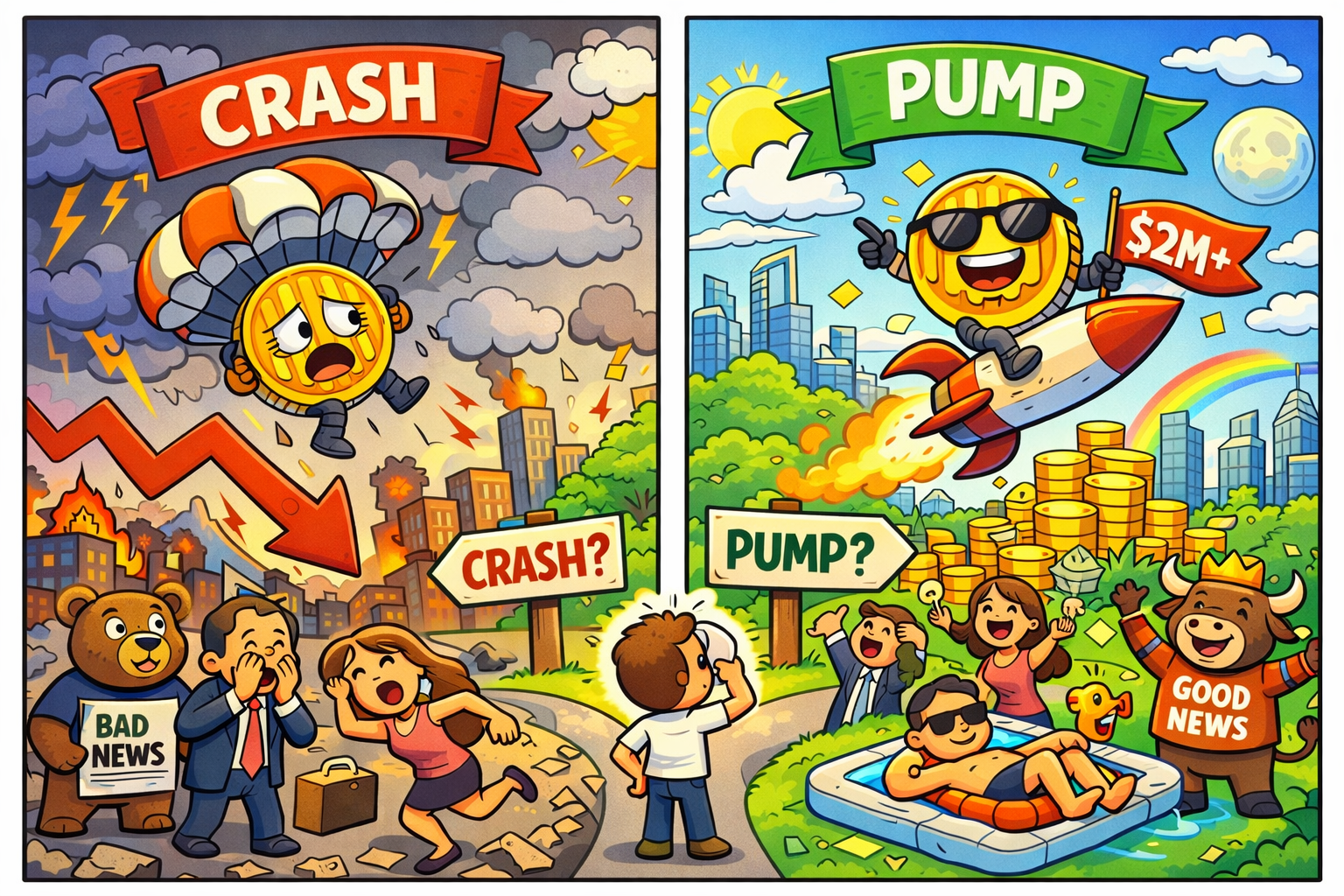
A serious long-term analysis of both futures
Introduction
Bitcoin reaching one million dollars would not simply be a price event.
It would represent a shift in how the world thinks about money, trust, power, and value.
At that point, Bitcoin would no longer be discussed as a speculative asset.
It would be treated as a global financial force.
But the most important question is not whether Bitcoin can reach $1,000,000.
The real question is what happens after that moment.
This article explores two realistic future paths:
- Bitcoin crashes after touching $1,000,000
- Bitcoin continues rising beyond $1,000,000
Both scenarios are examined calmly, without hype or fear, covering economic, institutional, psychological, and social consequences.
Scenario One: Bitcoin Reaches $1,000,000 and Then Crashes
Why a Crash Would Still Be Possible
Even at one million dollars, Bitcoin would remain exposed to human behavior and global events. History shows that markets do not move in straight lines, especially when emotions reach extremes.
A crash could be triggered by mass profit-taking from early holders, sudden global liquidity crises, aggressive regulation, coordinated political pressure, or loss of confidence among newer investors.
At that price level, even a “normal” correction could feel catastrophic. A fall from one million to four hundred thousand dollars would shock the global system, despite being historically common for Bitcoin.
Positive Effects of a Crash After $1,000,000
A major correction could reset excessive greed and speculation. When price euphoria fades, markets often return to fundamentals rather than narratives.
Such a crash could redistribute Bitcoin from early holders to long-term believers who buy during fear. Historically, Bitcoin’s strongest supporters emerge after deep corrections, not during rallies.
Lower hype would also shift attention away from price obsession toward real-world use cases such as settlement, savings, and financial independence. This phase could quietly strengthen the network.
Most importantly, Bitcoin has historically emerged stronger after every major collapse. A crash would not necessarily mean failure — it could mean maturity.
Negative Consequences of a Post-$1M Crash
For investors who entered near the top, psychological damage could be severe. Many would exit permanently, associating Bitcoin with loss and instability.
Governments could use the crash as justification for stricter controls, heavier taxation, or tighter surveillance of digital assets.
At one million dollars, Bitcoin would likely be embedded in ETFs, corporate treasuries, and institutional portfolios. A sharp decline could spill into traditional markets, creating broader financial stress.
The crash might also freeze wealth inequality. Early adopters would remain extremely wealthy, while late participants would carry losses, reinforcing social tension.
Scenario Two: Bitcoin Reaches $1,000,000 and Keeps Rising
Why Continued Growth Is Plausible
If Bitcoin continues rising beyond one million dollars, it would signal something deeper than price momentum. It would suggest that global trust in traditional monetary systems is weakening faster than expected.
Persistent fiat devaluation, sovereign debt expansion, geopolitical instability, and digital scarcity could drive continued demand. In this scenario, Bitcoin is no longer competing with assets — it is competing with monetary credibility itself.
Positive Outcomes of Bitcoin Rising Beyond $1,000,000
Bitcoin would evolve into a neutral global store of value, independent of any single nation. For people living under unstable currencies, it would provide protection against inflation and capital controls.
As market capitalization grows, volatility would likely decrease, making Bitcoin more suitable for institutional and long-term capital.
At this stage, Bitcoin’s network effect could become irreversible. Once deeply integrated into global finance, replacing it would be nearly impossible.
This scenario could redefine wealth preservation for generations.
Risks of Bitcoin Pumping Beyond $1,000,000
One of the most serious risks is extreme wealth concentration. Early holders would possess influence rivaling corporations and governments, raising ethical and political concerns.
Accessibility would also decline. New generations might feel priced out, believing meaningful ownership is no longer possible.
Governments may view Bitcoin as a direct challenge to monetary sovereignty, potentially increasing political tension and regulatory conflict.
Social friction could rise as traditional work and savings lose relevance compared to early digital ownership. This could reshape how societies define effort, reward, and fairness.
The Most Realistic Outcome
History suggests Bitcoin rarely follows a single straight path. The most likely future lies between collapse and endless rise.
Bitcoin may reach one million dollars, experience several deep corrections, and gradually stabilize as a long-term global asset. It would not replace fiat overnight, but it would quietly coexist alongside it.
Not a sudden revolution — but a slow, irreversible shift.
Final Reflection
Whether Bitcoin crashes from one million or rises far beyond it, the deeper truth remains unchanged.
Bitcoin is no longer an experiment.
It is a reflection of global uncertainty, trust erosion, and the search for financial independence.
The price will move.
The consequences will last much longer.
