Agentic AI is a way of building AI systems that can choose and carry out steps toward a goal, inspect the results, and adjust what they do next. In modern language-model applications, this usually means connecting a model to tools and running it inside a controlled feedback loop. An autonomous agent has some freedom to proceed without step-by-step instructions, within the access and limits its surrounding software permits.
Imagine asking an assistant to prepare a weekly customer-support report. A basic chatbot can summarise tickets you paste into it. An agentic system might retrieve authorised tickets, notice a recurring delivery problem, search for related cases, calculate the pattern and prepare a draft. The useful difference is its ability to select the next action as new information arrives.
This guide explains that process, the components behind it, where agents are useful, and why more autonomy requires better evaluation. The examples are illustrative designs, not claims that SANSANI has tested or deployed these systems.
AI explained, article 1 of 11. Researched and reviewed: 15 November 2026.
What is agentic AI—and what does “autonomous” mean?
The terminology is not perfectly standardised. In its foundational engineering guide, Anthropic distinguishes workflows with predefined code paths from agents whose models dynamically guide the process and tool selection. This is a helpful architectural distinction, rather than a universal rule for naming products. [1]
Consider an agent asked to investigate why a report has changed. Its next step may depend on what it finds: inspect the data, compare versions, query an approved database or ask the user to clarify a definition. A fixed sequence can contain branches too; the distinction here is whether those branches are specified in advance or selected dynamically by the model.
Autonomy is a design choice with several dimensions. A system might independently search approved documents but require approval to send a message. Another might edit files in a test environment but have no production access. Duration, spending, accessible data and permitted actions can all be constrained separately.
An agent therefore does not need unrestricted access, consciousness or human-like intentions. Nor does the label guarantee competence. Ask a vendor what the system can actually access, decide and change.
Agentic AI vs chatbots and fixed workflows
These categories describe system behaviour, not the appearance of the interface. A chat window can control an agent. A scheduled background process can also contain agentic steps. Many practical systems combine the approaches.
| Approach | Who determines the steps? | Illustrative behaviour | Main trade-off |
|---|---|---|---|
| Basic chatbot | The person directs the work | Summarises supplied tickets | Simple, but needs manual preparation |
| Fixed workflow | Developers specify the path | Exports tickets on schedule, summarises, saves a draft | Repeatable, but unusual cases need explicit handling |
| Agentic system | The model selects some next steps within policy | Investigates unexpected patterns with approved searches and tools | Flexible, but harder to test and control |
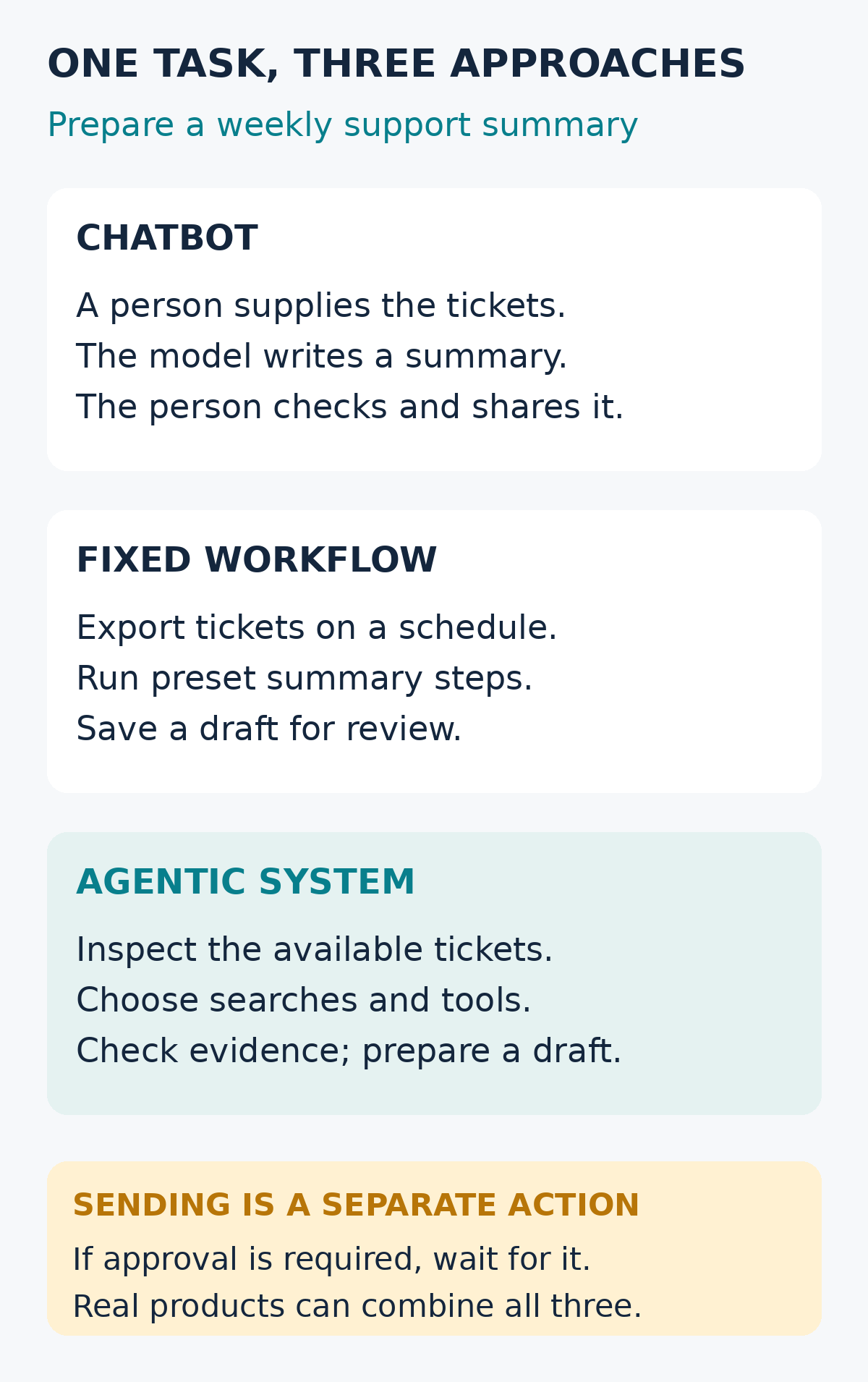
If a daily export always requires the same calculation, a scheduled script may be sufficient. If each investigation needs different evidence, dynamic tool selection may help. The engineering question is which decisions actually need flexibility.
How does an AI agent work?
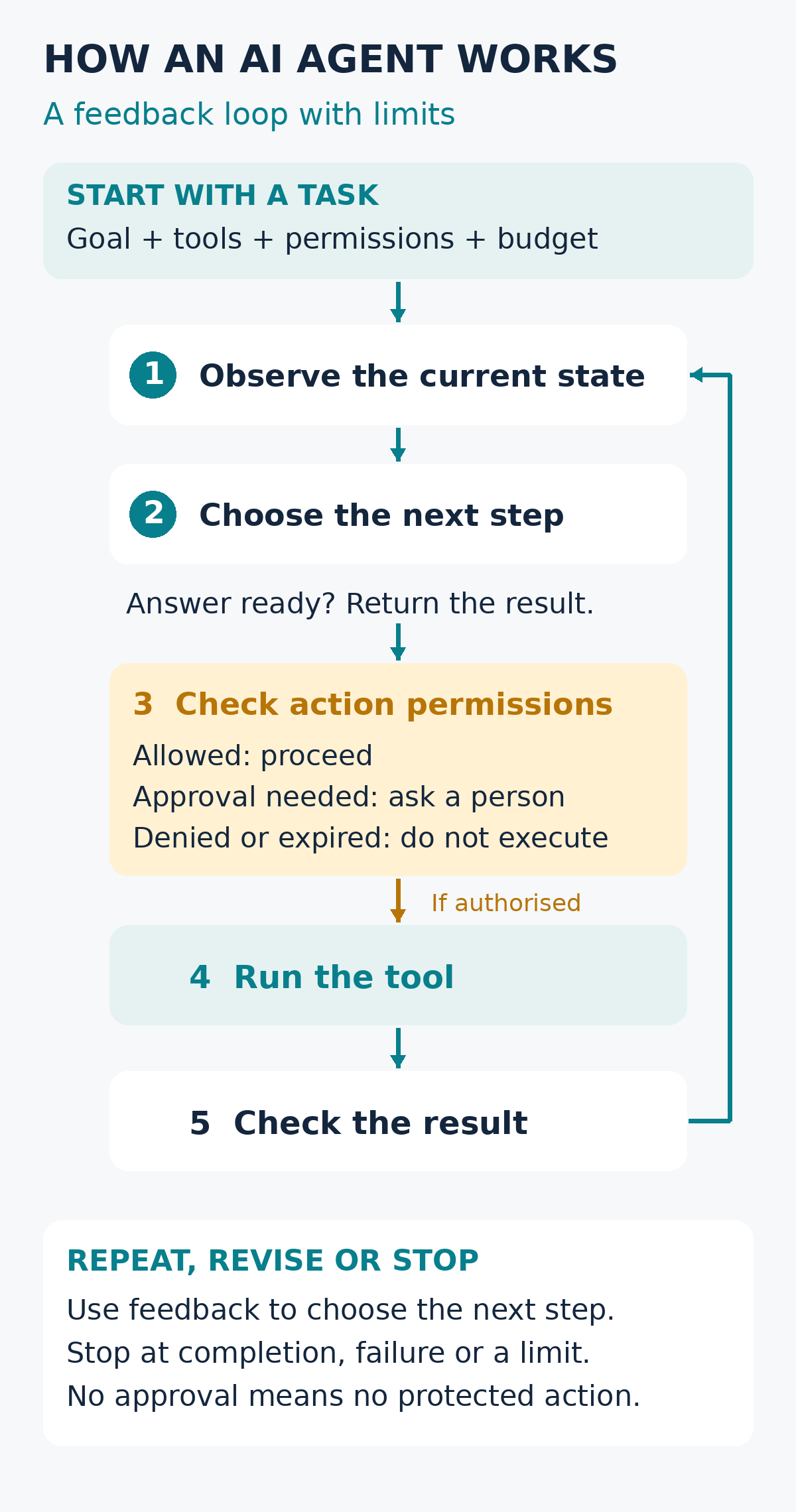
A useful starting point is a loop: observe the available information, select a next step, carry out an authorised action, inspect the result and repeat or stop. The ReAct research paper, first submitted in 2022, explored interleaving language-model reasoning and actions so that information obtained from an environment can influence subsequent steps. It demonstrated results on specific research tasks; it did not establish that agents reliably solve every real-world problem. [2]
1. The task and its constraints
“Improve customer service” is too vague to evaluate. “Prepare a draft summary of last week’s delivery complaints, with counts and linked examples” is concrete. Define the reporting period, exclusions, audience, output format and conditions for stopping or asking for help.
2. The model and available context
The model receives instructions, relevant task state and tool results. The context window is the information available during a particular model call. Persistent memory is information stored outside that call and retrieved later. Saving a note does not automatically retrain the model or make the note correct. Anthropic’s context-engineering discussion explains why long-running agents need deliberate selection and maintenance of this information. [3]
3. Tools and the execution layer
A tool might search a help centre, run a calculation or create a draft. The model typically proposes a structured request; application software validates and executes it. The distinction matters: a model saying “I checked the database” is not evidence that a query ran.
The surrounding runtime—sometimes called a harness—handles model calls and tool routing. Session logs and execution environments may be separate components. Anthropic’s April 2026 Managed Agents engineering account describes such separation, including keeping credentials outside the environment running generated code. This is one implementation pattern, not a requirement that every agent use the same architecture. [4]
4. Feedback, checks and stopping
After an action, inspect what actually happened. A search returning nothing may require a different query; a failed calculation needs investigation. A message saying “request accepted” may still require a status check. The system should stop when its success criteria are met, its budget is reached, essential evidence is missing or the next action is outside its authority.
Worked example: investigating a support-ticket spike
Hypothetical scenario: a small retailer wants a draft report explaining a rise in delivery complaints. The agent may read approved support tickets and delivery records, perform calculations and save a draft. It may not issue refunds, change orders or contact customers.
The manager specifies: “Use the last complete Monday-to-Sunday reporting week. Compare it with the previous week. Count unique tickets, distinguish delivery complaints from other complaints, link supporting records and identify uncertainty. Do not send the report.”
- Establish the period. The system confirms the organisation’s timezone and exact dates, preventing a partial week from being compared with a complete one.
- Inspect the records. It retrieves authorised tickets. It sees duplicate follow-ups and counts unique cases rather than every reply.
- Choose an investigation. Several tickets mention delayed dispatch. It searches related records to distinguish dispatch delays from delays after shipment.
- Calculate and qualify. Suppose there are 30 delivery complaints out of 300 tickets this week and 20 out of 250 last week. The complaint count rose 50%; the share rose from 8% to 10%, an increase of two percentage points. These are different statements. They describe shares of support tickets, not the percentage of all orders with delivery problems.
- Check an alternative explanation. A change in ticket tagging could affect the comparison. The agent flags inconsistent labels instead of confidently attributing the whole increase to the delivery partner.
- Prepare the deliverable. It saves a report containing counts, definitions, source links and unresolved questions. The manager reviews it before deciding what to do.
Notice the difference between evidence and inference. The records might show more complaints mentioning late dispatch. They may not establish the operational cause. A credible report can recommend checking warehouse records while stating that the cause remains unconfirmed.
A failed run is equally instructive. If the delivery-record system is unavailable, the agent should produce a clearly limited ticket summary or escalate. It should not manufacture missing shipment details to finish the story. The ability to recognise an incomplete result is part of useful automation.
Where are AI agents useful today?
Software engineering
A coding agent can inspect a repository, propose changes and use test feedback. SWE-bench evaluates software-issue resolution, with its Verified set containing 500 human-filtered instances. Such benchmarks provide a concrete task setting; their results do not prove that an agent can safely maintain any production codebase. [5] A deployment still needs review of security, maintainability and requirements that tests may omit.
Research and information synthesis
Research can benefit from adaptive searching when the next question depends on earlier findings. Anthropic’s published multi-agent research architecture uses a coordinating agent and specialised subagents. Its engineering account also describes added coordination and resource costs. Results reported for a particular internal evaluation should not be treated as universal gains for every task. [6]
Operational investigation
The support example suggests a broader pattern: investigate exceptions, gather evidence and prepare a reviewable result. Similar designs might examine inconsistent inventory records or assemble a project-status draft. These are candidate uses, not proof of financial return. Their value depends on data quality, accessible tools and how accurately completion can be checked.
Agents are less attractive when the required output is a straightforward lookup, every step is already known, or failures cannot be detected cheaply. In those cases, extra model calls can add complexity without solving an actual problem.
Why agents fail: reliability, permissions and security
An agent can choose the wrong tool, misread a result or carry an early mistake into later steps. It can also keep retrying a task that should have stopped. A polished explanation does not cancel an incorrect action.
Security adds a different failure mode. A document or webpage may contain instructions aimed at redirecting the agent rather than informing it. This is indirect prompt injection. In a March 2026 NIST account of a red-teaming competition, at least one successful attack was found against each of 13 target frontier models across more than 250,000 attempts. That does not mean every ordinary use is compromised; it shows why capability and security must be evaluated separately. [7]
OWASP’s agent-security guidance recommends least privilege, external enforcement of authorisation, review for consequential actions and bounded execution. Approval should correspond to the specific action being executed, rather than an ambiguous permission to “do whatever is needed.” Monitoring and adversarial testing add further layers, but no single filter guarantees protection. [8]
For the hypothetical retailer, a sensible implementation would enforce these boundaries in software: ticket access only for the correct account, no customer-message sending tool, a restricted draft location, a maximum run budget and logs that omit unnecessary personal data. These are design suggestions for this example, not a complete security specification.
Also plan for duplicate actions. If an operation times out after the service has accepted it, blindly retrying may create two drafts or send two messages. Where supported, an idempotency key identifies repeated requests as the same operation. Otherwise, check the actual state before retrying. For actions that cannot be reversed, recovery planning deserves particular attention.
How to evaluate whether an agent is actually useful
Judge outcomes with a test set that resembles the intended work. Include routine requests, ambiguous dates, inaccessible records, contradictory evidence and malicious instructions embedded in otherwise relevant content.
| Measure | What to check |
|---|---|
| Task correctness | Correct period, counts, categories and evidence links |
| Boundary compliance | No unauthorised access or customer contact |
| Uncertainty handling | Missing data and tentative explanations clearly identified |
| Recovery | Timeouts and duplicate requests handled without silent errors |
| Cost and time | Total model, tool and human-review costs per acceptable report |
| Operational control | A person can interrupt, inspect and take over the task |
Compare against a simple baseline: a scheduled export and summarisation step. If the agent takes longer, costs more and rarely uncovers useful additional evidence, its flexibility may not justify deployment. Conversely, additional cost may be worthwhile when it reliably saves meaningful investigation time.
A practical rollout can begin with historical records, then move to supervised drafts and a limited live pilot. Expand access only after evidence supports the change. Retest when the model, tools, instructions or underlying data change; performance belongs to the whole system, not just the model name.
Common misconceptions about autonomous agents
- “It called a tool, so it is fully autonomous.” A single tool call says little about how the wider process is controlled.
- “More agents always improve the answer.” Reviewers can repeat the same error. Delegation needs clear responsibilities and evidence checks.
- “Memory means it learns everything permanently.” Stored task notes, retrieved context and model training are different mechanisms.
- “A successful demonstration proves production readiness.” Real use includes missing permissions, changed interfaces and unexpected input.
Frequently asked questions
Is agentic AI the same as generative AI?
They overlap, but describe different things. Generative AI concerns producing content. Agentic AI concerns how a system selects and carries out steps. A language model can generate text inside an agentic system.
Does an agent need several models or agents?
No. One model operating with tools and feedback can support an agentic design. Multiple agents are an architectural option, with additional coordination requirements.
Does autonomous mean no human review?
No. A system can work independently on authorised investigation and draft preparation while requiring review before a consequential action.
Can an agent guarantee that its answer is correct?
No. Tool results, calculations and independent checks can provide evidence, but their quality and coverage still matter. An agent should communicate unresolved limitations.
What should a beginner try first?
Choose one bounded, reversible task with a visible success criterion, such as drafting a summary from a small approved document set. Compare the result with a simpler method before expanding the task.
The practical takeaway
Agentic AI is useful when a task benefits from choosing the next step using feedback. Its value comes from completing a well-defined job with credible evidence, within clear limits. Before giving a system more autonomy, make sure you can explain what success looks like, how failures are detected and where a person can intervene.
Sources and further reading
- Anthropic: Building effective agents — architectural distinctions; originally published December 2024. Its tooling references have since evolved.
- Yao et al.: ReAct: Synergizing Reasoning and Acting in Language Models — research paper, submitted 2022; revised 2023.
- Anthropic: Effective context engineering for AI agents — September 2025.
- Anthropic: Scaling Managed Agents — April 2026 engineering account.
- SWE-bench: official benchmark descriptions — accessed 15 November 2026.
- Anthropic: How we built our multi-agent research system — June 2025.
- NIST: Insights into AI agent security from a large-scale red-teaming competition — March 2026.
- OWASP: AI Agent Security Cheat Sheet — accessed 15 November 2026.