Exclusive Content:

Power Talks Loud. The Cost Stays Silent.

The Truth No One Wants to Say Out Loud People...

Why Do We Overthink Things That Don’t Really Matter?

You replay a conversation in your head. You wonder if...

If a Fish Comes Out of the Water to Tell You the Crocodile Is Sick, Believe It

There are moments in life that don’t fit the...
Home Blog Page 12

A Letter to the Years I Thought I Was Falling Behind

0

Dear years,

For a long time, I misunderstood you.

I believed you were racing ahead of me.

Every birthday felt like a quiet reminder that I had not arrived where I thought I should be.
Every passing season felt like another step behind the invisible timeline I had built in my mind.

By a certain age, I thought life would look different.

There would be clear achievements.
Clear answers.
Clear proof that I had chosen the right path.

But instead, there was uncertainty.

Plans that did not unfold the way I imagined.
Opportunities that appeared too late or disappeared too early.
Moments when everyone else seemed to be moving forward while I remained in the same place.

At least, that is how it felt.

I compared my life to others without realizing how incomplete those comparisons were.

I saw their successes but not their doubts.
Their progress but not their struggles.
Their milestones but not the quiet sacrifices behind them.

And slowly, without noticing, I began to believe something that was never true.

That I was falling behind.

But time has a strange way of revealing its secrets.

Years later, I started to see those same seasons differently.

The years I thought I was losing were not empty at all.

They were shaping something I could not yet see.

They were teaching patience when I wanted speed.

They were teaching resilience when I expected certainty.

They were teaching me how to walk without the safety of a clear destination.

Those years were not delays.

They were preparation.

Preparation for a version of life that younger me could not yet understand.

Because growth does not always look like progress.

Sometimes it looks like confusion.

Sometimes it looks like standing still.

Sometimes it looks like wandering through questions that have no immediate answers.

But beneath that uncertainty, something quiet is always happening.

Experience is accumulating.

Perspective is forming.

Strength is developing in places we rarely notice.

Now when I look back at those years, I no longer see failure.

I see construction.

Invisible construction.

The kind that builds foundations before anyone can see the house above them.

So to the years I once resented, I owe an apology.

You were never against me.

You were simply working in ways I was too impatient to understand.

And now I realize something that younger me never could.

Life was never a race.

It was always a journey unfolding at its own pace.

And somehow, without realizing it, I was exactly where I needed to be.
A Letter to the Person I Became After That Goodbye

0

Dear stranger,

It took me a long time to recognize you.

At first, I thought you were just a temporary version of myself.
Someone created by circumstance.
Someone shaped by a moment that would eventually fade.

But time kept passing.

And you stayed.

I remember the day everything changed.

It was not loud.

There were no dramatic scenes.
No thunder.
No clear moment where the world announced that life would now be different.

It was simply a goodbye.

A quiet one.

The kind that leaves behind more silence than words.

At the time, I believed the hardest part would be losing someone.

But I later discovered something far stranger.

I had also lost the person I used to be.

Before that goodbye, life felt predictable in a way I never noticed.

There were plans.

Expectations.

Invisible maps of how things were supposed to unfold.

But when that moment arrived, those maps quietly disappeared.

And suddenly I found myself walking through unfamiliar territory.

You were born there.

In the space that goodbye left behind.

At first, I did not like you.

You were quieter than the person I used to be.

More careful with trust.

More thoughtful with words.

You no longer rushed toward people the way I once did.

I mistook that for weakness.

I thought something important inside me had been broken.

But slowly, I began to understand.

You were not broken.

You were rebuilt.

The innocence that once guided me had softened into awareness.

The certainty I once carried had turned into patience.

And the urgency I once felt to hold on to everything had slowly transformed into the ability to let go.

It took years for me to see this clearly.

Because change rarely announces itself.

It grows silently inside the spaces where old versions of ourselves used to live.

Now when I look at you, I no longer see a stranger.

I see someone shaped by experience.

Someone who learned that endings are not only losses.

Sometimes they are quiet beginnings.

Beginnings that arrive disguised as goodbye.

So I write this letter not to question who you are.

But to acknowledge you.

The person who continued walking when the path disappeared.

The person who learned that life can rebuild itself in unexpected ways.

And perhaps the most surprising truth of all…

The person who discovered that even after goodbye, the story does not end.

It simply changes direction.

A Letter to the Memory That Refuses to Fade

0

Dear memory,

I have tried many times to place you gently in the past.

I told myself that time would eventually soften your edges.
That the years would slowly carry you away like footprints disappearing in the sand.

But somehow, you remain.

Not loudly.

Not dramatically.

Just quietly present.

Sometimes you arrive without warning.

In the middle of an ordinary day.
In the sound of a song playing somewhere in the distance.
In the way the light falls across a room at a certain hour.

And suddenly I am there again.

Standing inside a moment that no longer exists.

It is strange how the mind works.

Thousands of days have passed since then.

Entire chapters of life have unfolded.
New people have entered.
Old worries have faded.

Yet you remain untouched by time.

Exactly as you were.

The same feeling.

The same silence.

The same quiet weight in the chest that I never fully learned to explain.

For a long time I tried to understand why some memories refuse to fade.

Why certain moments stay alive while others disappear completely.

I used to think it was because they were painful.

But pain alone does not explain it.

Some memories remain because they held something unfinished.

A word never spoken.

A goodbye never fully accepted.

A feeling that arrived too suddenly to be understood.

And so the mind keeps the moment alive.

Not to punish us.

But perhaps to remind us.

That something meaningful once passed through our lives.

Even if it stayed only briefly.

With time, I stopped trying to erase you.

Instead, I began to see you differently.

Not as a wound.

But as a quiet marker in the story of who I became.

You remind me of a person I once was.

Someone who felt deeply.
Someone who believed moments could last forever.

Maybe that innocence had to fade.

But the memory remained.

And perhaps that is not a burden after all.

Perhaps it is simply proof that life once touched me in a way that mattered.

So I no longer try to silence you.

You may visit when you wish.

You are part of the path that brought me here.

And strangely, I am grateful for that.

Because some memories refuse to fade not because they hurt.

But because they meant something real.

A Letter to the Version of Me Who Learned Silence Too Late

0

Dear younger me,

There was a time when you believed every truth needed to be spoken.

You believed honesty was always the right answer.
That if something hurt, it should be said.
That if something felt wrong, it should be confronted.

You thought silence was weakness.

I remember how certain you were about that.

You walked into conversations like someone carrying a torch, ready to illuminate everything that felt unfair, confusing, or painful.

And sometimes you were right.

But there were moments you did not yet understand.

Moments when words were not bridges, but sparks.

Moments when saying everything only turned small wounds into permanent scars.

You learned this slowly.

Not through advice.
Not through wisdom handed down by someone older.

But through consequences.

There were arguments that lasted longer than they needed to.
Relationships that cracked under the weight of unnecessary explanations.
Truths spoken at the wrong moment, to people who were never ready to hear them.

And each time it happened, something inside you shifted.

Not bitterness.

Something quieter.

Awareness.

You began to notice something strange about the world.

Not everyone wants the truth.
Some people only want comfort.
Some want agreement.
Some want silence.

And for the first time, you started to understand that wisdom is not just knowing what to say.

It is knowing when not to say it.

You discovered that silence is not always surrender.

Sometimes silence is protection.

Sometimes silence is dignity.

Sometimes silence is the only way to keep a storm from entering your life.

This was difficult for you to accept.

Because you had always believed strength meant speaking loudly.

But strength has many forms.

Sometimes it is the courage to walk away from a conversation that no longer deserves your voice.

Sometimes it is the discipline to let someone misunderstand you rather than fight for their approval.

Sometimes it is the quiet decision to keep your peace instead of proving your point.

These lessons did not arrive all at once.

They came through long nights of reflection.

Through conversations replayed endlessly in your mind.

Through the slow realization that not every battle improves your life.

Some only exhaust it.

If I could sit beside you now, I would not tell you to stop speaking your truth.

Your voice matters.

But I would tell you something you learned much later.

Choose your moments carefully.

Not every ear deserves your honesty.

Not every room deserves your energy.

Not every argument deserves your presence.

The world will try to convince you that silence means defeat.

But sometimes silence is the most powerful sentence you will ever speak.

And one day, you will understand this fully.

Not with anger.

Not with regret.

But with a calm that younger you could never have imagined.

A calm that comes from finally realizing that peace is more valuable than being right.

Take your time learning this.

Some lessons cannot be rushed.

They must be lived.

A Letter to the Younger Version of Myself

0

Dear younger me,

I still remember the way you looked at the world.

Your eyes carried a quiet fire.
A belief that life would unfold in a straight line if you worked hard enough, trusted people enough, and stayed kind.

You thought the world rewarded sincerity.

I wish I could sit next to you for a moment and tell you something gently.

Life will not always move the way you imagine.

There will be days when you will question your strength.
There will be nights when silence feels heavier than noise.
There will be moments when the people you trusted most will become strangers.

But listen carefully.

None of this will break you the way you fear.

It will reshape you.

You will learn that not every door closes because you failed.
Sometimes doors close because the room behind them was never meant for you.

You will lose things you thought were permanent.

Friendships.
Dreams.
Versions of yourself.

And at first, it will feel like the ground has disappeared beneath your feet.

But something strange happens when life removes what you thought you needed.

You begin to see yourself more clearly.

You will discover a quiet strength that younger you never believed existed.
A patience that grows slowly through disappointment.
A calm that arrives only after storms.

You will learn that not every victory needs applause.
Some victories are silent.

Like walking away from what once held you hostage.
Like choosing peace instead of proving a point.
Like waking up one morning and realizing you no longer carry yesterday’s weight.

If I could give you one piece of advice, it would be simple.

Do not rush your life.

You will spend years believing you are behind everyone else.

Behind in success.
Behind in money.
Behind in recognition.

But life is not a race with a single finish line.

Everyone is walking through a different landscape.

Some paths are smooth.
Some are steep.
Some are quiet forests where progress feels invisible.

Yours will often be the quiet kind.

And one day, you will understand something that younger you could never see.

The things that felt like delays were actually protection.

The detours were teachers.

And the struggles were carving space inside you for a deeper kind of strength.

So breathe.

You do not need to become someone extraordinary overnight.

You only need to keep moving.

Slowly.
Honestly.
Patiently.

And when the world feels overwhelming, remember this small truth:

You are not lost.

You are simply becoming someone the younger version of you could not yet imagine.

Take care of yourself.

The road ahead is longer than you think.

But it will shape you in ways that make the journey worth it.

And one day, you will look back at this moment and smile softly.

Because despite everything…

you kept going.

Do Humans Truly Have Free Will?

0

The Question Behind Every Decision

Every day, humans make thousands of choices.

We choose what to say, what to eat, where to go, what to believe, and how to respond to the world around us.

But beneath all these choices lies a deeper and unsettling question:

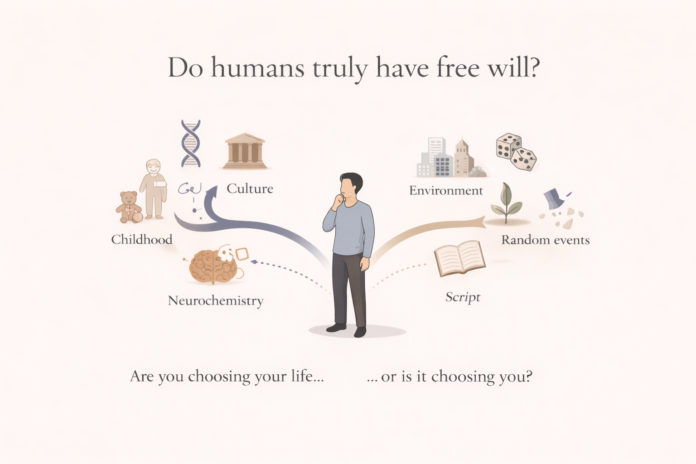
Do humans truly have free will?

Are you genuinely deciding your life…

or are your decisions the result of forces you never chose?

This question has been debated for centuries by philosophers, scientists, and theologians, and even today the answer remains uncertain.


The Possibility That Your Choices Are Not Fully Yours

Many factors shape every decision you make.

Genetics

Your biology influences personality traits such as impulsiveness, patience, risk tolerance, and emotional sensitivity.

Two people facing the same situation may react differently because their brains are wired differently from birth.


Culture

The society you grow up in shapes your beliefs, values, and expectations.

Language, religion, traditions, and social norms influence how you interpret the world long before you are aware of them.

What feels like a personal decision may partly be a cultural pattern.


Childhood Experiences

Early experiences shape how people think and behave.

Family environment, education, trauma, encouragement, and relationships leave deep psychological patterns that influence adult decisions.

Many reactions later in life come from habits formed long before conscious reflection.


Neurochemistry

Your brain operates through complex chemical signals.

Hormones and neurotransmitters influence mood, motivation, and impulse control.

Changes in these systems can dramatically alter behavior, sometimes without a person realizing why.


Environment

Circumstances also affect decisions.

Economic pressure, social relationships, political systems, and access to opportunity shape the options available to individuals.

Often people are not choosing freely between unlimited paths, but navigating within constraints.


Random Events

Unexpected events can redirect entire lives.

A chance meeting, an accident, an opportunity, or a crisis can change a person’s path dramatically.

Life sometimes shifts direction because of factors completely outside human control.


What Science Has Discovered

Modern neuroscience has introduced another layer to the debate.

Experiments suggest that the brain may begin preparing decisions before a person becomes consciously aware of making them.

In some studies, measurable brain activity predicting a decision appears moments before the person reports consciously choosing.

This raises a disturbing possibility:

Your brain may decide first, and your conscious mind may simply observe the decision afterward.

If this is true, the feeling of control might be partly an illusion created by consciousness.


The Two Opposing Views

Because of these discoveries, two major perspectives exist.

Humans Are Determined

Some thinkers argue that every decision results from prior causes.

Genetics, environment, and brain activity combine to produce behavior.

In this view, humans are part of a chain of cause and effect stretching back through time.

Choice feels real, but it may simply be the result of complex processes.


Humans Still Possess Agency

Others argue that even if influences exist, humans still have the ability to reflect and guide their actions.

People can learn, reconsider decisions, develop discipline, and change behavior over time.

Self-awareness may allow individuals to influence the forces shaping them.

In this view, free will may not be absolute, but it still exists within constraints.


The Question That Remains

The debate between freedom and determinism continues without a final answer.

But the question itself reveals something important.

Humans experience life as if their choices matter.

They regret mistakes, celebrate achievements, and hold themselves accountable for actions.

Even if many forces influence behavior, people still experience themselves as participants in their own story.


The Deeper Reflection

So the question remains:

Are we the authors of our lives…

or simply characters following a script written by biology, environment, and chance?

Perhaps the truth lies somewhere in between.

Humans may not control everything that shapes them.

But they may still have the power to decide how they respond to what shapes them.

And that small space between influence and response may be where human freedom lives.


What Happens After Death?

0

The Question That Every Human Eventually Faces

Among all the questions humans ask, one stands above the rest in mystery and gravity:

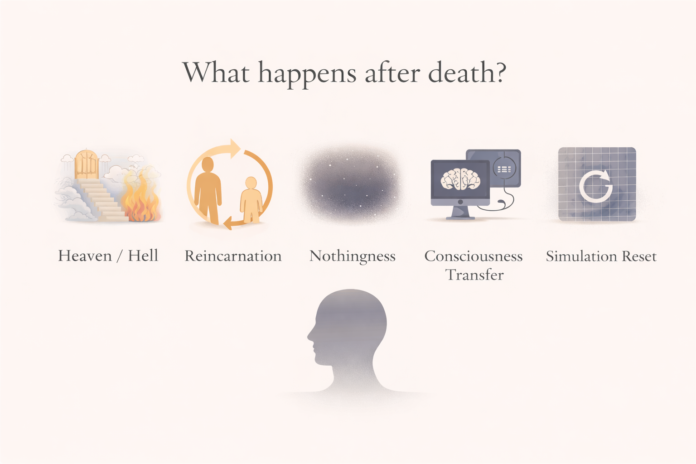
What happens after death?

Every civilization that has ever existed has tried to answer it. Ancient cultures, modern religions, philosophers, scientists, and storytellers have all proposed explanations.

Yet despite thousands of years of thought and belief, no human has ever returned with verifiable proof of what lies beyond death.

This uncertainty is what makes the question so powerful.


The Theories Humans Built to Understand Death

Across history, several major ideas emerged about what may happen when life ends.

Heaven and Hell

Many religious traditions teach that life continues after death in a spiritual realm.

According to these beliefs, human actions during life influence what happens next.

Some traditions describe:

  • Heaven as a place of peace, reward, and closeness to the divine
  • Hell as a place of consequence for wrongdoing

These ideas provide a moral framework where actions in life carry eternal significance.

For billions of people, this belief gives structure to both hope and responsibility.


Reincarnation

Other traditions suggest that death is not an ending but a transition.

In the concept of reincarnation, the soul or consciousness continues by entering another life.

The new life may depend on previous actions, sometimes explained through karma.

Under this perspective, life is part of a long cycle of existence, where learning and growth continue across multiple lifetimes.

This idea shifts the meaning of death from a final boundary to a doorway between experiences.


Eternal Nothingness

Some philosophical and scientific perspectives propose a simpler explanation.

When the brain stops functioning, consciousness ends.

Just as a flame disappears when the fuel is gone, awareness simply stops existing.

This view suggests that death may resemble the state before birth: complete absence of experience.

For some people this idea feels unsettling, while for others it removes fear by framing death as a natural conclusion.


Consciousness Transfer

Modern technological thinking has introduced new possibilities.

Some futurists speculate that consciousness could eventually be preserved or transferred through advanced technology.

Ideas include:

  • digital consciousness
  • brain simulation
  • memory replication

These concepts remain theoretical, but they raise questions about whether identity could continue in artificial environments.


Simulation Reset

Another modern philosophical idea suggests reality itself could be a simulation.

In such a scenario, death might represent a kind of system reset or exit from the simulation.

This idea appears in science fiction and philosophical thought experiments, exploring the nature of reality itself.

While intriguing, it currently remains speculation without evidence.


Why This Question Shapes Human Behavior

Regardless of which theory someone believes, the uncertainty surrounding death influences human life in powerful ways.

The possibility of life after death shapes:

  • religious belief
  • ethical systems
  • cultural rituals
  • personal fear and hope

People build moral frameworks partly because they believe life may continue beyond death.

Others seek meaning in the present precisely because they believe life may be finite.

Either way, the mystery of death pushes humans to reflect on how they live.


The One Fact Everyone Shares

Despite all theories, one fact remains universal.

No living person possesses verified knowledge of what happens after death.

This uncertainty creates both fear and curiosity.

It is one of the reasons humans write stories, create religions, explore philosophy, and study consciousness.


The Deeper Question Hidden Inside

While people ask what happens after death, a quieter question often sits beneath it:

How should we live knowing that life will end?

Because whether death leads to another existence or complete silence, the time before it remains the only part we can experience with certainty.

And how we use that time becomes the story of our life.


Why Do Good People Suffer While Bad People Prosper?

0

The Moral Paradox That Has Haunted Humanity

Few questions disturb the human mind more than this one:

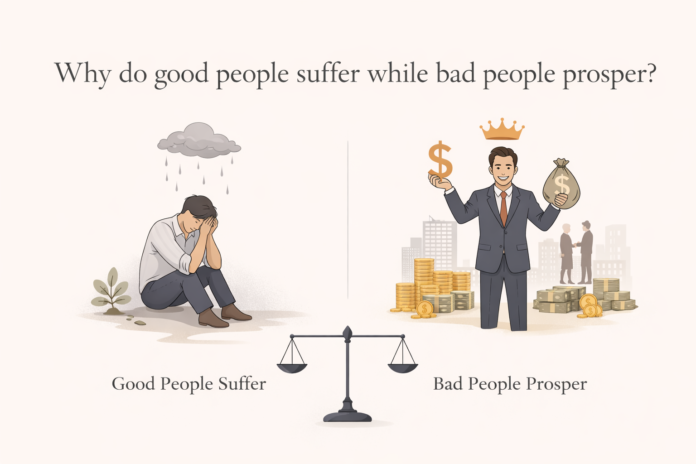
Why do good people suffer while bad people prosper?

From ancient scriptures to modern philosophy, humans have wrestled with this contradiction. We are raised with the idea that goodness should lead to reward and wrongdoing should lead to punishment.

But reality often tells a different story.

We see honest people struggle for decades while dishonest individuals rise quickly to power. We see kind-hearted individuals betrayed while manipulative personalities dominate social, political, or corporate hierarchies.

The world does not always appear to reward virtue.

And that deeply unsettles our sense of justice.


The Pattern Humans Keep Noticing

Across societies and time periods, people observe similar patterns.

An employee who works with integrity may remain unnoticed, while someone who manipulates relationships climbs the ladder faster.

A compassionate person may sacrifice for others yet face hardship, while individuals who exploit systems accumulate wealth and influence.

History itself contains many examples where ruthless strategies created empires, while principled leaders were removed or forgotten.

These observations force us to confront an uncomfortable reality:

The world does not always operate on moral fairness.


The Explanations Humans Have Proposed

To cope with this paradox, different traditions have proposed explanations.

Karma: Justice Exists Beyond What We See

Many spiritual traditions suggest that justice operates on a scale larger than one lifetime.

According to the idea of karma, actions eventually return to the person who created them, even if the consequences are delayed or invisible.

In this view, the apparent imbalance we see today may simply be an incomplete chapter of a longer story.

However, this explanation relies on belief rather than observable proof.


Randomness: The World Is Not Morally Organized

Another explanation suggests that events in life are not controlled by moral logic at all.

Accidents happen.

Luck influences outcomes.

Circumstances favor some individuals while disadvantaging others.

In this perspective, suffering and success are often the result of complex systems rather than moral worth.

This explanation removes the expectation of fairness, but it also removes comforting certainty.


Hidden Justice: Consequences Appear Later

Some thinkers believe that wrongdoing carries hidden costs.

A manipulative individual may gain wealth or power but lose trust, loyalty, and genuine relationships.

Someone who harms others may accumulate internal consequences such as anxiety, fear of exposure, or unstable alliances.

Meanwhile, people who act with integrity may quietly build trust, reputation, and long-term resilience.

Justice may exist, but it may unfold slowly and indirectly.


The Survival Advantage of Aggression

Another uncomfortable possibility is rooted in evolutionary thinking.

Throughout history, individuals willing to break rules or dominate others sometimes gained short-term advantages in competition for power and resources.

Aggressive strategies can produce rapid gains.

But these strategies also create unstable systems, which often collapse over time.

Many empires built through exploitation eventually fell under the weight of their own methods.


The Truth Most People Avoid

Perhaps the most difficult realization is this:

Goodness and success are not automatically connected.

Being ethical does not guarantee wealth.

Being kind does not guarantee protection from suffering.

And being ruthless does not guarantee permanent victory.

Reality is more complicated than moral stories suggest.


What This Means for How We Live

Once people realize that fairness is not guaranteed, they face a personal decision.

Some choose to abandon their principles, believing that success requires manipulation.

Others decide that integrity matters even if it does not guarantee immediate reward.

In this sense, the paradox becomes a test of character.

Not because the world guarantees fairness.

But because individuals must decide what kind of person they want to become within an imperfect world.


The Quiet Question Beneath the Paradox

When people witness injustice, they often ask:

Why does this happen?

But a deeper question slowly emerges:

Will you remain good even when goodness is not rewarded?

That question does not have a universal answer.

But every human life eventually responds to it.


What Makes Life Meaningful?

0

The Question Every Human Quietly Carries

At some point in life, every person confronts a deep and unsettling question:

What actually makes life meaningful?

We chase goals, build careers, form relationships, accumulate experiences, and pursue success. Yet many people eventually pause and wonder whether the things they are chasing truly matter.

History shows that humans have never stopped asking this question. But the answers have never been universal.

Because meaning, unlike mathematics or physics, does not behave like a fixed law.

It behaves like something far more fragile.


The Three Competing Answers Humans Keep Returning To

Throughout history, thinkers have offered three major explanations for where meaning comes from.

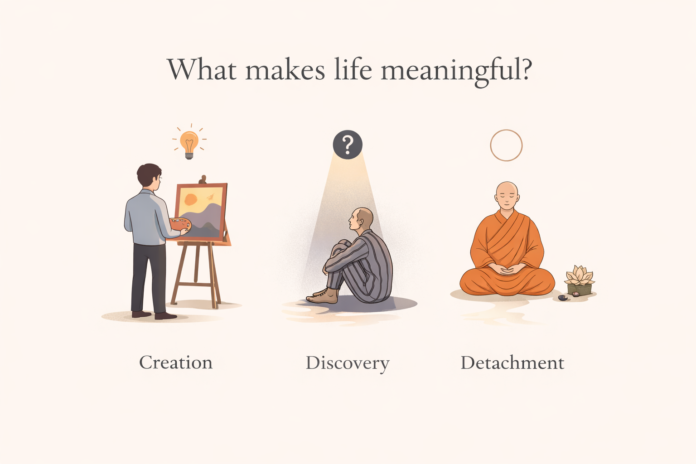
Meaning Is Created

Some philosophers argue that meaning does not exist until humans invent it.

Friedrich Nietzsche believed that people must create their own purpose rather than waiting for the world to provide one.

Under this view, meaning is something you build through your actions, values, and goals.

An artist finds meaning through creation.
An entrepreneur finds meaning through building something.
A parent finds meaning through raising a child.

Meaning here is constructed through personal choice.

But this idea also carries a risk.

If meaning is created, it can also collapse.


Meaning Is Discovered

Others believe meaning already exists and humans must discover it.

Psychiatrist Viktor Frankl, who survived Nazi concentration camps, argued that meaning can be found even in extreme suffering.

He observed that people who survived often held onto a sense of purpose beyond themselves.

For Frankl, meaning is discovered through:

  • responsibility
  • love
  • sacrifice
  • endurance

Under this view, meaning is not invented but revealed through experience.

Yet not everyone agrees that life contains a hidden purpose waiting to be found.


Meaning Is an Illusion

Some philosophical traditions challenge the entire idea of meaning.

Certain interpretations of Buddhism suggest that attachment to meaning itself may create suffering.

The more humans cling to purpose, identity, and achievement, the more they become trapped by expectations.

Instead of chasing meaning, these traditions encourage detachment and awareness.

Life is experienced rather than defined.

This perspective suggests meaning may not be something to obtain at all.


The Uncomfortable Reality

One of the most confusing aspects of meaning is how easily it changes.

A career that once felt exciting can become exhausting.

A goal that once felt important can suddenly feel irrelevant.

A lifestyle that once brought pride may later feel empty.

Meaning shifts with age, experience, and perspective.

This instability is why people who achieve everything sometimes feel lost.

Because meaning is not permanent.


The Hidden Trap Most People Miss

Many people assume that meaning is something they will reach someday.

Once I achieve this goal…
Once I earn this amount…
Once I reach this position…

Then life will feel meaningful.

But meaning rarely works like a destination.

It behaves more like a temporary alignment between your values, actions, and environment.

When those elements drift apart, meaning fades.


A Practical Way to Think About Meaning

Instead of treating meaning as a final answer, it may be more useful to treat it as a direction.

Meaning often appears when three things overlap:

Contribution — doing something that affects others
Growth — becoming better or wiser over time
Connection — forming relationships that matter

When these three elements align, life often feels meaningful.

When they disappear, life can feel empty even if success remains.


The Question That Remains

Meaning may never have a permanent answer.

But the search for it shapes human civilization.

People build families, write books, invent technology, and explore the world because they believe life should matter in some way.

So the deeper question may not be:

What is the meaning of life?

It may be something more personal.

What kind of life would feel meaningful to you right now?

Because the answer to that question may change many times during a lifetime.

What Is the Right Way to Live a Life?

0

The Question That Has No Final Answer

Every human being eventually confronts the same quiet question:

What is the right way to live a life?

It seems like a simple question, yet it is one that humanity has debated for thousands of years. Philosophers wrote books about it. Religions built entire civilizations around it. Economies shaped their systems around different answers.

Yet despite centuries of thought, no universal formula has ever been found.

Because the truth is uncomfortable:

Life does not come with a single correct blueprint.


The Different Paths Humans Have Chosen

Across cultures and eras, societies have proposed their own answers.

Religion: Live Through Obedience

Many religious traditions teach that the right life is one lived through obedience to divine guidance.

In this view, meaning and correctness come from aligning your actions with sacred teachings.

The goal is not personal invention, but faithful alignment with a higher authority.

For millions of people, this provides clarity and structure.

But not everyone follows the same faith.


Philosophy: Live Through Virtue

Philosophers like Aristotle, Socrates, and Confucius proposed another path.

According to them, the right life is built on virtue, wisdom, and character.

A good life means becoming:

  • just
  • disciplined
  • thoughtful
  • courageous

Here, the focus is not wealth or belief but the quality of one’s character.

Yet even philosophers disagree on which virtues matter most.


Capitalism: Live Through Achievement

Modern society often suggests a different answer.

Success.

In this worldview, the right life is measured through:

  • financial growth
  • status
  • productivity
  • influence

The idea is simple: build something, create value, accumulate progress.

But many who achieve everything later ask a troubling question:

Was this all there was?


Minimalism: Live Through Simplicity

Another movement rejects complexity entirely.

Minimalists argue the right life is one that removes excess.

Less noise.
Less consumption.
Less distraction.

Instead, the focus shifts to clarity, time, and intentional living.

But simplicity for one person may feel like limitation for another.


Stoicism: Live Through Inner Control

Stoic thinkers offered a powerful principle:

Focus only on what you can control.

According to Stoicism, the right life means mastering your reactions rather than trying to control the world.

Wealth may disappear.
People may betray you.
Circumstances may collapse.

But if your mind remains stable, you remain free.

Still, not everyone wants emotional detachment as their guiding rule.


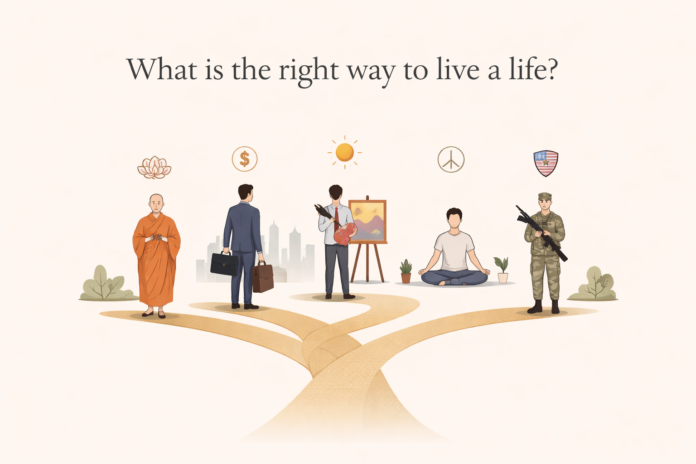
The Hidden Truth

The monk in a monastery.

The billionaire building companies.

The artist creating beauty.

The soldier protecting a nation.

Each may believe they lived the correct life.

And perhaps they all did.

Because the unsettling reality is this:

There is no universal formula for a right life.

Human lives are too complex, too varied, and too shaped by circumstance.


The Real Responsibility

Since there is no final answer handed down to everyone, something surprising happens.

The responsibility returns to the individual.

Every person must slowly discover their own balance between:

  • purpose
  • values
  • relationships
  • ambition
  • peace

And the answer may even change over time.

What felt meaningful at twenty may feel empty at forty.

What seemed unimportant earlier may become everything later.


The Question That Never Ends

The right way to live is not something you solve once.

It is something you keep adjusting as life unfolds.

And perhaps that is the real design of the question.

Not to give humanity a final answer…

But to make every human consciously participate in shaping their own life.