Exclusive Content:

Why Do People Stay in Jobs They Hate for Years?

Every morning, millions of people wake up with the...

Power Talks Loud. The Cost Stays Silent.

The Truth No One Wants to Say Out Loud People...

Why Do We Overthink Things That Don’t Really Matter?

You replay a conversation in your head. You wonder if...
Home Blog Page 13

What Is the Right Way to Live a Life?

0

The Question That Has No Final Answer

Every human being eventually confronts the same quiet question:

What is the right way to live a life?

It seems like a simple question, yet it is one that humanity has debated for thousands of years. Philosophers wrote books about it. Religions built entire civilizations around it. Economies shaped their systems around different answers.

Yet despite centuries of thought, no universal formula has ever been found.

Because the truth is uncomfortable:

Life does not come with a single correct blueprint.


The Different Paths Humans Have Chosen

Across cultures and eras, societies have proposed their own answers.

Religion: Live Through Obedience

Many religious traditions teach that the right life is one lived through obedience to divine guidance.

In this view, meaning and correctness come from aligning your actions with sacred teachings.

The goal is not personal invention, but faithful alignment with a higher authority.

For millions of people, this provides clarity and structure.

But not everyone follows the same faith.


Philosophy: Live Through Virtue

Philosophers like Aristotle, Socrates, and Confucius proposed another path.

According to them, the right life is built on virtue, wisdom, and character.

A good life means becoming:

  • just
  • disciplined
  • thoughtful
  • courageous

Here, the focus is not wealth or belief but the quality of one’s character.

Yet even philosophers disagree on which virtues matter most.


Capitalism: Live Through Achievement

Modern society often suggests a different answer.

Success.

In this worldview, the right life is measured through:

  • financial growth
  • status
  • productivity
  • influence

The idea is simple: build something, create value, accumulate progress.

But many who achieve everything later ask a troubling question:

Was this all there was?


Minimalism: Live Through Simplicity

Another movement rejects complexity entirely.

Minimalists argue the right life is one that removes excess.

Less noise.
Less consumption.
Less distraction.

Instead, the focus shifts to clarity, time, and intentional living.

But simplicity for one person may feel like limitation for another.


Stoicism: Live Through Inner Control

Stoic thinkers offered a powerful principle:

Focus only on what you can control.

According to Stoicism, the right life means mastering your reactions rather than trying to control the world.

Wealth may disappear.
People may betray you.
Circumstances may collapse.

But if your mind remains stable, you remain free.

Still, not everyone wants emotional detachment as their guiding rule.


The Hidden Truth

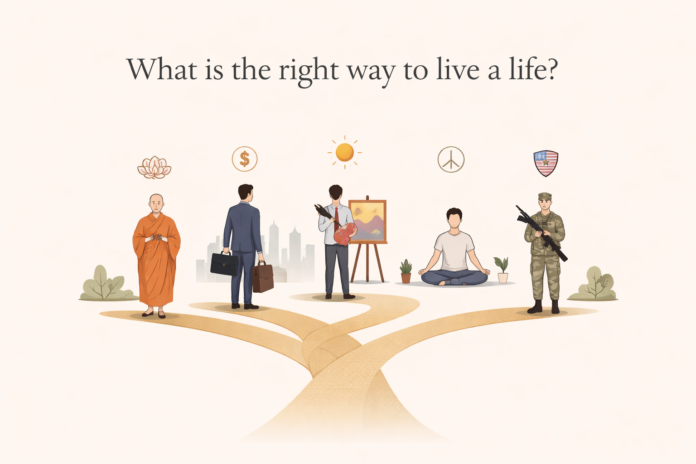
The monk in a monastery.

The billionaire building companies.

The artist creating beauty.

The soldier protecting a nation.

Each may believe they lived the correct life.

And perhaps they all did.

Because the unsettling reality is this:

There is no universal formula for a right life.

Human lives are too complex, too varied, and too shaped by circumstance.


The Real Responsibility

Since there is no final answer handed down to everyone, something surprising happens.

The responsibility returns to the individual.

Every person must slowly discover their own balance between:

  • purpose
  • values
  • relationships
  • ambition
  • peace

And the answer may even change over time.

What felt meaningful at twenty may feel empty at forty.

What seemed unimportant earlier may become everything later.


The Question That Never Ends

The right way to live is not something you solve once.

It is something you keep adjusting as life unfolds.

And perhaps that is the real design of the question.

Not to give humanity a final answer…

But to make every human consciously participate in shaping their own life.


Designing Your Personal Risk Detection System Before You Start

0

Most entrepreneurs think about risk after something goes wrong.

Smart founders design a risk detection system before they even begin.

Because risk rarely appears as a dramatic collapse.

It appears as small signals.

Subtle shifts.
Tiny cracks.
Quiet warnings.

If you notice them early, you adjust.

If you ignore them, they compound.


Why Risk Detection Matters More Than Risk Avoidance

Entrepreneurship is built on risk.

You cannot remove it.

But you can detect it early.

Risk detection allows you to:

  • Pivot before damage grows
  • Protect cash flow
  • Avoid emotional decisions
  • Maintain stability under uncertainty

The goal is not to eliminate risk.

The goal is to see it before it becomes irreversible.


The Most Dangerous Risks Are Slow Ones

The biggest threats are rarely sudden.

They grow quietly:

  • Declining leads
  • Rising expenses
  • Energy burnout
  • Client dissatisfaction
  • Market shifts
  • Strategic drift

Each one begins small.

Ignored signals become crises.


The Founder’s Blind Spot

When you are building something, you are emotionally attached.

Attachment creates blindness.

You may ignore:

  • Negative feedback
  • Warning numbers
  • Stress signals
  • Market resistance

A system prevents emotional blindness.

It forces objective observation.


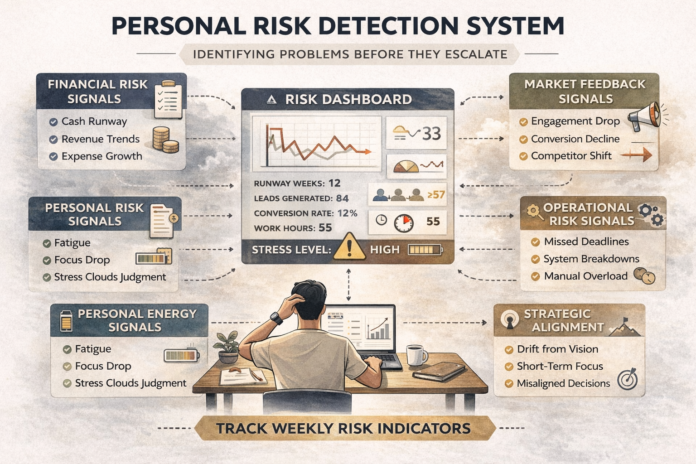
The 5-Layer Personal Risk Detection System

This framework monitors the most critical areas of your entrepreneurial life.


1. Financial Risk Signals

Track weekly:

  • Cash runway remaining
  • Revenue consistency
  • Expense growth
  • Profit margin trends

Warning sign:

Expenses rising faster than revenue.

If ignored, cash flow collapse follows.


2. Market Feedback Signals

Watch for:

  • Declining engagement
  • Reduced conversions
  • Increasing objections
  • Competitor shifts

Warning sign:

Interest exists but purchases decline.

This indicates positioning problems.


3. Operational Risk Signals

Observe:

  • Missed deadlines
  • System breakdowns
  • Overload of manual tasks
  • Customer service delays

Warning sign:

The business becomes dependent on your constant attention.

This limits scalability.


4. Personal Energy Risk Signals

Monitor:

  • Sleep quality
  • Focus levels
  • Emotional stability
  • Motivation

Warning sign:

Persistent fatigue combined with declining productivity.

Burnout often destroys businesses silently.


5. Strategic Alignment Signals

Ask weekly:

  • Does this still align with the long-term model?
  • Are we drifting from the core idea?
  • Are decisions reactive or strategic?

Warning sign:

Short-term opportunities dominating long-term vision.

Strategic drift kills clarity.


Creating Your Personal Risk Dashboard

Choose 5–8 indicators that reflect your real situation.

Example:

  • Monthly runway
  • Leads generated weekly
  • Conversion rate
  • Work hours per week
  • Stress level rating
  • Customer satisfaction signals

Review them weekly.

Numbers reveal truth before emotions do.


The Early Warning Rule

If two indicators decline for three consecutive weeks, investigate immediately.

This rule prevents small problems from growing quietly.

Patterns matter more than single events.


The Advantage of Risk Awareness

When you monitor risk:

  • You pivot earlier
  • You preserve capital
  • You reduce emotional panic
  • You protect long-term growth

You move from reactive to strategic.


The Founder’s Discipline

Most founders build:

  • marketing systems
  • product systems
  • revenue systems

But ignore risk monitoring systems.

That is why many collapse suddenly.

Not because the business was impossible.

Because the signals were ignored.


Final Thought

Entrepreneurship rewards awareness.

The founder who sees problems early survives longer than the founder who reacts late.

Your personal risk detection system is not pessimism.

It is professional awareness.

Build it before the storm.

And when uncertainty arrives — you will already be watching the horizon.

The Quiet Training We Do Without Realizing

0

Most people believe forgiveness is the highest form of strength.

And in many situations, it is.

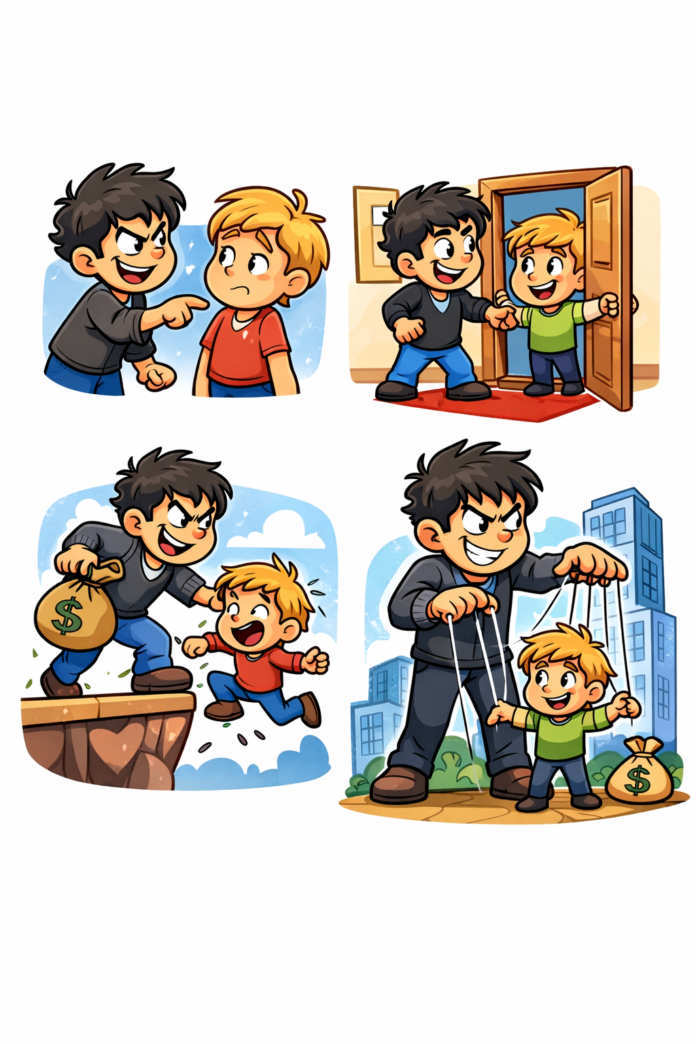
But there is a dangerous misunderstanding hidden inside the idea of forgiveness. When someone harms you—betrays your trust, disrespects you, manipulates you, or crosses a boundary—and you respond by giving them the same level of access to your life, your time, your trust, or your resources, you are not teaching them compassion.

You are teaching them permission.

Human behavior follows a simple rule: what gets rewarded gets repeated.

If a person hurts you and still receives your attention, your trust, your opportunities, or your presence in their life, their brain quietly records a lesson:

“This behavior works.”

And the next time, the harm will rarely be the same size.

It will usually be larger.


The Psychology Behind Repeated Harm

People rarely escalate harm randomly. They escalate based on feedback.

When a harmful action produces no consequence, three psychological signals are sent:

  1. The boundary is weak.
    The person learns there is little resistance to crossing it.
  2. The cost is low.
    If the relationship, trust, or opportunity remains intact, the behavior carries minimal risk.
  3. The reward remains.
    Access to you continues.

Over time, the brain treats this pattern like a successful strategy.

And strategies that succeed get repeated—often with more confidence.


The Hidden Root Cause Most People Miss

Many people believe kindness requires tolerance.

But tolerance without boundaries is not kindness.

It is training.

In psychology, this is similar to behavioral reinforcement. When negative behavior is not corrected or restricted, it becomes normalized.

The person harming you may not even consciously realize they are doing it.

But the pattern grows.

First disrespect.
Then manipulation.
Then exploitation.

And each step feels easier than the last.


The Access Principle

The real currency in human relationships is not money or words.

It is access.

Access means:

  • Your time
  • Your attention
  • Your trust
  • Your emotional energy
  • Your opportunities
  • Your network
  • Your presence in their life

When someone harms you and still receives full access, the message becomes clear:

“The door is still open.”

And open doors invite repeat entry.


The Boundary Restoration Framework

Protecting yourself does not require revenge, anger, or hostility.

It requires structure.

Here is a practical framework for responding to harm in a healthy way.

1. Recognize the Harm Clearly

Do not minimize the action.

Ask yourself honestly:

  • Was a boundary crossed?
  • Was trust broken?
  • Was there manipulation or disrespect?

Clarity is the first protection.

2. Separate Forgiveness from Access

Forgiveness is an internal decision.

Access is an external privilege.

You may forgive someone emotionally while still reducing their proximity to your life.

These are not the same thing.

3. Adjust the Level of Access

Not every harm requires complete removal.

But access should reflect behavior.

Possible adjustments include:

  • Less emotional disclosure
  • Reduced collaboration
  • Limited time together
  • Clear communication boundaries

This teaches accountability without hostility.

4. Observe Future Behavior

Real change shows itself through consistent action over time.

Watch carefully.

People who truly respect you will adapt.

Those who were benefiting from your tolerance will often resist.

That resistance reveals the truth.

5. Protect the Door

Once a boundary is placed, protect it.

Repeated boundary breaking should lead to stronger limits.

This is not cruelty.

It is self-respect.


The Opposite Truth Most People Avoid

Many people fear that setting boundaries will make them appear harsh or unforgiving.

But the opposite is often true.

Clear boundaries attract healthier relationships.

People who value respect feel safer around individuals who protect their standards.

And those who exploit others often disappear once access is restricted.

Boundaries do not destroy relationships.

They filter them.


The Larger Life Lesson

Every relationship is a training system.

People learn how to treat you based on what your behavior allows.

If harm receives unlimited access, the pattern grows.

If harm receives consequence and reduced access, respect grows instead.

You are always teaching others how to treat you.

The question is simply:

What lesson are they learning?


If You Forgive the Wolf for Stealing Your Chicken, He Will Return for Your Sheep

0

Some lessons arrive softly.
This one arrives with teeth.

Because forgiveness is not the same as removing consequences. And when you confuse the two, you don’t become “kind.” You become available.

A wolf doesn’t learn morality from your mercy.
He learns your boundary is negotiable.


The real meaning behind the quote

This line isn’t telling you to live bitter, paranoid, or revengeful.

It’s warning you about a specific human mistake:

When someone harms you and you reward it with access, you train them to repeat it—at a larger scale.

Not everyone is a wolf.
But wolves exist. And they don’t need your hate.

They only need your permission.


Why people forgive too early (and pay later)

Most people forgive the “chicken” because the loss feels small.

  • “It wasn’t that serious.”
  • “Maybe it was an accident.”
  • “I don’t want conflict.”
  • “I want peace.”
  • “I want to be the bigger person.”

The problem is: peace without boundaries isn’t peace. It’s delayed damage.

Forgiveness is an inner act.
Boundaries are an outer policy.

When you skip the policy, you don’t heal the relationship. You subsidize the behavior.


The hidden root cause most people miss

People think the risk is one bad action.

But the real risk is this:

A person’s character reveals itself in what they do when they think they can get away with it.

The first theft isn’t the whole story.

The real story is:

  • Did they feel shame?
  • Did they take responsibility without excuses?
  • Did they repair the damage without being forced?
  • Did they accept reduced access without manipulation?

If not—then you didn’t forgive a mistake.

You forgave a pattern.


The Boundary Mercy Framework

Here’s how to be compassionate without becoming prey.

Step 1: Separate the human from the behavior

You can forgive someone emotionally while still treating their behavior as unacceptable.

Forgiveness = your heart.
Consequences = your standards.

Step 2: Require accountability before closeness

Words don’t rebuild trust.
Actions do.

Look for:

  • clear ownership (“I did it”)
  • no blame-shifting
  • repayment/repair
  • changed behavior over time

Step 3: Reduce access while trust rebuilds

Access is the currency of relationships.

If someone breaks trust, they don’t get the same privileges again immediately.

  • less information
  • less influence
  • less proximity
  • less dependency

Step 4: Watch for manipulation disguised as softness

Wolves often wear polite language:

  • “Why are you still stuck on this?”
  • “You’re not forgiving.”
  • “You’re being negative.”
  • “Let’s move on.”

Translation:
“I want the benefit of your trust without the cost of rebuilding it.”

Step 5: Decide your “sheep line”

Before it happens again, define:

What is the next thing I will not tolerate?
And what will I do when it happens?

If you can’t answer that, you’re vulnerable by default.


Mistakes and traps to avoid

  • Forgiving to end discomfort (temporary peace, permanent loss)
  • Explaining your boundaries too much (wolves study your reasoning)
  • Accepting “sorry” as proof (sorry is cheap; change is expensive)
  • Confusing empathy with trust (you can understand someone and still restrict them)
  • Waiting for certainty (you don’t need certainty to set a boundary)

Opposite-truth ego check

What would have to be true for the opposite to be correct?

It would have to be true that:

  • the person genuinely made a one-time mistake,
  • they quickly accepted responsibility,
  • they repaired the harm without being chased,
  • and they consistently changed behavior over time.

If those signs are real, then restoring trust slowly can be wise.

But if those signs are missing, “forgiveness” becomes a cover story for avoidance.


The calm conclusion

You don’t need revenge.
You don’t need cruelty.

You just need clarity.

Because the goal isn’t to punish the wolf.
The goal is to protect the sheep.

Forgive if you want.
Heal if you can.

But never confuse mercy with permission.

Your kindness should never be a business model for someone else’s greed.


When Love Wears Two Uniforms

0

There is something quietly powerful about this image:

A wife standing with a protest sign.
A husband standing in a police uniform.

One challenges the system.
One protects it.

And yet — at night — they go home together.


Love in a Divided World

We live in a time where disagreement often turns into division.
Politics separates friends.
Ideology divides families.
Social media amplifies conflict.

But sometimes, love stands right in the middle of it all.

A wife may protest because she believes change is necessary.
A husband may serve in uniform because he believes order is essential.

Both can be sincere.
Both can be principled.
Both can be right in their own way.

And that is what makes this story beautiful.


Duty vs. Conscience

The wife represents conscience — the voice that says, “We can do better.”
The husband represents duty — the voice that says, “We must keep stability.”

Conscience pushes forward.
Duty holds the line.

Society needs both.

Without conscience, systems become rigid.
Without duty, systems collapse.

In their own ways, they are not enemies — they are balancing forces.


The Real Test of Love

The true beauty is not in the tension.
It’s in the respect.

She does not reduce him to “the system.”
He does not reduce her to “the opposition.”

They see each other as human first.

That is rare.

Love becomes mature when it allows space for disagreement without turning it into contempt.

It means:

  • Listening without attacking
  • Respecting without surrendering
  • Disagreeing without humiliating

That is emotional strength.


When Roles End

Uniforms come off.
Protest signs are put away.

But partnership remains.

Marriage is not built on identical opinions.
It is built on trust, empathy, and shared humanity.

Two people can stand on different sides of a street
and still stand on the same side of life.


A Lesson for Society

The strongest relationships are not those without disagreement.
They are the ones that survive it.

If a home can hold both protest and uniform,
then perhaps a nation can hold both change and order.

Maybe the most beautiful thing is not agreement —
but choosing each other despite it.

Because in the end,
love is not about winning arguments.

It’s about protecting what matters most.

Knowledge Is Power. But Power Is Power

0

We grow up hearing it everywhere:

“Knowledge is power.”

It sounds noble. Clean. Inspirational.

But life eventually whispers something less comfortable:

Knowledge is power… but power is power.

And those two are not always the same thing.


The Beautiful Lie We Love

The idea that knowledge equals power comforts us.
It suggests a fair world — where intelligence wins, education matters, and truth rises naturally.

Study hard.
Read more.
Think better.

And you’ll succeed.

In theory, that’s true.

But reality is more layered than that.


The Uncomfortable Truth

Knowledge gives potential power.

But actual power comes from:

  • Control over resources
  • Authority over systems
  • Influence over people
  • Access to networks
  • The ability to enforce decisions

Someone can understand a system deeply…
and still have zero control over it.

Meanwhile, someone else may not understand it fully —
but they hold the key.

And the key changes everything.


Why This Matters

There are brilliant people who remain unheard.
There are average minds who shape policies.
There are experts who advise quietly…
and leaders who decide loudly.

The world doesn’t only reward what you know.
It rewards what you can move.

And movement requires leverage.


Knowledge Without Power Feels Frustrating

You may know:

  • A business model is flawed.
  • A political decision is shortsighted.
  • A relationship dynamic is unhealthy.
  • A system is broken.

But without influence, knowledge becomes internal pressure.

It’s like seeing the storm coming…
without owning the steering wheel.


The Hidden Layer Most People Miss

Power itself is a skill.

It’s built through:

  • Strategic relationships
  • Consistent credibility
  • Emotional intelligence
  • Financial positioning
  • Decision-making under pressure

Knowledge informs.
Power transforms.

The smartest person in the room is not always the most powerful.

But the most powerful person in the room rarely ignores knowledge for long.


The Integration Most People Avoid

The real goal is not choosing one over the other.

It’s combining them.

Knowledge without power becomes theory.
Power without knowledge becomes chaos.

But when the two align —
you get impact.

History shows this repeatedly.

Those who understand systems and influence them
reshape the future.


A Gentle Self-Question

Instead of asking:

“Am I learning enough?”

Also ask:

“Am I positioning myself to act?”

Are you building influence?
Are you earning trust?
Are you developing leverage?

Or are you collecting information without direction?


A Real-Life Example

Imagine two people:

One reads about investing for ten years.
Another starts small, builds networks, gains access to capital, and makes decisions.

Who becomes powerful?

The second one.

Not because knowledge didn’t matter —
but because it was applied inside a structure of influence.


The Balanced Path

If you only chase power, you risk becoming reckless.
If you only chase knowledge, you risk becoming passive.

But if you:

  1. Learn deeply
  2. Build credibility
  3. Develop relationships
  4. Create economic strength
  5. Practice decisive action

You begin to merge the two forces.

And that is where real stability lives.


Final Reflection

Knowledge opens the door.

Power decides who walks through it.

The world does not automatically reward intelligence.
It rewards applied intelligence inside systems of influence.

So learn.

But also build.

Because knowledge may give you insight…
but power gives you reach.

And reach changes reality.


Gravity Was Discovered in a Moment — Why Is Humanity Still Missing?

0

One Apple Fell — The World Discovered Gravity

Millions Fell — Yet We Still Struggle to Discover Humanity

“One apple fell and the whole world knew gravity.
Millions of bodies fell, but no one knew humanity.”

It sounds sharp. Almost accusatory.

But it’s not about science versus compassion.

It’s about what we choose to notice.


Why One Apple Changed History

When an apple fell, it sparked curiosity.
Curiosity led to observation.
Observation led to laws.
Laws led to physics.

Human beings are excellent at studying patterns.

We measure force.
We calculate motion.
We test, prove, publish, and repeat.

Gravity became universal because it was observed, questioned, and respected.


But What About the Falls We Ignore?

Wars.
Famines.
Accidents.
Injustice.
Loneliness.
Neglect.

Bodies fall every day.

Yet the reaction is different.

There are headlines.
There are moments of outrage.
There are social media posts.

But rarely is there deep collective transformation.

Why?

Because humanity is harder to quantify than gravity.


Gravity Is a Law. Humanity Is a Choice.

Gravity pulls everything equally.

Humanity does not.

Humanity requires:

  • Awareness.
  • Empathy.
  • Responsibility.
  • Action.
  • Personal sacrifice.

It is easier to measure force than to measure compassion.

It is easier to study objects than to confront ourselves.


The Real Contrast

The apple fell once — and we built science around it.

Millions fall — and we debate, divide, justify, forget.

Gravity became undeniable because it affects everyone.

But suffering often becomes selective.

If it’s far, we scroll.
If it’s close, we care.
If it’s political, we argue.
If it’s inconvenient, we move on.

Humanity struggles not because we don’t understand pain —
but because we often don’t want to carry it.


What Would It Mean to “Know Humanity”?

To truly know humanity would mean:

  • We respond before it trends.
  • We protect before it’s profitable.
  • We care even when no one is watching.
  • We act even when it doesn’t benefit us.

Knowing gravity made us powerful.

Knowing humanity would make us better.


The Quiet Question Behind This Quote

Are we more committed to discovering physical laws
than to living moral ones?

We celebrate breakthroughs in technology.

But the real breakthrough would be simple:

Seeing every fallen body as not a statistic,
not a headline,
not a side —

but a life.


The Shift Starts Small

You don’t need to fix the world.

But you can:

  • Notice.
  • Refuse to dehumanize.
  • Speak with dignity.
  • Act with fairness.
  • Treat suffering as real — even when it’s distant.

Maybe humanity doesn’t need discovery.

Maybe it needs practice.

Gravity pulls everything down.

Humanity lifts.

And the question is not whether we understand it.

The question is whether we choose it.


The Darker the Night, the Brighter the Stars

0

“The darker the night, the brighter the stars, the deeper the grief, the closer is God.”

Some sentences are not meant to impress.
They are meant to hold you when nothing else does.

This is one of them.


Why Darkness Reveals What Light Hides

We think light shows everything.

But comfort hides depth.

When life is smooth:

  • Faith becomes routine.
  • Gratitude becomes casual.
  • Relationships become assumed.
  • Time feels unlimited.

But when night falls — real night — something shifts.

Loss.
Failure.
Loneliness.
Disappointment.

Suddenly, the noise fades.

And in that silence, the stars appear.


Pain Is a Revealer, Not Just a Destroyer

Grief has a strange architecture.

It breaks you —
but it also strips illusions.

You begin to see:

  • Who truly stays.
  • What truly matters.
  • What you can survive.
  • What you can’t control.

Grief removes distractions.

And when everything external is shaken, the internal becomes louder.

That is often where faith lives.


Why People Feel Closer to God in Suffering

Notice something:

Most people do not cry out to God during comfort.
They whisper “thank you” at best.

But in grief?

They speak.
They question.
They plead.
They surrender.

Pain creates honesty.

And honesty creates proximity.

Not because God moves closer —
but because ego moves aside.


The Spiritual Physics of Darkness

Stars are always in the sky.

You just don’t see them at noon.

Likewise:

  • Strength exists before hardship.
  • Faith exists before loss.
  • Wisdom exists before suffering.

Darkness doesn’t create them.

It reveals them.


The Deeper the Grief, the Deeper the Surrender

There’s a stage in grief where control collapses.

You realize:

  • You cannot rewind time.
  • You cannot bargain reality.
  • You cannot engineer outcomes.

And when control dissolves, surrender becomes possible.

Surrender is often misunderstood as weakness.

But sometimes surrender is the most powerful alignment a human can experience.

It is the moment when you stop fighting reality
and start walking through it.


What This Quote Is Really Saying

It is not romanticizing pain.

It is reframing it.

Darkness increases contrast.
Grief increases depth.
Loss increases awareness.

And in awareness, connection grows.

Sometimes the closest spiritual moments are born in the quietest tears.


A Question for You

When was the last time you grew the most?

Was it in comfort?

Or was it when the night felt longest?

If you look carefully, you may notice something:

The moment that felt like abandonment
may have been the moment you were being reshaped.


The Hidden Comfort

The night does not last forever.

But the stars it reveals stay with you.

The grief may not disappear overnight.

But the depth it gives you does not fade.

And if darkness has entered your life recently,
maybe it is not only a test.

Maybe it is an unveiling.

Because sometimes, the deeper the grief…
the clearer the sky becomes.


Why Asking Everyone Guarantees the Wrong Decision

0

There’s a strange comfort in crowds.

When we’re unsure, confused, or afraid to choose, we look around.
We ask friends.
We ask family.
We ask colleagues.
We ask the internet.

And somehow, the more opinions we collect, the less clear we become.

“If you want to make the wrong decision, ask everyone.”

That sentence sounds harsh — but it hides a quiet truth about how decisions actually work.


The Illusion of Safety in Numbers

Asking many people feels responsible.

It feels wise.

It feels humble.

But what we often collect isn’t wisdom — it’s projection.

Each person answers from:

  • Their fears
  • Their past failures
  • Their personal limits
  • Their worldview
  • Their risk tolerance
  • Their comfort zone

They’re not answering for your life.

They’re answering for theirs.


When Advice Becomes Noise

Here’s what usually happens:

You ask 10 people.

You receive:

  • 3 cautious answers
  • 2 ambitious answers
  • 4 emotionally reactive answers
  • 1 confusing philosophical answer

Now your mind is overloaded.

Instead of clarity, you have contradiction.

Instead of confidence, you have doubt.

Instead of direction, you have delay.

And delay itself becomes a decision.


Why Most Advice Is Biased

People rarely give neutral advice.

They give protective advice.

If someone failed at business, they’ll warn you against risk.
If someone regrets not trying, they’ll push you to leap.
If someone values stability, they’ll preach security.
If someone values freedom, they’ll preach boldness.

Advice reflects identity.

So when you ask everyone, you’re not collecting truth —
you’re collecting identities.


The Hidden Cost of Over-Consulting

There are three quiet dangers:

1. You Outsource Responsibility

If it fails, you can blame them.

But growth only happens when ownership is internal.


2. You Dilute Your Intuition

Your inner voice gets weaker every time it’s overridden.

Eventually, you can’t even hear it.


3. You Paralyze Momentum

Too many inputs create analysis paralysis.

And opportunities don’t wait for perfect consensus.


When You Should Ask Others

This doesn’t mean isolate yourself.

It means filter intentionally.

Instead of asking everyone, ask:

  • Someone who has achieved what you want.
  • Someone emotionally neutral.
  • Someone who benefits nothing from your choice.
  • Someone brutally honest but calm.

Quality over quantity.

Precision over noise.


The Decision Authority Rule

Before asking anyone, ask yourself:

  1. What do I actually want?
  2. What am I afraid of?
  3. If no one judged me, what would I choose?
  4. What would have to be true for the opposite choice to be correct?

That last question forces intellectual honesty.

Now, if you still seek advice — you’ll seek it with clarity, not confusion.


The Courage to Decide Alone

The truth is simple:

The person who lives the consequence should hold the authority.

Not the crowd.

Not the committee.

Not the comment section.

Decision-making is less about information and more about alignment.

Sometimes, asking everyone isn’t wisdom.

It’s fear disguised as research.

And sometimes, the strongest move is to listen…
and then close the door.

Because clarity doesn’t come from noise.

It comes from ownership.


If You Don’t Think a Penny Is Worth Picking Up, You May Be Undervaluing More Than Money

0


A Small Coin. A Big Test.

Most people walk past a penny.

It’s “just” one cent.

Too small.
Too insignificant.
Not worth bending down for.

But here’s the uncomfortable thought:

If you believe something small has no value…
What does that say about how you measure worth?

This isn’t about money.

It’s about mindset.


The Hidden Psychology of Small Things

A penny represents three uncomfortable truths:

  1. Compounding power
  2. Attention to detail
  3. Respect for value

Individually, it feels meaningless.

Repeated consistently, it becomes a signal of character.

People who dismiss small gains often struggle with big outcomes.

Not because of the penny.

But because of the pattern.


The Compounding Reality

One penny won’t change your life.

But one disciplined action repeated daily might.

We underestimate:

• Small savings
• Small habits
• Small improvements
• Small kindnesses
• Small efforts

Compounding does not feel dramatic.

It feels boring.

That’s why most people ignore it.


What the Penny Really Reveals

Refusing to pick up a penny can symbolize:

  • “This is beneath me.”
  • “This isn’t worth my energy.”
  • “Small things don’t matter.”

But life is built on small things.

Trust builds slowly.
Skill builds gradually.
Wealth builds incrementally.
Reputation builds quietly.

The person who respects small value understands long-term value.


The Ego Trap

Sometimes ignoring the penny isn’t about laziness.

It’s about ego.

“If it’s not big, I’m not interested.”

This thinking leaks into:

  • Career choices
  • Business decisions
  • Learning
  • Relationships

People chase big wins while neglecting tiny improvements.

And the irony?

Big wins are usually the result of tiny improvements stacked over time.


The Character Signal Framework

Use this 4-step reflection:

1. Micro-Value Awareness

Do you dismiss small gains automatically?


2. Pattern Detection

Where else in your life do you ignore small details?

Finances?
Health?
Communication?


3. Compounding Lens

Ask:
“If this tiny action repeated daily for 5 years, what would happen?”


4. Ego Audit

Is your resistance about effort — or image?

Be honest.


The Opposite Truth

Not every penny must be picked up.

Efficiency matters.

Time has value too.

The lesson isn’t literal coin collection.

The lesson is internal calibration.

Do you respect value — even when it’s small?

Or do you only respond to what looks impressive?


Why This Matters in a Digital World

Modern culture glorifies:

• Viral success
• Overnight wealth
• Massive breakthroughs

But ignores:

• Quiet discipline
• Gradual mastery
• Invisible effort

The penny mindset is about long-term orientation.

It’s about saying:

“Nothing valuable is beneath my awareness.”


Final Reflection

You are not measured by how you treat big opportunities.

Everyone respects those.

You are measured by how you treat small ones.

The unnoticed task.
The small saving.
The minor improvement.
The humble beginning.

Because the person who respects the penny
eventually understands the dollar.

And the one who ignores small value
often misses large opportunity.

Not because of luck.

But because of mindset.