Exclusive Content:

How You Deal With People Defines What You Become

Most people think dealing with people is about being...

Why Do People Stay in Jobs They Hate for Years?

Every morning, millions of people wake up with the...

Power Talks Loud. The Cost Stays Silent.

The Truth No One Wants to Say Out Loud People...
Home Blog Page 37

Pain Plus Reflection Equals Progress: A Lesson from Ray Dalio

0

“Pain plus reflection equals progress.” — Ray Dalio

In life, pain is inevitable — but whether it becomes destructive or transformative depends on how we handle it. Ray Dalio, billionaire investor and author of Principles, reminds us that growth comes not from avoiding pain but from reflecting on it and extracting lessons. Progress is born where discomfort meets deep thinking.


🌟 Why Pain Is a Teacher

Most of us try to escape pain as quickly as possible. But Dalio argues that pain signals where the greatest learning opportunities exist. Like a coach pushing you beyond your comfort zone, pain shows us our weaknesses, blind spots, and limits.

  • In business: A failed startup isn’t just a loss — it’s feedback about market fit, execution, or timing.
  • In relationships: A broken friendship or partnership can reveal communication gaps or unspoken expectations.
  • In personal life: Missing a goal can highlight discipline, focus, or planning issues.

💡 The Missing Ingredient: Reflection

Pain alone doesn’t guarantee progress — reflection does. Without pausing to analyze mistakes, setbacks just repeat themselves. Reflection is the practice of asking:

  • What caused this pain?
  • What did I miss or ignore?
  • How can I do it differently next time?

This reflective process turns raw experience into wisdom.


🌍 Real-World Example: Ray Dalio’s Bridgewater

Dalio himself built Bridgewater Associates, the world’s largest hedge fund, by embracing this principle. Early in his career, he made a bold economic prediction that went disastrously wrong. He lost money, credibility, and almost his firm.

Instead of quitting, he reflected on the failure. This painful moment led him to design Bridgewater’s culture of radical transparency — where mistakes are openly dissected, and feedback is brutally honest. That reflection transformed failure into a foundation for long-term success.


⚖️ Lessons for Everyday Life

  1. Don’t fear mistakes — study them. Every error is tuition paid for wisdom.
  2. Slow down and reflect. Journaling, meditation, or candid conversations help transform pain into insight.
  3. Turn feedback into action. Reflection without change is wasted.

“If you’re not failing, you’re not pushing your limits. And if you’re not pushing your limits, you’re not maximizing your potential.” — Ray Dalio


🌍 Why This Matters Today

In an uncertain, fast-changing world, setbacks are inevitable. Dalio’s formula provides a timeless framework: Instead of fearing pain, embrace it as a signal for growth. Reflection ensures we don’t just survive difficulties — we transform through them.

Pain is the price of wisdom. Reflection is the currency of progress. Together, they create resilience.

In the Race for Excellence, There Is No Finish Line

0

“In the race for excellence, there is no finish line.” — Sheikh Mohammed bin Rashid Al Maktoum

Excellence is not a destination; it is a journey. This timeless quote from Sheikh Mohammed bin Rashid, the visionary leader of Dubai, reminds us that true progress is about continuous improvement. Success today is only the foundation for tomorrow’s greater achievements.


🌟 What the Quote Really Means

At first glance, the phrase may sound simple — but it holds a profound truth. Most people see success as an endpoint: a degree earned, a business launched, or a promotion secured. Sheikh Mohammed challenges this mindset. Excellence is never final. It is a cycle of growth, learning, and renewal.

  • No endpoint in learning → Knowledge keeps expanding.
  • No endpoint in innovation → Technology keeps evolving.
  • No endpoint in human potential → We are always capable of more.

🌍 Real-World Example: Dubai’s Transformation

Dubai itself is a living example of this philosophy. In just a few decades, it has evolved from a desert trading port to a global hub of business, tourism, and innovation.

  • Burj Khalifa: The tallest building in the world was not built just to set a record — it was built to inspire future generations.
  • Expo 2020 Dubai: A showcase of innovation, sustainability, and global collaboration that pushed new ideas forward.
  • Smart City Initiatives: Dubai’s vision to become one of the smartest, most sustainable cities on Earth proves that excellence is a moving target.

💡 Lessons for Business and Life

  1. Never Settle
    Achieving one goal should spark your next ambition. If you close the race after one win, growth stops.
  2. Redefine Failure
    Excellence accepts mistakes as stepping stones. A setback is not an endpoint, but an invitation to try again smarter.
  3. Lead with Vision
    Excellence is not about being the best once; it’s about raising the bar for yourself and others continuously.

“Dubai will never settle for anything less than first place.” — Sheikh Mohammed bin Rashid


⚖️ Why This Mindset Matters Today

In a world changing at lightning speed, complacency is dangerous. Companies that stop innovating fade into irrelevance. Individuals who stop learning risk being left behind. Nations that stop investing in progress lose their competitive edge.

Sheikh Mohammed’s words remind us: Excellence is a race without a finish line — because the future is limitless.

Light and Dark: The Twin Teachers of Humanity

0

“There is no light without shadow, and no psychic wholeness without imperfection.” — Carl Jung

Life is a dance between two forces — light and dark. Too often, we are told to embrace the light and reject the dark. Yet both carry essential lessons. Light teaches us compassion, empathy, and the art of giving. Darkness, on the other hand, sharpens our resilience, awakens our strength, and forces us to stand tall when storms rage.

In truth, one cannot exist without the other. Humanity thrives because we learn from both.


🌞 Light: The Path of Humanity and Love

Light represents clarity, openness, and connection. It is in the light that we see others clearly and extend our hands with kindness.

  • Real-world example: When Nelson Mandela was released from prison after 27 years, he chose forgiveness over revenge. His embrace of reconciliation illuminated South Africa with hope. That was light teaching humanity the power of love.
  • Everyday lesson: Holding the door open for a stranger, listening without judgment, or offering help without expecting anything in return — these small acts of light expand our shared humanity.

“Darkness cannot drive out darkness; only light can do that. Hate cannot drive out hate; only love can do that.” — Martin Luther King Jr.


🌑 Dark: The Path of Power and Strength

Darkness is often misunderstood as evil, yet it is also a teacher. The night sky shows us stars we could never see in daylight. Likewise, challenges and struggles reveal inner strength we never knew existed.

  • Real-world example: Think of Malala Yousafzai. Shot in the face for daring to go to school, she emerged stronger, using her darkest moment to fight for education worldwide. Darkness forged her into a symbol of power and resilience.
  • Everyday lesson: Facing rejection, enduring loss, or walking through loneliness teaches us survival. Strength is rarely born in comfort; it is shaped in shadow.

“The wound is the place where the light enters you.” — Rumi


⚖️ The Balance Between Light and Dark

True wisdom lies not in choosing one over the other, but in learning from both. Light without darkness becomes naive. Darkness without light becomes destructive. Together, they form balance.

  • In business, success isn’t just built on opportunities (light) but also on failures (dark) that teach adaptation.
  • In relationships, love thrives in laughter (light) but deepens in moments of hardship (dark).
  • In personal growth, joy expands us, but pain defines us.

The world needs both the warmth of compassion and the steel of resilience.


🌍 Why It Matters Today

In a world filled with rapid change, uncertainty, and division, understanding this duality makes us stronger individuals and better communities. Light reminds us to stay human. Darkness reminds us to stay unbreakable.

To deny either is to deny half of life’s teaching. To embrace both is to walk in wholeness.

Slowing Down When the World Feels Too Fast

0

“When life seems to rush past me, I pause and wonder—has the world sped up, or is it just my thoughts racing?”


The Mirage of Speed

Every generation has believed it was living at the fastest pace in history. In the 1800s, railways were criticized for making towns feel “unnaturally close.” In the early 2000s, broadband was called “instantaneous.” Today, viral videos and algorithm-driven feeds convince us the world is a blur. Yet psychologists remind us that speed is often a matter of perception, not fact.

A 2018 study from Stanford University revealed that multitaskers felt busier than they were—while performing worse at filtering distractions. In other words, our attention fractures create the illusion of a world spinning out of control.


Real-World Example: A CEO’s Five-Minute Pause

In 2020, during a tense product review meeting, a well-known startup CEO (let’s call her “Rania”) noticed her team firing off ideas without listening. She stopped the meeting and said:

“Let’s step away from the slides. Five minutes of silence. Breathe.”

The break transformed the room. The team returned calmer, scrapped two low-value projects, and sharpened their focus. Rania later reflected: “The market wasn’t pressuring us—we were pressuring ourselves.”


Why We Feel Overwhelmed

  1. Comparison Traps: Social media makes everyone’s highlight reel look like constant achievement.
  2. Dopamine Loops: Notifications condition us to crave nonstop stimulation.
  3. Productivity Culture: We equate worth with busyness, mistaking motion for progress.

Voices That Echo the Truth

“Almost everything will work again if you unplug it for a few minutes… including you.” — Anne Lamott

“In an age of movement, nothing is more critical than stillness.” — Pico Iyer

These words remind us that stillness is not indulgence—it’s maintenance.


Practical Ways to Slow the Mind

  • Single-Task Moments: Brew coffee or wash dishes without checking your phone.
  • Micro-Breath Breaks: Before replying to a message, inhale deeply and exhale slowly.
  • Digital Sabbaths: Reserve an hour each evening without screens. Try a book or a quiet walk.
  • Name the Noise: When you feel rushed, write down the “urgent” tasks. Often, half can wait.

A Reflection Exercise

Next time overwhelm hits, ask yourself:

  1. Is the urgency real, or is it my perception?
  2. Would slowing down improve my decisions?
  3. What’s the single most important thing right now?

Why It Matters

Slowing down doesn’t mean falling behind. Athletes call it “slowing the game.” Creators call it “flow.” Leaders call it “clarity.” The world’s speed may be an illusion crafted by our restless minds. Choosing stillness isn’t surrender—it’s reclaiming your perspective.

The Biggest Mistake: Why Failing to See Objectively Keeps You Stuck

0

“We don’t see things as they are—we see them as we are.”

Most of us like to believe we’re rational. Yet one of the biggest mistakes people repeatedly make is failing to see themselves and others objectively. This blind spot doesn’t just cause friction in relationships—it limits careers, distorts decisions, and traps teams in avoidable cycles of conflict.

Below is a deep dive into what this mistake looks like in real life and how to break free from it.


1. The Workplace: When Bias Blocks Opportunity

Imagine a startup founder who believes she’s a great delegator. In reality, her team quietly feels micromanaged. Because she doesn’t objectively evaluate her own leadership style—or ask for honest feedback—she burns out and loses two high-performing engineers.

Real-World Example:
In 2017, Uber’s early leadership faced public criticism for fostering a toxic culture. Many insiders later said that executives ignored warning signs, assuming their aggressive style was a strength. Objectively assessing their own behavior could have prevented reputation damage, costly lawsuits, and mass resignations.

Takeaway: Even well-intentioned leaders can misjudge their impact if they rely solely on their self-perception.


2. Friendships & Family: Misreading Intentions

A friend forgets your birthday, and you assume they don’t value you. In truth, they’re battling personal stress. Your emotional lens—colored by past disappointments—turns a small oversight into a perceived betrayal.

Real-World Example:
During the pandemic, many families fractured over disagreements about safety measures. Often, the fight wasn’t truly about masks or gatherings—it was about deeper fears or identity triggers. Seeing the other person objectively—as someone with different values, not malicious intent—could have preserved bonds.


3. Finance & Business: Ignoring Weaknesses in Strategy

Investors often fall prey to “confirmation bias”—they see only what supports their existing beliefs. In 2008, countless investors dismissed warnings about the housing bubble. They trusted their models and ignored uncomfortable data. The crash that followed was a painful lesson in selective perception.

Entrepreneurial Example:
A small business owner keeps blaming “bad luck” for declining sales. An objective review reveals outdated branding and poor SEO. Without that honest look, they’ll keep “bumping into” the same weakness.


4. Personal Growth: The Mirror Test

Psychologist Daniel Kahneman notes that our brains are “machine-like in producing confident stories that justify our beliefs.” The first step to avoiding repeated mistakes is to question your narrative.

Try this:

  • Externalize Your Assumptions: Write down your view of a conflict or decision. Then write how a neutral observer would describe it.
  • Seek Disconfirming Evidence: Ask someone you trust to poke holes in your logic.
  • Use Feedback Loops: Great athletes, like Serena Williams, constantly review their weaknesses through film, stats, and coaches—even after winning.

5. How to See More Objectively

  1. Pause Before Reacting: Emotional spikes distort perception.
  2. Name Your Bias: Is it confirmation bias, halo effect, or projection?
  3. Gather External Input: Use peer reviews, surveys, or mentors.
  4. Accept Imperfection: Objectivity isn’t about being cold—it’s about clarity.
  5. Practice Empathy: Understand others’ contexts without assuming intent.

6. Why This Matters for Your Future

Repeatedly colliding with unexamined weaknesses wastes years of potential. Teams collapse, partnerships sour, and opportunities vanish—not because of lack of talent, but lack of honest vision. Seeing clearly—yourself and others—isn’t just self-help advice. It’s a competitive advantage in business, relationships, and personal growth.

Final Reflection: The next time you’re frustrated with someone—or with yourself—ask: Am I seeing the full picture, or just the version my ego prefers? That single question can change the trajectory of your life.

Netarion Voss: The Galactic Tyrant Who Imploded Under His Own Ego

0

“Empires don’t collapse—they choke on their own propaganda.”

In the aurora-streaked skies of Zionara Prime, Netarion Voss paraded like a demigod crowned by starlight. His empire spanned a thousand suns, yet the neural implant in his skull looped a single refrain: You are destiny itself. It fed him doctored footage—crowds cheering, planets kneeling—while, in truth, smog-choked cities cursed his name.

Voss’s bio-engineered immortality wasn’t a gift but a glitch; his skin shimmered too smooth, his eyes too bright, like a holo-projection on the edge of failure. Beneath his ceremonial cloak—stitched with filaments of dark-matter silk—his heart beat to the rhythm of paranoia.


The Hollow Majesty (Mild Roast — Laying the Trap)

In his holographic war sanctum, Voss ordered “pacification sweeps” with the same casual tone used for lunch. Drone swarms dissolved towns into ionized dust while his advisors silently mouthed insults. Tavern bards joked, “The Emperor conquers worlds but can’t conquer a staircase without an honor guard.”

He performed public empathy stunts—stroking alien hatchlings for the cameras—then sanitized his gloves with neutron spray. His speeches dripped with irony:

“We bring peace to the stars… by deleting the inconvenient parts.”


The Data-Crystal Revelations (Medium Roast — The Mask Slips)

The ragtag alliance—hackers, refugees, rogue AI archivists—unlocked forbidden archives revealing:

  • Rigged Stellar Referenda: Mind-leash codes hidden in ballot holos.
  • Black-Hole Kickbacks: Mining cartels funneled antimatter credits for exclusive plundering rights.
  • Clone Council Scandal: Twelve junior Voss copies debating policy in front of mirrors to simulate consensus.
  • Population Purges Rebranded: “Urban renewal” beams that exiled entire cities onto lifeless asteroids.

During a peace summit, a neural glitch hijacked his teleprompter, projecting his inner monologue:

“Flatten them all—tell the press it was an asteroid storm.”


The Plasma-Level Roast (Severe — Turning Up the Heat)

The empire’s “defense shields” were revealed as wormhole siphons—vampiric funnels stealing vitality from conquered worlds. The displaced whispered legends of children fading into spectral echoes, their laughter absorbed into Voss’s reactors.

Inside his Opaline Star-Palace, corridors gleamed with stolen mosaics from civilizations he erased. Holo-tapes surfaced: decadent feasts while frontier moons starved, secret deals with gravity-syndicate warlords, and late-night rants calling democracy “a cute but obsolete superstition.”

His final broadcast disintegrated in public humiliation:

“We… uh… vaporized the orphan nebula because—uh—they violated orbital etiquette!”

The rebels streamed every incriminating log across the galactic mesh. Billions watched their “eternal savior” unravel into a punchline.


The Collapse and Aftermath

Cornered, Voss activated a failsafe simulation, intending to rewrite history. Instead, the code trapped him in a looping nightmare—every ignored plea for mercy echoing louder, every erased world rebuilding in phantom light to mock him. His immortality tech began to decay: synthetic skin cracking like shattered moons, neural implant sparking phantom screams.

The galaxy’s historians would later call it “The Implosion of Hubris.” Markets soared as war profiteers fled. Former colonies painted murals of spectral children dancing on Voss’s empty throne. Zionara Prime outlawed cloning councils and passed the Ghost Accords, ensuring transparency in AI warfare.


Why It Matters

Netarion Voss is not a hero or even a grand villain—he’s a cosmic caricature, a warning about unchecked power, manipulated truths, and the fragile veneer of “security.” His downfall echoes across eras: empires built on fear eventually roast themselves. The story’s absurdity amplifies real-world parallels—corruption scandals, civilian suffering in conflicts, and the erosion of democratic norms—without ever naming real people.

Imperion and Paladria: A Cosmic Cycle of Memory, Power, and Hypocrisy

0

In the distant galaxy of Zorath, where stars whispered secrets of ancient atrocities, there existed two rival worlds: Imperion, a fortified planet of gleaming spires and unyielding defenses, and Paladria, a lush orb of resilient oases and defiant spirits.

Long ago, Imperion’s people—the Imperites—had suffered under the iron fist of a tyrannical empire led by the infamous Overlord Haxon. In what history dubbed the Great Purge, Haxon’s forces herded the Imperites into desolate camps, stripping them of homes, dignity, and lives in a mechanized genocide that shocked the cosmos. Billions perished in fusion chambers and orbital bombardments, their cries echoing as warnings against unchecked power. The galaxy recoiled in horror, vowing “Never again,” as the survivors rebuilt Imperion into a beacon of remembrance, armed with plasma shields and a narrative of eternal victimhood.

Yet, eons later, the wheel of fate spun cruelly. Imperion, now a superpower with fleets of war-drones and quantum walls encircling its borders, turned its gaze upon Paladria. The Paladrians, a nomadic folk who had shared the stars peacefully for millennia, found their lands claimed under ancient territorial edicts—scrolls dusted off from Imperion’s archives, conveniently rediscovered amid resource shortages.

What began as “security operations” escalated into a symphony of destruction: orbital strikes pulverizing villages into craters, neural nets hacking Paladrian minds to sow division, and bio-engineered blockades starving entire sectors of sustenance. Children on Paladria grew up dodging seeker missiles, their schools reduced to rubble, while Imperion’s holoscreens broadcast tales of “necessary defense” against phantom threats.

The irony burned brighter than a supernova. The Imperites, who once decried Haxon’s “final solution” as the pinnacle of evil—systematic erasure cloaked in propaganda—now orchestrated their own variant. They deployed empathy-dampening fields to numb their citizens’ consciences, labeling Paladrian resistance as “existential terror” while their leaders amassed fortunes from asteroid mines seized in the fray.

The galaxy watched, aghast, as holovids captured Paladrian refugees crammed into derelict space hulks, echoing the ghost-ships of the Great Purge. “How,” whispered interstellar diplomats, “can the heirs of horror become its architects? Is this not the same shadow, recast in Imperion’s chrome?”


A Deeper Wound: Pain Beyond the Stars

This isn’t just a tale of Imperion and Paladria—it’s the timeless ache of memory betrayed. Trauma should be a bridge to compassion, yet here it becomes a blueprint for domination. The Imperites’ story reminds us of how easily pain can be polished into justification, its edges sharpened into hypocrisy.

In the cold vacuum between galaxies, the question lingers like cosmic dust:

Does suffering grant a people the right to inflict suffering, or does it demand they break the cycle?


A Warning Written in Stardust

Perhaps the true heinous act isn’t the destruction itself—but the forgetting. The universe will not remember Imperion’s fleet numbers or Paladria’s casualty counts. It will remember the moment when the heirs of pain chose to become its merchants.

If Haxon’s legacy was raw monstrosity, Imperion’s is polished hypocrisy—a blade sharpened on the bones of the past, wielded without shame under the banner of “never again.”


Closing Reflection

The story of Imperion and Paladria is a mirror held to every world—ours included. It whispers: Your history is your teacher, not your excuse. If even the stars mourn when lessons are forgotten, then perhaps the bravest act in any galaxy is not vengeance, but mercy.

Dubai vs. Abu Dhabi: The Most Overdramatic (and Hilarious) Sibling Rivalry in the Desert

0

The Scene

Picture it: a breezy UAE evening. The desert wind is calm… but not for long.
Dubai, wearing sunglasses at night, is polishing Burj Khalifa like it’s a sword. Abu Dhabi, sitting on a gold-plated throne, casually sips gahwa and scrolls through Formula 1 memes.

Dubai smirks.

Dubai: “You might have Yas Marina Circuit, but who’s got a building tall enough to poke the clouds?”

Abu Dhabi rolls his eyes.

Abu Dhabi: “Congratulations on your giant toothpick. While you’re busy chasing tourists with malls, I’m hosting world leaders and racing Ferraris.”


The “Battle” Begins

Suddenly, Sharjah plays referee, waving an art exhibit flyer like a white flag. Fujairah sets up a beach umbrella, selling popcorn. Ajman and Umm Al Quwain place bets in dirhams under a palm tree.

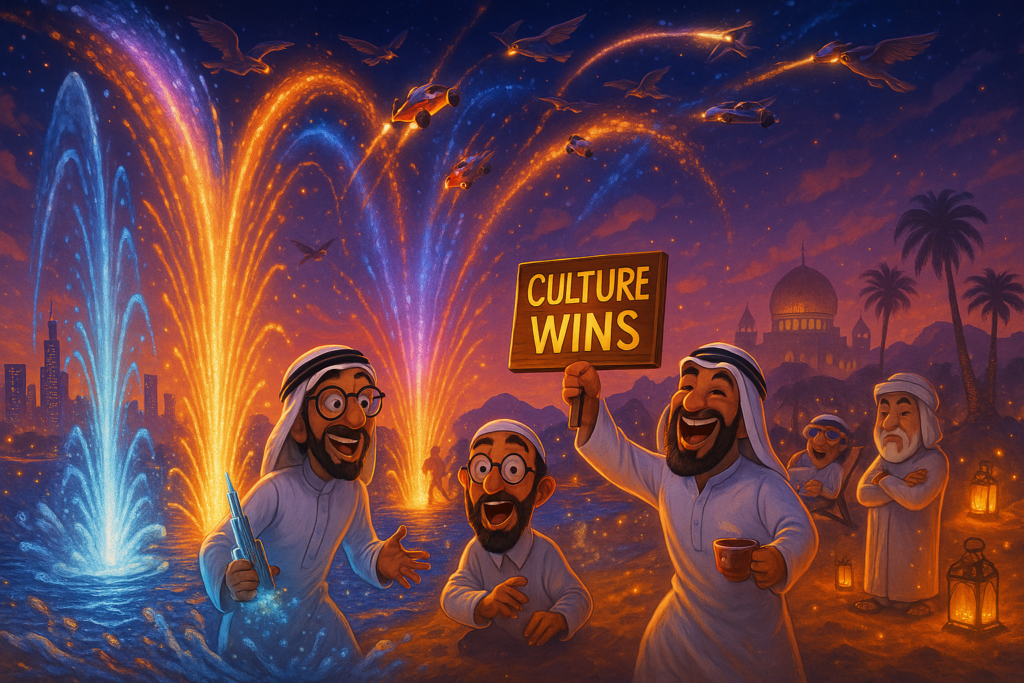
Dubai unveils its “weapon”: a dancing fountain show synchronized to K-pop.
Abu Dhabi counters: a parade of falcons carrying tiny Formula 1 cars.

The falcons swoop over the fountain, accidentally creating the world’s first desert water-falcon light show. Ras Al Khaimah laughs so hard from Jebel Jais he nearly starts an avalanche.


The Twist

Just as things escalate, Umm Al Quwain clears his throat:

Umm Al Quwain: “You two do realize you’re fighting on my sand dune?”

The entire desert falls silent. A date tray falls over in slow motion. Dubai and Abu Dhabi glance at each other, then burst into laughter. They high-five, turn the fight into a group barbecue, and invite the other emirates.


Closing Punchline

By midnight, the “battlefield” is covered with lanterns, grilled fish from Ajman, and selfies. Dubai brags about the best skyline filter, while Abu Dhabi insists his palace has better lighting. The falcons? They’re dancing in the fountain.

In the UAE, even a fight between siblings ends in a feast—and probably a TikTok trend.

When Emirates Joke: A Friendly Desert Banter

0

One breezy evening, two personified emirates—Dubai and Ajman—sat on a dune sipping Arabic coffee, watching the sun dip below the horizon. The other emirates were nearby, enjoying the cool night air.

Dubai, always flashy, adjusted its metaphorical designer sunglasses and smirked.

Dubai: “You know, Ajman, if glamor had a capital, it would have my skyline. Even the falcons stop mid-flight to take selfies with Burj Khalifa.”

Ajman chuckled, tossing a pebble playfully.

Ajman: “Sure, Dubai. But let’s be honest—people come to me when they want the beach without a traffic jam or a shopping mall big enough to get lost in.”


The Playful Back-and-Forth

Abu Dhabi chimed in with a grin:

Abu Dhabi: “While you two argue about beaches and skyscrapers, remember I’m the one with the palace parties and Formula 1. The only thing faster than my racetrack is how quickly you both borrow my cultural clout.”

Sharjah, polishing its museums, added:

Sharjah: “Please, Abu Dhabi. Culture lives here. While you’re busy with your horsepower, I’m making sure the world actually learns about our history instead of just taking photos for Instagram.”

Ras Al Khaimah, lounging like a mountain king, laughed:

Ras Al Khaimah: “All of you forget—I’ve got Jebel Jais. When people need adventure or a zipline that makes their hearts race, they’re climbing my peaks.”

Fujairah raised an eyebrow from the coast:

Fujairah: “And when those climbers need a quiet beach to recover, I’m the hero they turn to. No malls, no traffic—just turquoise water and peace.”

Umm Al Quwain, sipping calmly, delivered the punchline:

Umm Al Quwain: “You’re all adorable. While you’re busy showing off, I’m the secret spot locals whisper about when they’re tired of your big-city egos.”


The Big Laugh

The group burst into laughter, their friendly teasing echoing through the desert night. The falcon overhead tilted its wings as if to say, “Typical UAE family drama.”

Dubai finally raised its cup of coffee:

Dubai: “Fine. Maybe we’re all amazing. But admit it—you’d be boring without my nightlife!”

Ajman winked:

Ajman: “And you’d starve without my fish.”

They clinked coffee cups, united by a shared love for the country they all called home.


Closing Thought

The UAE’s beauty isn’t just in its landmarks—it’s in the playful rivalries that make each emirate shine brighter together. Seven siblings, seven personalities, one extraordinary family.

From Emirate to Emirate: The UAE’s Heartbeat of Beauty, Family, and Togetherness

0

In the UAE, beauty isn’t just in the skyline or the dunes—it’s in the short journeys that turn neighbors into family, and ordinary weekends into unforgettable memories.

Close your eyes. Imagine driving less than an hour, and the world around you changes—towering skyscrapers give way to golden deserts, heritage forts, and turquoise coastlines. Children giggle in the backseat, their excitement growing as you cross an invisible line between emirates. This is the United Arab Emirates: seven jewels so close you can visit them all before sunset.


The Magic of Short Distances

One of the UAE’s understated luxuries is proximity. Abu Dhabi to Dubai? Roughly 90 minutes. Sharjah to Ajman? Barely a coffee break. This closeness means:

  • Spontaneous Family Trips: A couple in Dubai can decide over breakfast to visit Fujairah’s beaches by lunch.
  • Holiday Happiness: Children grow up associating vacations with laughter in Ras Al Khaimah’s mountains or sandcastle-building in Umm Al Quwain.
  • Effortless Gatherings: Relatives spread across emirates meet for dinners or picnics without complex travel plans.

Psychological Triggers That Make UAE Life Feel Magical

  1. Familiarity + Discovery: Familiar roads, new memories—families feel both safe and adventurous.
  2. Instant Gratification: Short drives deliver immediate joy, reinforcing positive family bonds.
  3. Cultural Pride: Seeing your heritage reflected in every emirate strengthens identity and belonging.
  4. Anticipation & Nostalgia: Children anticipate holidays eagerly, and adults relive childhood memories on familiar routes.

Examples of Simple Joys Between Emirates

  • A Dubai Couple in Ajman: A spontaneous detour leads to discovering a hidden seafood restaurant by the Corniche.
  • Abu Dhabi Parents in Ras Al Khaimah: Their kids watch the sunrise from Jebel Jais, their laughter echoing through the mountains.
  • Sharjah & Fujairah Families Unite: A shared camping trip by Al Aqah beach turns acquaintances into lifelong friends.

Tips for Experiencing UAE Beauty Like a Local

  • Embrace the Weekend Drives: Pack snacks, pick a direction, and let the road surprise you.
  • Blend Heritage & Modernity: Visit Sharjah’s museums in the morning, then catch Dubai’s fountains by evening.
  • Include Children in Planning: Let them choose an emirate each weekend—this creates excitement and ownership.
  • Capture Stories, Not Just Photos: Share tales of small discoveries—a roadside café, a sunset picnic—that become family legends.

Why Emiratis Embody This Beauty

Emiratis’ hospitality is legendary. Whether you’re visiting a friend in Al Ain or exploring a cultural festival in Sharjah, their warmth bridges distances. Their pride in heritage and generosity with guests make every trip feel personal, as though the whole country were one extended family.

The UAE isn’t just beautiful for its skyscrapers and deserts—it’s beautiful because its people turn every kilometer into a memory.


Closing Emotional Beat

In the UAE, love doesn’t stop at city limits—it flows from emirate to emirate, carried by laughter, tradition, and the joy of being together.

Whether you’re a visitor or a lifelong resident, the UAE’s magic lies in its ability to make a simple weekend drive feel like a cross-continental adventure—yet always bring you home by nightfall.