
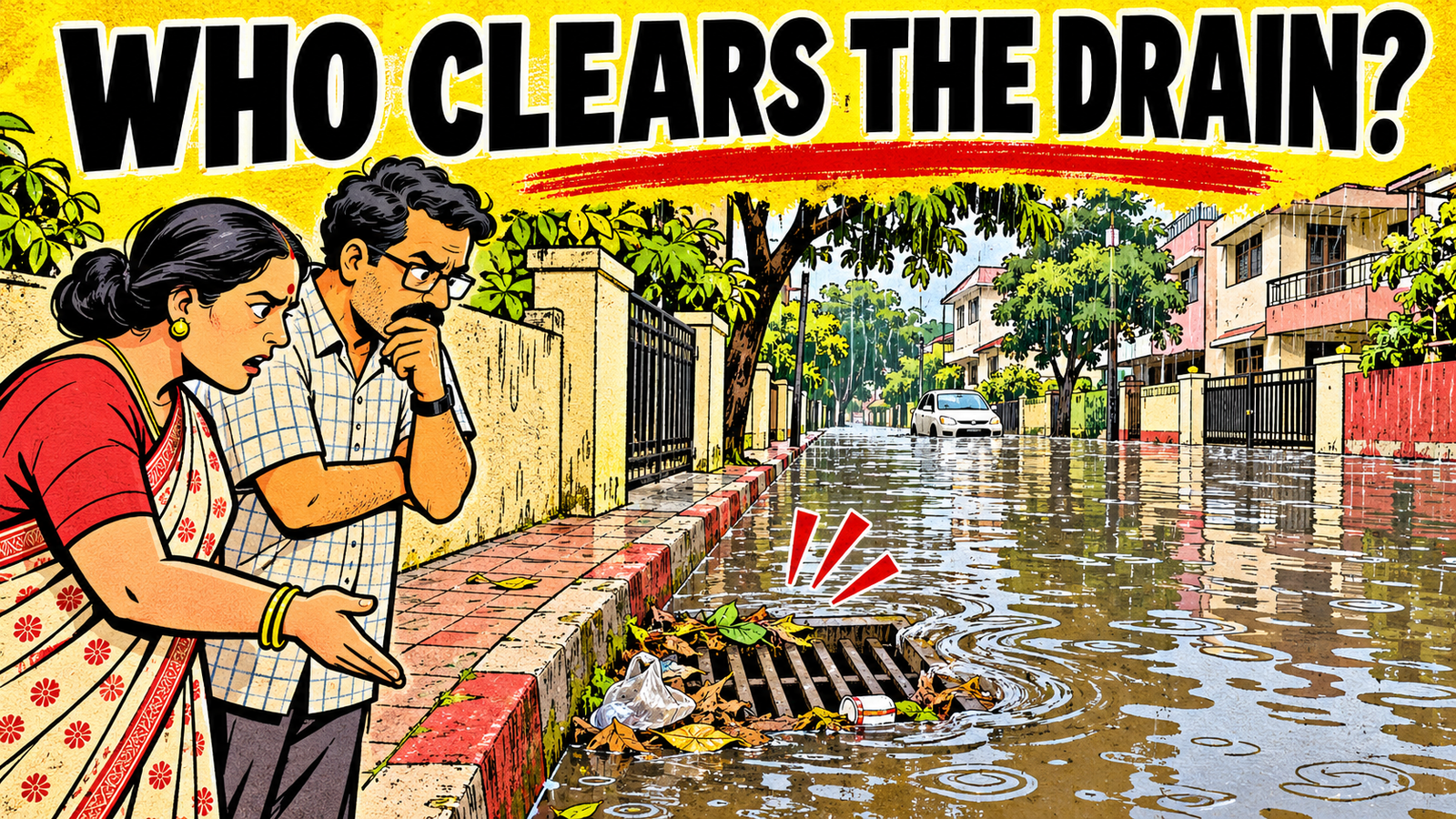
Every heavy shower leaves the same stretch of road under water. The puddle forms near a bend, spreads across the pavement, and sometimes reaches a building entrance. Residents might assume a drain simply needs cleaning. The first useful question is whether water is failing to enter the drain, or entering and then backing up because it cannot get away. Both can look similar from the street, and they can require different fixes.
What to do first: From a safe, dry spot, note the exact location, time, direction the water appears to come from, and how much of the road or footpath is affected. Report the location through the official civic complaint system, request an inspection of the roadside inlet and connected stormwater drain, and save the reference number. If it repeats, follow up on the same record with dates and comparable photos.
Which authority should you start with?
Start with the municipal authority responsible for the street. On an ordinary municipal road, the ward office or stormwater drainage department can often route a roadside drainage complaint. Where the road belongs to a highway authority, development authority or another public agency, the municipality may need to refer the issue. If the water collects only inside a gated property, tell the building manager where it pools and ask them to check the internal drains. If water also collects in the public street, describe both locations so the two problems can be checked together.
In Mumbai, BMC’s Environment Status Report lists 1916 as the central number for registering civic complaints. The corporation also publishes a stormwater drainage FAQ covering complaints about blocked drains and flooding. If you are outside Mumbai, use your municipal body’s official contact page to find the corresponding channel. Give the location first, then ask which ward or agency owns the drain at that point.
Describe what happens when it rains
A roadside grate can look blocked from the surface while a problem farther down the line is doing most of the damage. Leaves or debris can cover an inlet. A drain can also fill downstream, limiting how much water it can carry. Water may collect in a low spot before reaching an inlet, or runoff from another street may reach the junction faster than the system can handle. A resident can describe these possibilities as observations or questions and leave the diagnosis to the inspection team.
For example, write that water covered the road beside the north gate and stayed there well after rain stopped. If you saw an inlet covered with leaves from dry ground, include that detail. If the water rose beside a driveway even though the nearest visible grate looked clear, describe the position and timing. The time it takes to recede can help an officer decide where to start looking and whether a visit after a shower would capture the issue.
Make a record the ward can use
- Give the road name, nearest junction, building name or other public landmark, and the side of the street. Add a map pin if it points to the actual flooding spot.
- Record when you first noticed water collecting and when it cleared, if you can observe both from safety. Exact times are useful even if you do not know when the rain began.
- Take a wide photo from dry ground that includes a fixed landmark. Use the same viewpoint on later days when possible so the images are easy to compare.
- Describe the impact in plain terms. For example, the pedestrian crossing was underwater, the building driveway became unusable, or water reached the first entrance step.
- Save the complaint reference and acknowledgement. Keep later photos and dates together so you can attach them to a follow-up.
Let the photographs show the scale rather than guessing the depth. A line of parked tyres or a submerged kerb can give context if it is already visible. Never enter the water to measure it, pull up a drain cover or move a roadside barrier yourself. You can document important details without showing faces or posting the exact addresses of affected private households on social media.
Use this complaint template
I am reporting recurring street flooding at [road name, nearest landmark and map pin]. On [dates and times], water collected at [side of street or junction] and affected [footpath, driveway or traffic lane]. It was still present at [time], approximately [duration] after the rain eased. I have attached photos showing the location from dry ground. Please confirm which department or road-owning authority handles this location, inspect the roadside inlet and connected stormwater drain, and share the complaint reference and inspection outcome.
What to do if the complaint closes and the street floods again
Ask for the inspection date and what was checked. A clearing visit might have dealt with a grate but left an issue farther along the line, or an inspection might have taken place after the water receded. Give the new date and time and ask whether the latest incident can be added to the original complaint or whether you should file a new reference. If the ward says a different agency owns the road, ask them to name the agency and provide a routing or transfer reference if available.
A residents’ association can combine records from several storms into a brief timeline. Document each distinct trouble spot separately so the ward can locate it. A single complaint with a small set of clearly labelled photos is easier to investigate than an album of unlabelled pictures from several streets. If temporary clearing helps, record how long the improvement lasts and whether the problem returns after a similar shower.
Common questions
Should everyone in the building file separately? One point of contact can keep a recurring issue easier to track. Ask neighbours for their dated observations and add them to the shared record. Keep separate references for separate locations.
Can I report a missing cover as part of the same complaint? Flag it prominently as a separate immediate hazard and give the exact location. Give road users room and stay on dry ground. If someone is already in danger, use the local emergency channel and give the location before describing the history of the flooding.
What is the most useful follow-up question? Ask which part of the drainage system was inspected and where to send the next dated observation. That gives you a named point of contact and a clear way to report what happens after the next storm.


