
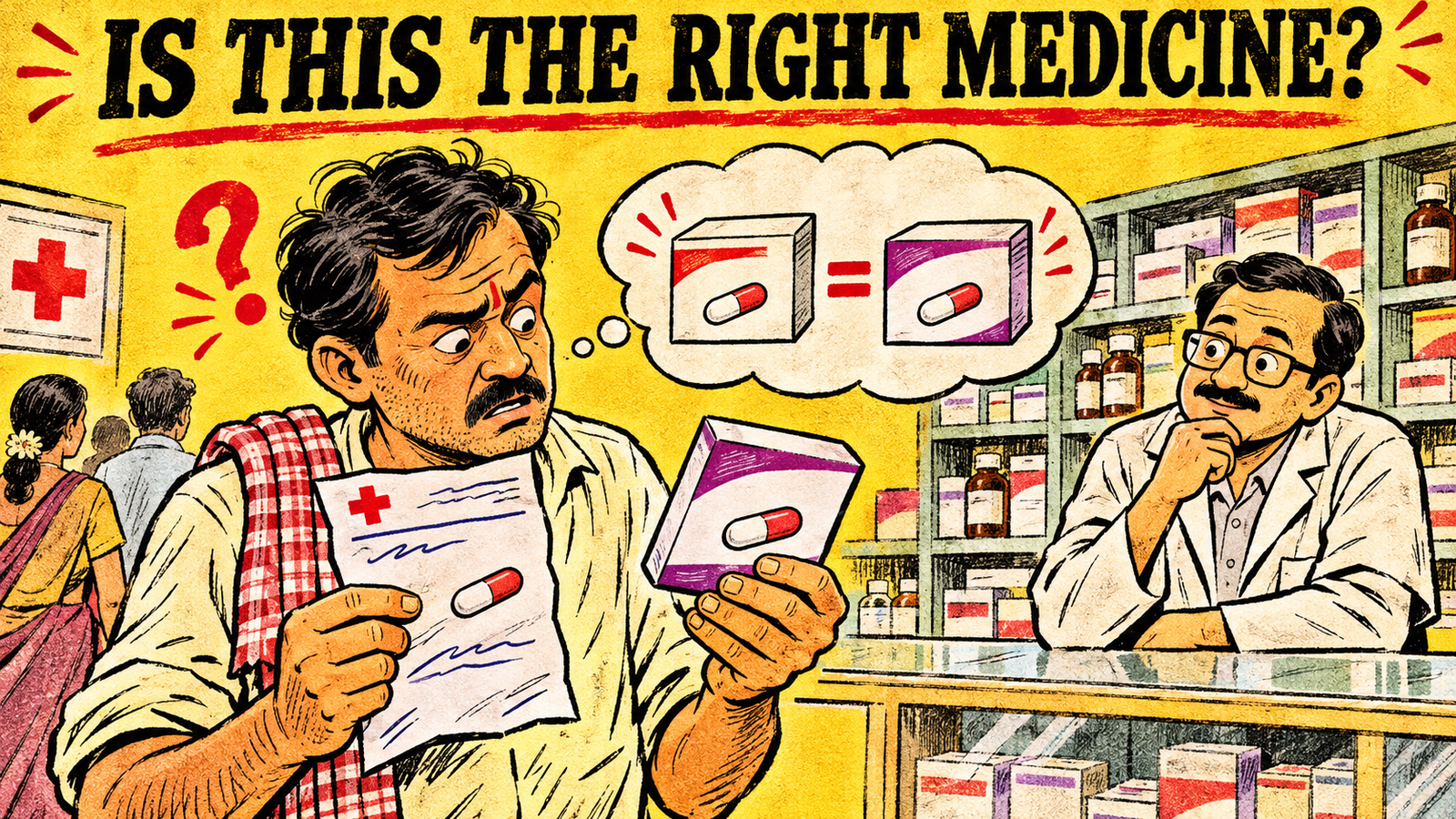
You collect your medication and notice that the box looks unfamiliar. The label may show a different brand, a different strength or a release abbreviation you have never seen. A changed package can be harmless, but it can also signal a dispensing mismatch. Ask the pharmacist to compare the product with the written prescription before taking a dose from the unfamiliar pack.
Start here: Keep the prescription and package together. Ask the pharmacist to confirm the active ingredient, strength, dosage form, route and release type and to explain any difference. If anything is unclear or the product differs from what was prescribed, contact the prescriber or an on-call clinician promptly for instructions. If a scheduled dose is due, ask what to do about that dose instead of deciding on your own to skip it, take the unfamiliar product or double up later.
Find the difference before deciding what it means
A medicine often has a brand name and the name of one or more active ingredients. A different brand name does not settle whether the medicine matches your prescription. Ask the pharmacist to read the prescription and the package with you. The US FDA’s generic medicines guide illustrates why the active ingredient, strength, form and route matter when comparing medicines. The rules governing dispensing and substitution depend on where you live, and the pharmacist or prescriber should verify the actual product and instructions for you.
If two boxes list the same ingredient but one says 5 mg and the other says 10 mg, ask for clarification. Do not decide on your own to split tablets or change the number you take. With liquids, ask the pharmacist to compare the concentration and the prescribed volume. With a combination product, get each active ingredient and its strength checked. A large number on the front can describe pack size or concentration, and a similar-looking label is easy to misread.
Check the dosage form, route and release type
Ask whether the prescription specifies a tablet, capsule, liquid, inhaler, injection, cream or another form. The active ingredient can appear in several forms intended for different routes or purposes. Have the pharmacist point to the part of the label that identifies the form and route. Ask whether the product matches the instructions you were given rather than using the appearance of the package as a guide.
Also look for letters such as ER, XR, SR or CR, or words such as modified release or delayed release. Ask the pharmacist what they mean for this specific product. If the prescription and package show different release terms, contact the prescriber for guidance. Do not crush, open or divide an unfamiliar product to try to match the prescription unless a qualified professional confirms that it is appropriate for that exact formulation.
If you have a known allergy or a past reaction to a particular product, tell the pharmacist and prescriber before taking the replacement. Ask them to check the ingredients that matter to your situation. Mention medicines you already take if there is a chance the new product duplicates one of them. Combination products can make duplication hard to spot from brand names alone.
Use these questions at the pharmacy counter
- Which active ingredients and strengths are on the prescription and on this pack?
- Do the form, route and release characteristics match, and are the directions the same?
- Is the different product a brand change, a proposed substitution or a dispensing error?
- If anything differs, has the prescriber authorised it, and how can I verify the instructions?
- If it needs to be corrected, can you provide the correct package, label and receipt?
Read the label again after the conversation. It should identify the patient where applicable and provide directions you understand. Ask how the product should be stored and whether there is a specific measuring device or inhaler technique to use. The World Health Organization’s medication safety material highlights the risks of look-alike and sound-alike products. A check with the dispensing pharmacist helps when names or packages are easily confused.
Copy this message to the pharmacist or prescriber
My prescription lists [name, strength and form]. The package I received lists [name, strength, form and release type as printed]. Please confirm whether this is the correct medicine and what directions apply. If a change was intended, please explain the difference and confirm whether the prescriber needs to approve it. My next dose is scheduled for [time]. Please tell me what to do before that dose.
If you already took some of the medicine
Contact a qualified clinician or appropriate poison information service promptly if you think you took the wrong medicine or dose, even if you feel well. Give the exact product, strength, quantity, time taken and any symptoms. Keep the package nearby so a professional can read the label with you. If there are serious or rapidly worsening symptoms such as trouble breathing, collapse or severe confusion, seek emergency medical help immediately. Do not wait for the pharmacy to finish checking its stock records.
Keep the prescription, pack, batch information, pharmacy receipt and any written correction. If more than one person uses medicines in the home, store the unfamiliar pack separately so nobody takes it by mistake. When you receive the corrected product, check it at the counter with the pharmacist, and ask which pack should be returned and how to dispose of it safely if return is unavailable.
Common questions
What if the tablet looks different but the box seems correct? Ask the pharmacist to verify the actual tablets against the packaging and dispensing record. Appearance alone cannot identify a medicine reliably.
Can I use an image search to identify it? Use the printed label, dispensing record and qualified professional. Pictures may show a product that looks similar without matching its strength or formulation.
What if the pharmacy is closed? Reach the prescriber, an on-call clinician or another qualified pharmacist through a verified channel. Explain when the next dose is due and ask for instructions. If you believe there may have been an accidental ingestion or overdose, seek appropriate medical guidance promptly.


